

On this page
If you have ever opened the reagent cupboard on a cold morning and found the bottle marked "glacial acetic acid" holding a solid, glassy lump instead of a liquid, you have already seen where the name comes from. It is about ice.
Why is pure acetic acid called glacial?
Pure acetic acid (ethanoic acid, CH3COOH) melts and freezes at 16.6 °C, according to the property data collected in PubChem. That is only a few degrees below a comfortable room. So in an unheated lab in winter, the liquid turns into clear crystals that look a lot like ice.
That look is the whole story of the name. Science Notes explains that the acid is called glacial because it "freezes and forms crystals resembling ice at a temperature slightly below room temperature".
Glacial acetic acid is acetic acid that contains less than 1% water (Science Notes). The ILO-WHO International Chemical Safety Card for acetic acid lists "glacial acetic acid" as a synonym and gives a melting point of 16.7 °C and a boiling point of 118 °C. Published values differ by about a tenth of a degree; PubChem lists figures from 16.6 to 16.7 °C.
Here is the surprise for most students: acetic acid freezes at a higher temperature than water, which freezes at 0 °C. "Frozen" does not have to mean "very cold".
Why doesn't vinegar freeze like glacial acetic acid?
Vinegar is mostly water, with only 4–8% acetic acid by volume (Science Notes). It behaves like a watery solution and freezes a little below water's freezing point, nowhere near 16.6 °C.
The same idea works from the other side. In nearly pure acid, water is the impurity, and a dissolved impurity lowers the freezing point of the solvent. This is freezing-point depression, the colligative property you meet in the Class 12 chapter on solutions. If you want to know why acetic acid molecules hold on to each other so well in the first place, read why carboxylic acids boil higher than alcohols.
How much does a little water lower the freezing point?
You can estimate it with ΔTf = Kf × m, where acetic acid is the solvent and water is the solute. Reference tables differ slightly on Kf for acetic acid: 3.90 in the LibreTexts cryoscopic constants table_Constants) and 3.63 °C kg/mol in another LibreTexts table. We will use both and see the range.
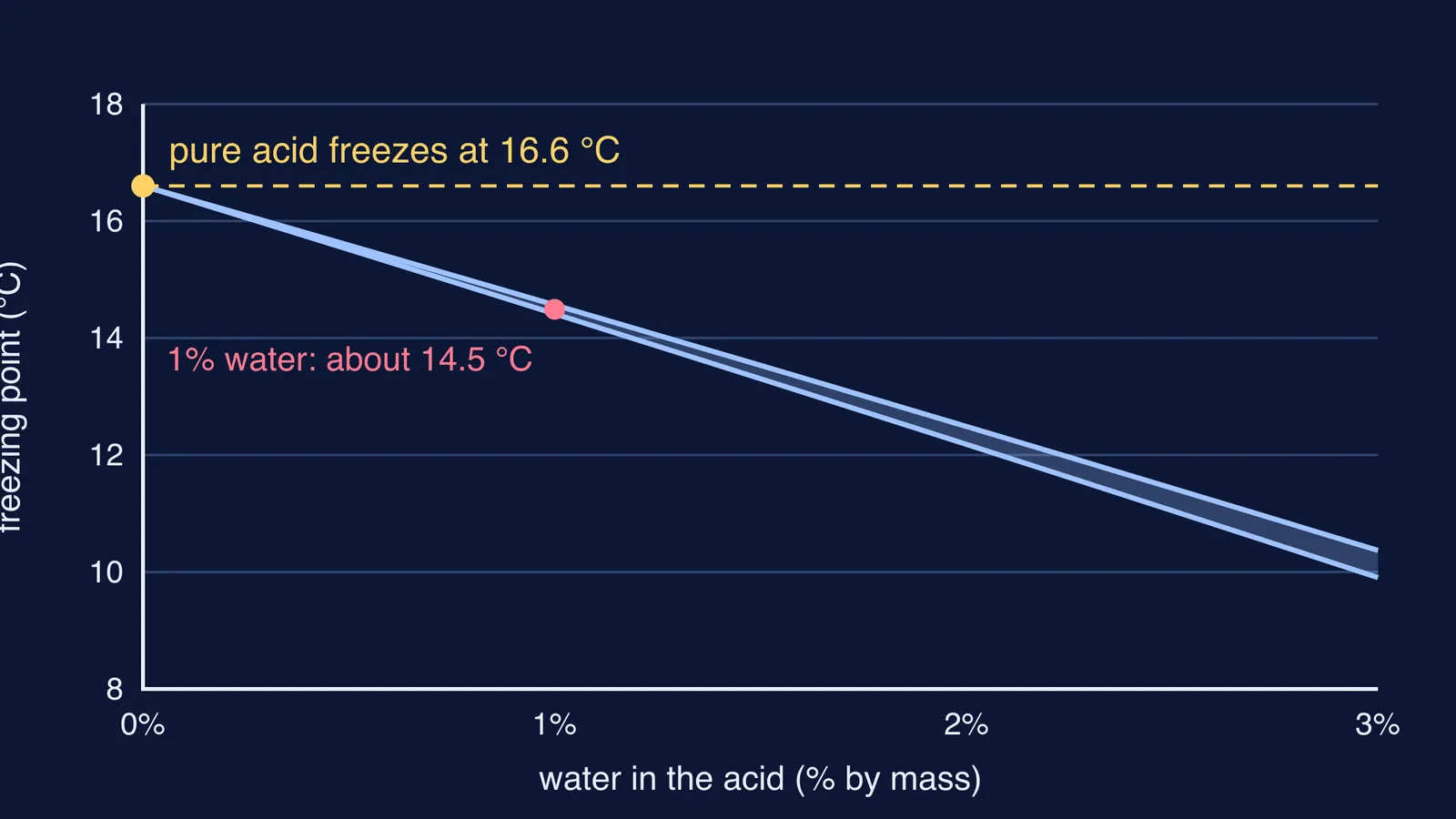
Worked example: acetic acid with 1% water by mass.
Take 1000 g of the sample: 10 g of water and 990 g of acid.
Moles of water = 10 ÷ 18.02 = 0.555 mol.
Molality = 0.555 mol ÷ 0.990 kg = 0.561 mol/kg.
ΔTf = 3.63 × 0.561 = 2.04 °C, or 3.90 × 0.561 = 2.19 °C.
Freezing point ≈ 16.6 − 2.1 ≈ 14.5 °C.
So a single percent of water knocks about two degrees off. Run the same steps for 3% water and you get roughly 10 °C. The formula is meant for dilute solutions, so treat these numbers as estimates, not lab values.
If the molality steps trip you up, the Fermi Problem Library has worked problems with a step-by-step solver that explains the reasoning rather than printing an answer.
How do exams ask about glacial acetic acid?
A classic objective question, which appeared in KCET 2002, asks how glacial acetic acid is obtained. In the version on IIT Kanpur's SATHEE practice platform, the answer is crystallising, separating and melting the acid, because acetic acid freezes at 16.6 °C while water freezes at 0 °C. Cool concentrated acid that holds some water and the acid crystallises first; pour off the water-rich liquid, then melt the crystals.
Your revision checklist:
Name: ethanoic acid, CH3COOH.
Glacial means nearly water-free, less than 1% water (Science Notes).
Freezes at about 16.6 °C and boils at about 118 °C (ICSC).
Vinegar is 4–8% acetic acid, so it does not freeze "glacially".
The name comes from the ice-like crystals in cold weather.
Purification by freezing works because the acid freezes well above water.
The idea of using a melting or freezing temperature to judge a substance comes up again when you find the melting point of an organic compound in the practical lab. In the Fermi Concept Library, each chemistry concept has its own lesson and its place in the map, so you can see how freezing-point depression links to the rest of solutions.
Is glacial acetic acid dangerous?
Yes. The safety card says it causes severe skin burns and eye damage, and that it is a flammable liquid and vapour with a flash point of 39 °C. If a lab bottle has frozen, let it thaw at room temperature rather than heating it, and handle it only with gloves, goggles and your teacher's say-so.
Next time the lab bottle is solid, you will know what you are looking at: acid ice, and a sign of purity.


