

On this page
Every cell in your body carries the same DNA, yet a muscle cell and a nerve cell make different proteins. The Nobel Prize press release for 2024 explains this as precise regulation of gene activity, so that only the correct set of genes is active in each cell type. In eukaryotes, that control happens at several steps between gene and protein.
What are the levels of regulation of gene expression in eukaryotes?
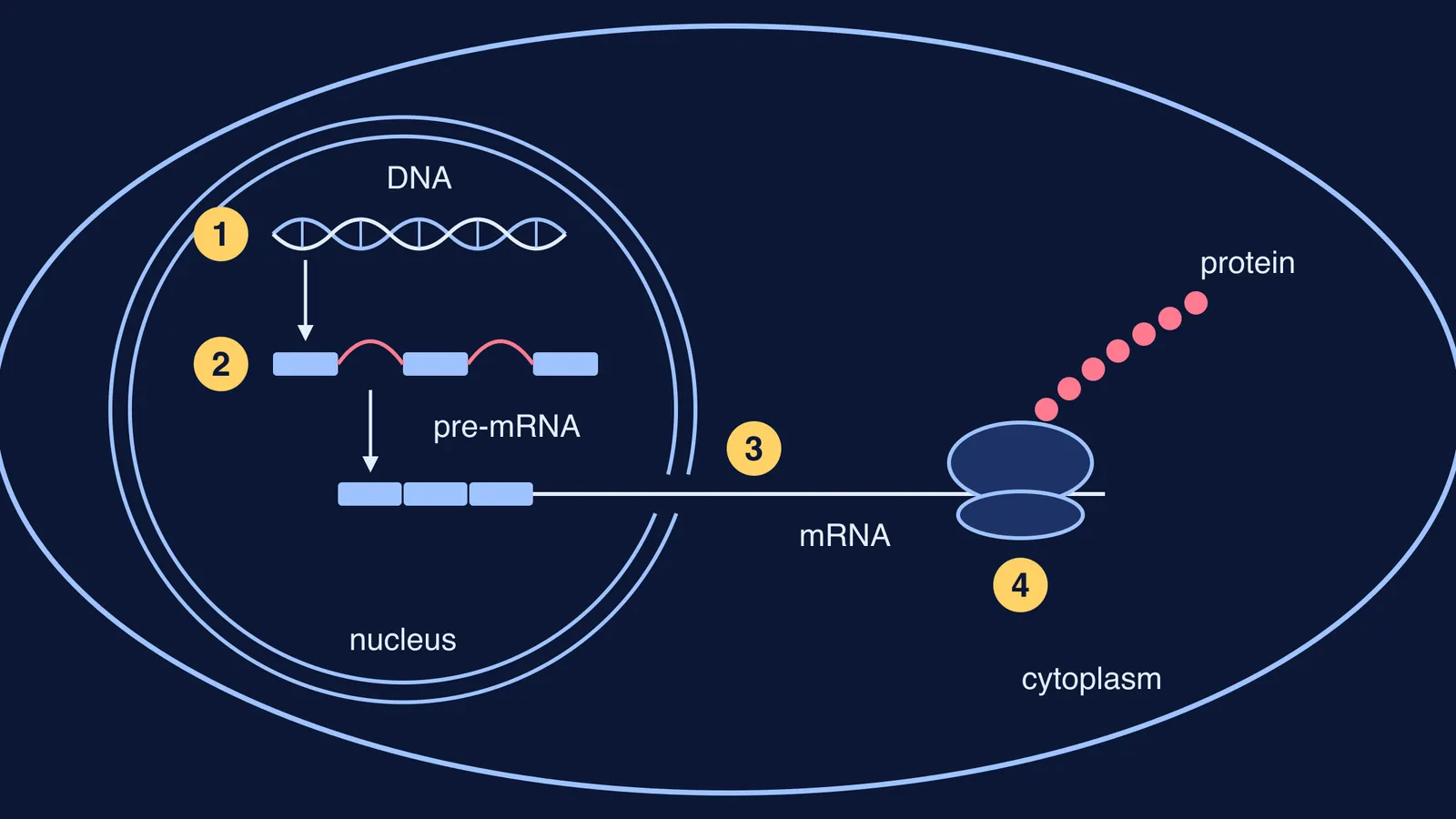
Section 5.8 of the NCERT Class 12 chapter Molecular Basis of Inheritance lists four levels:
Transcriptional level: formation of the primary transcript.
Processing level: regulation of splicing.
Transport level: movement of mRNA from the nucleus to the cytoplasm.
Translational level: whether the mRNA is read into protein.
To remember them, follow the molecule: the first two happen inside the nucleus, the third at the nuclear envelope, and the fourth on ribosomes in the cytoplasm.
How is gene expression controlled at the transcriptional level?
Transcriptional control decides whether a primary transcript is made at all. The 2024 Nobel press release notes that in the 1960s, specialised proteins called transcription factors were shown to bind specific regions of DNA and determine which mRNAs are produced, and that thousands of transcription factors have since been identified. Packing matters too: our explainer on euchromatin vs heterochromatin shows why loosely packed DNA is easier to read.
The textbook example is the lac operon. NCERT describes one regulatory gene (i) and three structural genes (z, y and a); when lactose is present it acts as an inducer, inactivates the repressor, and transcription goes ahead. It is bacterial: use it as the model of transcriptional control, not as a eukaryotic example.
What does control at the processing level mean?
A eukaryotic primary transcript contains exons and introns, and splicing removes the introns and joins the exons (our guide to RNA processing: capping, tailing and splicing covers the steps). If the cell joins different combinations of exons, one gene gives more than one mRNA. This is alternative splicing.
It is not rare. Pan and colleagues (Nature Genetics, 2008) estimated that transcripts from about 95% of human multi-exon genes undergo alternative splicing, with about 100,000 intermediate- to high-abundance splicing events across major human tissues.
How can mRNA transport from the nucleus be regulated?
An mRNA that never leaves the nucleus can never be translated, so export is a control point. A clear example comes from HIV-1. Malim and colleagues (Nature, 1989) showed that the viral protein Rev activates the export of incompletely spliced viral RNA from the nucleus to the cytoplasm. That RNA was already being made in the nucleus; Rev's effect needed a specific target sequence that forms a complex RNA structure in the viral env gene.
How is gene expression controlled at the translational level?
Here the mRNA is already in the cytoplasm; the question is whether ribosomes read it. Hentze and colleagues (Science, 1987) showed that making ferritin, the cell's iron storage protein, is regulated by iron at translation. They found an iron-responsive element in the 5' untranslated leader of human ferritin H-chain mRNA that is necessary and sufficient for this control.
MicroRNAs work at this level too. Lee, Feinbaum and Ambros (Cell, 1993)90529-Y) found that the worm gene lin-4 makes no protein; it makes small RNAs of about 22 and 61 nucleotides with sequences complementary to the 3' untranslated region of lin-14 mRNA, suggesting lin-4 regulates lin-14 translation. Ambros shared the 2024 Nobel Prize with Gary Ruvkun for the discovery of microRNA, and the press release notes that the human genome codes for over one thousand microRNAs. The story is told in our post on how Victor Ambros found lin-4.
How do you decide which level an example belongs to?
Ask where the molecule is when the control acts:
Is the question whether RNA is made from the gene at all? Transcriptional.
Is the RNA already made, and being cut and joined in the nucleus? Processing.
Is a finished mRNA waiting to leave the nucleus? Transport.
Is the mRNA in the cytoplasm, and the question whether ribosomes read it? Translational.
Try it on the examples above:
Lac repressor blocking the operon until lactose arrives: transcriptional (bacterial model).
One gene giving two mRNAs through different exon choices: processing.
HIV-1 Rev releasing unspliced RNA from the nucleus: transport.
Iron switching ferritin synthesis on and off: translational.
lin-4 microRNA acting on lin-14 mRNA: translational.
For a five-mark answer, write the four NCERT levels in order, give one line of mechanism for each, and add one example per level. If a step is still fuzzy, the Fermi Concept Library gives each biology concept its own lesson and its place in the map. To practise, the Fermi Problem Library has worked problems with a step-by-step solver that explains the reasoning rather than printing an answer.
Next time you meet a regulation question, follow the molecule from DNA to protein and ask where it is stuck.


