

On this page
When twentieth-century biologists mapped how cells express genes, the pathway seemed straightforward: DNA makes RNA, and RNA makes protein. Regulatory proteins called transcription factors bound to DNA switches, turning genes on or off. But in December 1993, American developmental biologist Victor Ambros and his team upended that assumption.
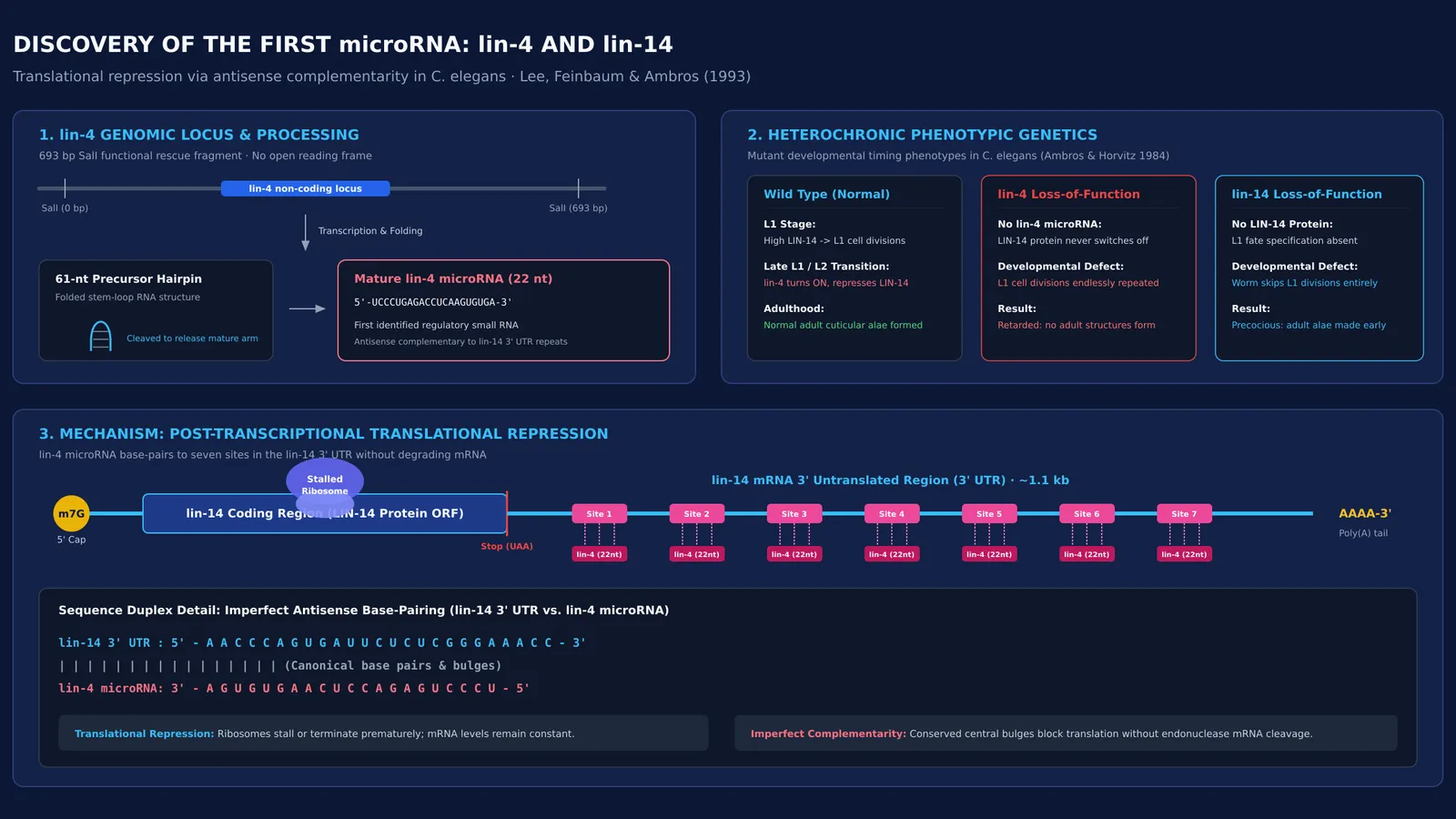
Working with the roundworm *Caenorhabditis elegans*, Ambros, Rosalind Lee, and Rhonda Feinbaum discovered that a gene called *lin-4* produced no protein. Instead, as reported in their Cell 1993 paper90529-y), it yielded a 22-nucleotide non-coding RNA. That tiny molecule bound to messenger RNA from another gene, *lin-14*, halting protein production: the first microRNA ever found.
What was the developmental puzzle inside Caenorhabditis elegans?
In the 1980s, researchers turned *Caenorhabditis elegans* into a premier genetic system, building on Sydney Brenner's early work catching messenger RNA. A developing worm hatches, progresses through four larval stages (L1 to L4) separated by molts, and reaches adulthood. Every cell division follows an invariant clock, allowing researchers to track the exact developmental fate of every single cell.
In H. Robert Horvitz's laboratory at MIT, postdocs Victor Ambros and Gary Ruvkun analysed developmental timing mutants, as detailed in their 1984 Science study. Worms lacking *lin-4* repeated stage L1 divisions during later stages, never forming adult structures. Conversely, loss-of-function *lin-14* mutants skipped L1 and matured precociously, while gain-of-function *lin-14* mutants stalled in L1. The genetics showed *lin-4* was an essential off-switch for *lin-14*.
How did Victor Ambros prove lin-4 was not a protein?
In 1985, Ambros launched his lab at Harvard to clone *lin-4*, while Ruvkun moved to Massachusetts General Hospital to clone *lin-14*. Ruvkun found that LIN-14 protein dropped sharply after L1, even though its messenger RNA stayed abundant. Furthermore, *lin-14* gain-of-function mutations that kept protein levels high were deletions in the 3' untranslated region (3' UTR) of the messenger RNA.
At Harvard, Rosalind Lee and Rhonda Feinbaum narrowed the *lin-4* locus down to a 693-base-pair restriction fragment that rescued mutant worms. But sequencing revealed no open reading frame. Introducing frameshift mutations into candidate starting codons did not stop rescue, as shown in their Cell 1993 study90529-y). Northern blots revealed only 61-nucleotide and 22-nucleotide RNAs: *lin-4* was non-coding RNA.
How does microRNA switch off target genes?
In June 1993, Ambros and Ruvkun compared sequences. The 22-nucleotide *lin-4* RNA matched seven partially complementary elements in the *lin-14* 3' UTR, as documented in Ruvkun's companion Cell 1993 report90530-4). By binding to these target sites in the cytoplasm, *lin-4* physically prevented ribosomes from translating LIN-14 protein without destroying the underlying messenger RNA.
This mechanism differed fundamentally from Fire and Mello's discovery of RNA interference, which destroys target transcripts completely and drives modern biotechnology applications of gene silencing. MicroRNAs act as fine-tuning dimmer switches rather than cleaving enzymes, adjusting how much protein a cell makes.
Why did the scientific world ignore lin-4 for seven years?
The scientific community initially dismissed *lin-4* as a biological oddity confined to worms. For seven years, textbooks continued to assert that post-transcriptional control in animals was mediated exclusively by proteins. That scepticism ended in 2000, when Gary Ruvkun's team discovered a second 21-nucleotide microRNA called *let-7*. Their Nature 2000 study revealed that *let-7* was conserved across evolution, present in flies, mice, and humans. As confirmed by the Nobel Assembly at Karolinska Institutet, the human genome codes for over 1,000 microRNAs, revealing an essential mechanism governing how tissues develop and specialize. In October 2024, Ambros and Ruvkun received the Nobel Prize in Physiology or Medicine.
How to diagnose gene regulation mechanisms in biology problems?
When analysing gene regulation in university coursework or genetics problem sets, use this diagnostic framework on experimental data:
Check mRNA levels: If mRNA falls alongside protein, regulation occurs during transcription or via transcript cleavage.
Check protein levels: If mRNA remains constant while protein drops, suspect translational repression by microRNAs.
Test untranslated regions: Promoter deletions affect transcription, whereas 3' UTR deletions eliminate microRNA binding sites.
Examine pairing geometry: Perfect base-pairing triggers messenger RNA cleavage, while imperfect pairing with bulges blocks translation.
If you find regulatory cascades hard to picture, the Fermi Concept Library covers every concept in biology, each with its own lesson and its place in the map. For genetics exercises and questions on regulation, the Fermi Problem Library provides worked problems with a step-by-step solver that explains the reasoning rather than printing an answer.


