

On this page
You have probably watched a house gecko, the chhipkali on your wall, run up a window and stop upside down on the ceiling. It uses no glue and no suction. Its grip comes from molecules that are almost touching, multiplied across an enormous number of tiny hairs.
How do geckos stick to walls?
In 2002, Kellar Autumn and colleagues published the first direct experimental evidence that gecko setae stick by van der Waals forces in PNAS. The toes of live Tokay geckos were highly water-repellent, yet they held equally well to strongly water-repelling and strongly water-attracting surfaces. So the grip depends mainly on the size and shape of the hair tips, not on surface chemistry.
A van der Waals force is a weak attraction between atoms or molecules that does not come from a chemical bond and fades quickly with distance. It works only when the tips get extremely close to the glass.
In 2005, Gerrit Huber's team measured the adhesion of a single spatula at different humidities and found, in contrast to the 2002 study, that humidity contributes significantly at the nanoscale. So moisture in the air can add to the grip, alongside van der Waals attraction.
How many hairs are on a gecko's foot?
Autumn's team reported in Nature in 2000 that a gecko's foot has nearly 500,000 hairs called setae. Each seta is 30 to 130 micrometres long, about one-tenth the diameter of a human hair, and ends in hundreds of projections tipped with spatula-shaped pads 0.2 to 0.5 micrometres across. Measured one at a time, a seta was ten times more effective at adhesion than whole-animal estimates predicted.
A Tokay gecko can support its body mass with a single toe, according to W. R. Hansen and Kellar Autumn, who also showed that setae self-clean: geckos with dirty feet clung to vertical surfaces again after only a few steps.
In 1941, Beni Charan Mahendra published a study of the Indian house gecko, Hemidactylus flaviviridis, in the Proceedings of the Indian Academy of Sciences; the 2000 Nature team cited his paper.
Why do millions of tiny tips beat one big pad?
Eduard Arzt and colleagues showed that splitting one contact into many finer contacts increases adhesion, and that heavier animals use finer tips: micrometre-sized tips are enough for flies and beetles, while geckos need tips smaller than a micrometre.
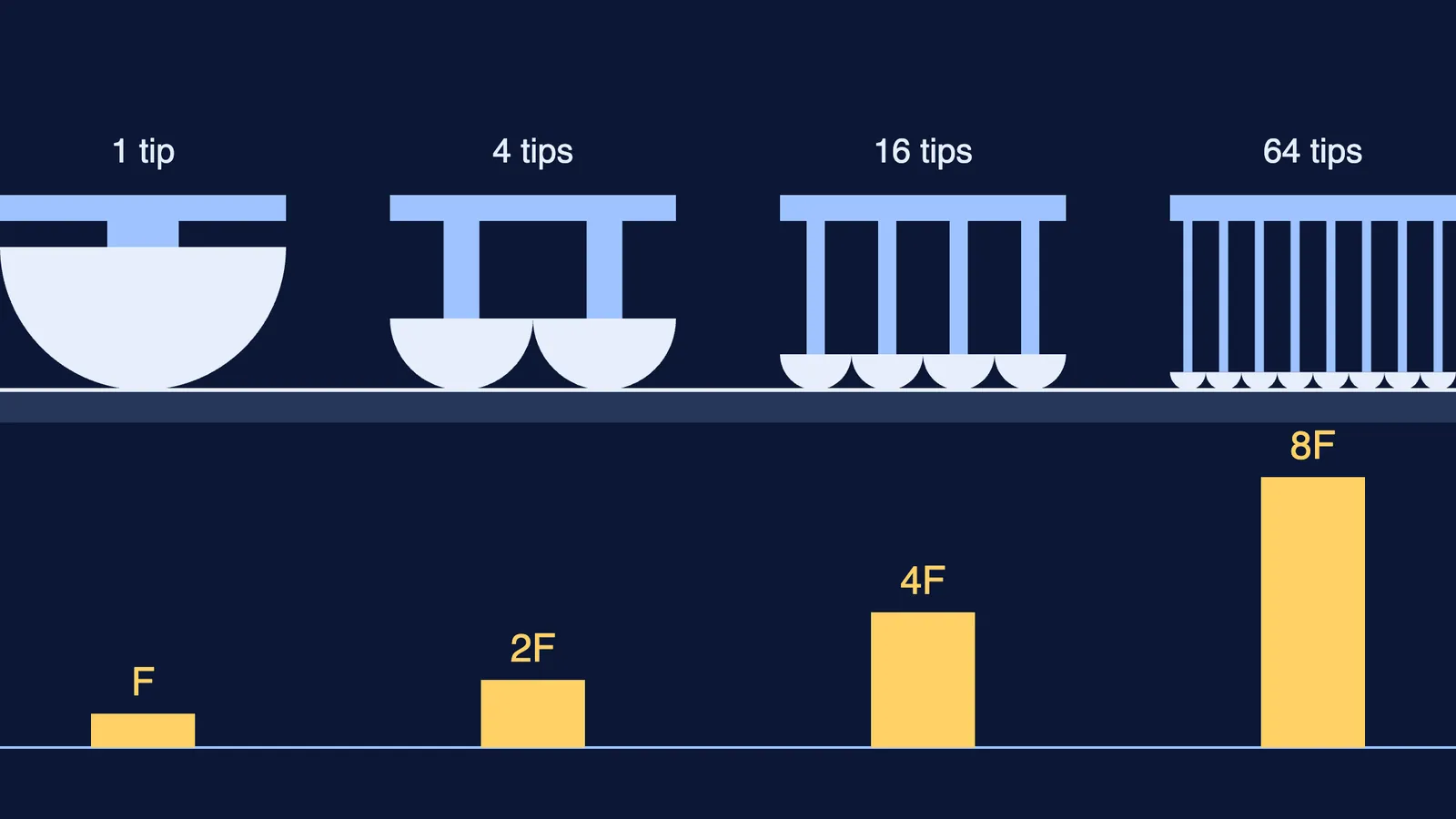
In the JKR model of elastic contact, the force needed to pull a rounded tip off a flat surface grows with the tip's radius, not its area. Split a square pad into an n × n grid of tips, each with 1/n of the original radius:
Number of tips: n².
Pull-off force of each tip: 1/n of the original.
Total: n² × (1/n) = n times the original force.
Split the pad 8 × 8 and you get 64 tips and 8 times the grip, as the diagram at the top shows. Real setae are not perfect spheres, but the trend holds.
Then why doesn't a gecko get stuck? The 2000 Nature study found that the seta's unusual orientation and preload raised its attachment force 600-fold above friction measurements of the material, and that setae let go once tilted past a critical angle. So a gecko peels its toes off, the way you peel tape from the edge.
How strong is gecko tape, and could it hold you?
In 2003, A. K. Geim's group at the University of Manchester made a prototype "gecko tape" from dense arrays of flexible plastic pillars. Their paper puts each of the gecko's submicrometre hairs, far finer than a whole seta, at about 10⁻⁷ newtons, and millions of them acting together at about 10 newtons per square centimetre; durability and mass production were still unsolved.
A Fermi estimate with those numbers:
A 50 kg student weighs about 50 × 9.8 = 490 N.
At 10 N per cm², the area needed is 490 ÷ 10 = 49 cm², a square 7 cm on a side.
At 10⁻⁷ N per tiny hair, that is 490 ÷ 10⁻⁷, about 5 × 10⁹ hairs.
The catch: every tip must be in full contact and pulled straight. Dust, curved surfaces and peeling break that, which is why a 7 cm square on paper is not yet a climbing glove.
How do you explain gecko adhesion in an exam answer?
Name the force: van der Waals attraction between the setae and the surface, acting only at very short distances.
Give the structure: nearly 500,000 setae per foot, each ending in hundreds of spatulae (Autumn et al., 2000).
Explain the scaling: many small contacts give more total force than one big one.
Explain the release: tilted past a critical angle, setae let go, so the gecko peels rather than pulls.
If a step in the estimate does not click, Fermi's AI tutor works through problems alongside you and checks your understanding as it goes.
The same force sits in the real-gas equation: read who discovered the van der Waals equation and why it works. On grip and surfaces, see why the coefficient of friction can be greater than 1 and why a steel needle floats on water and sinks with soap.


