

On this page
The ICSE Class 10 biology syllabus asks for "Ganong's potometer and its limitations" and a "demonstration of uptake of water and the rate of transpiration using Ganong's potometer", according to the 2026-27 syllabus as reproduced by Oswal Publishers. The name refers to William F. Ganong, a plant physiologist and Smith College's first head of botany, who wrote *A Laboratory Course in Plant Physiology* (1901) and designed teaching instruments with Bausch & Lomb (Smith College).
How does a Ganong's potometer work?
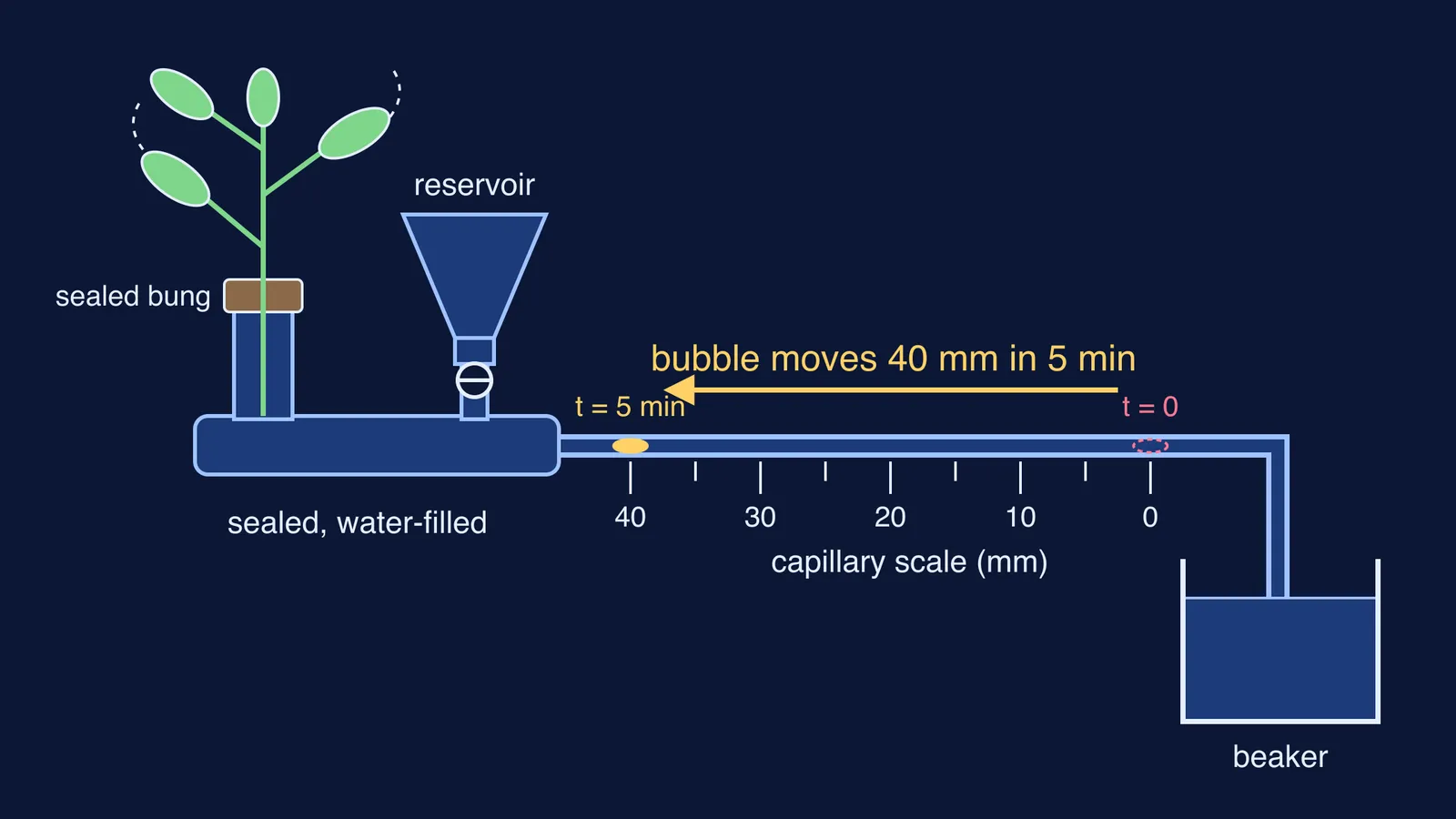
A potometer is a device that measures the rate at which a leafy shoot takes up water (Wikipedia: Potometer). Ganong's version has four parts:
a wide water-filled tube holding the cut shoot in a rubber bung or cork sealed with petroleum jelly
a reservoir (a funnel with a tap) joined to the tube
a horizontal graduated capillary tube coming off the main tube
a beaker of water that the bent end of the capillary dips into
Everything is water-filled and airtight. Lifting the capillary's end out of the beaker lets air in, and water from the reservoir pushes out extra bubbles until one bubble sits at the zero mark (Vedantu's description).
Water evaporates from the leaves, and the shoot pulls up water to replace it. That water leaves the sealed tube, so water from the beaker is drawn into the capillary and the bubble rides along towards the shoot. The faster the leaves lose water, the faster the bubble moves. To reset, open the reservoir tap and let water push the bubble back.
Why is the shoot cut under water?
The shoot is cut, or re-cut, under water so that air cannot enter the xylem vessels (Wikipedia: Potometer).
The water in xylem is a continuous column under tension. A gas bubble in a conduit, called an embolism, can fill it and block water movement (McElrone et al., Nature Education Knowledge). Vessels blocked by air carry less water than the leaves are losing, so the bubble no longer tracks the plant.
The same logic explains the other precautions. Seal every joint with petroleum jelly, because a leak lets air in or water out. Keep conditions such as temperature steady, changing only the factor you are testing.
Why does a potometer measure water uptake, not transpiration?
The potometer measures water uptake, and not all the water a shoot takes up is transpired. Some is used in photosynthesis, and some is kept by cells to stay turgid (Wikipedia: Potometer).
The gap is small. Plants retain less than 5% of the water their roots absorb for cell expansion and growth; the rest passes into the atmosphere as transpiration (McElrone et al., Nature Education Knowledge). So the potometer gives a close estimate of transpiration rate, not an exact one.
Two more limitations from the Vedantu summary are worth writing too:
A cut shoot may not stay alive for long, so the method suits short experiments.
Getting a single bubble into the capillary is fiddly and slow.
For where that water leaves the leaf, see how a leaf peel shows stomata, and for water lost as droplets, guttation vs transpiration.
How do you calculate the rate from the bubble?
The water in the capillary is a cylinder, so the volume taken up is π r² × d, where r is the capillary's internal radius and d is the distance the bubble moved. Divide by time to get the rate. Here is an illustrative set of readings (not data from a study):
Capillary internal diameter 1 mm, so r = 0.5 mm.
The bubble moves 40 mm in 5 minutes.
Volume = 3.14 × 0.5 × 0.5 × 40 = 31.4 mm³.
Rate of uptake = 31.4 ÷ 5 = 6.3 mm³ per minute, which is 0.0063 mL per minute.
If a fan then makes the bubble cover 40 mm in 2.5 minutes, the rate has doubled, because moving air carries moist air away from the leaves faster. If the units or the radius step trip you up, the Fermi Problem Library has worked problems with a step-by-step solver that explains the reasoning rather than printing an answer.
What should you write in the ICSE exam?
Use this checklist for a long potometer answer:
a labelled diagram: shoot in a sealed bung, reservoir with tap, graduated capillary, beaker
the principle: the rate of uptake roughly equals the rate of transpiration
the precaution: cut the shoot under water so that no air blocks the xylem
the reading: distance the bubble moves in a fixed time, and the reset with the reservoir
the limitation: it measures uptake, and a small part of that water is used and not transpired
For a similar bubble-counting practical, compare the Hydrilla photosynthesis experiment. If the links between xylem, stomata and transpiration still feel loose, go through them one at a time in the Fermi Concept Library, where each concept has its own lesson and its place in the map.


