

On this page
Have you ever walked across a lawn in the early morning and noticed perfect, round water droplets sitting exactly at the tips of the grass blades? While it is easy to assume this is dew, it is often a completely different biological process called guttation.
Students learning plant physiology often confuse guttation with transpiration. Both processes involve a plant releasing water, but they happen at different times, use different structures, and serve entirely different purposes.
What is the difference between guttation and transpiration?
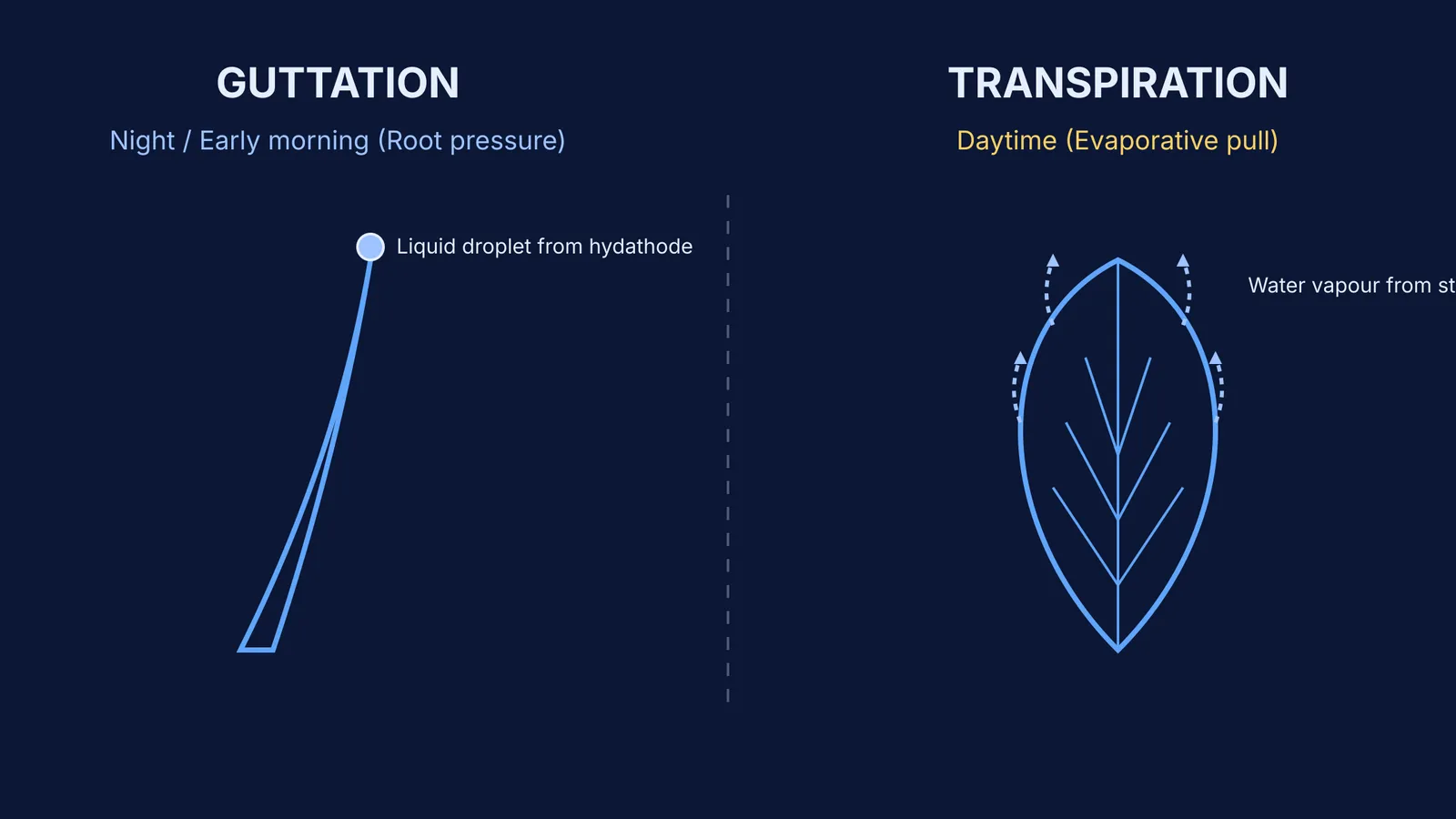
The core difference lies in the state of the water and the forces driving the process. Guttation is the exudation of liquid xylem sap from the tips or margins of leaves. It is driven by positive pressure from the roots. Transpiration is the loss of water vapour from the plant to the atmosphere, driven by the evaporative pull of dry air.
Here is how the two processes compare across key biological markers:
State of water: Guttation releases liquid droplets, while transpiration releases invisible water vapour.
Timing: Guttation primarily occurs at night or in the early morning when the surrounding air is highly humid. Transpiration happens during the day when sunlight drives evaporation.
Composition: Because guttation liquid comes directly from the xylem, it contains dissolved minerals, salts, and sugars. Transpired water vapour is pure water.
Driving force: Guttation is pushed by root pressure from below. Transpiration is pulled by negative tension from above.
How do hydathodes differ from stomata?
The structural exit points for the water also distinguish the two processes.
Transpiration relies heavily on stomata—microscopic pores scattered across the broad surface of the leaf. Stomata are active structures surrounded by guard cells that regulate their opening and closing to balance carbon dioxide intake with water loss.
Guttation occurs through specialized structures called hydathodes. Hydathodes are water stomata located exclusively at the vein endings, typically along the margins or tips of a leaf. Unlike regular stomata, hydathodes are permanently open pores that cannot regulate their size. When pressure builds up inside the leaf's plumbing system, the liquid has no choice but to spill out through these open valves.
For students struggling to picture these microscopic structures, reading standard textbook descriptions can be frustrating. The Fermi Concept Library breaks down plant anatomy with clear comparisons, helping you visualise the difference between an active guard cell and a passive hydathode pore.
Why does guttation happen in grass and tomato plants?
Guttation is essentially a pressure relief mechanism. At night, when the air is humid and stomata are closed, transpiration largely stops. However, the roots continue to actively pump mineral ions into the xylem.
This active transport lowers the water potential in the roots, drawing water in from the soil. The continuous inflow creates a positive hydrostatic pressure called root pressure, which can reach up to 0.6 MPa. In short herbaceous plants like grass and tomatoes, this root pressure is strong enough to force water all the way up the stem and out through the hydathodes.
Grass blades show guttation distinctly as single large droplets at their very tips. Tomato plants, which have serrated leaf edges, will often display a beautiful perimeter of evenly spaced droplets along the leaf margin following a humid night. This is distinctly different from dew.
If you are working on active and passive water absorption or practicing assertion-reason questions for exams, distinguishing between these physical pressures is crucial.
By understanding these differences, you can accurately read what a plant is doing simply by looking at where its water droplets form.


