

On this page
This question turns up in Class 11 gravitation chapters and in JEE practice sets. It looks like it needs big numbers, but it is quick once you stop plugging in values and compare ratios instead.
Why does g depend on mass over radius squared?
At the surface of a planet of mass M and radius R, a body of mass m feels a force GMm/R². Divide by m and you get the acceleration due to gravity: g = GM/R².
G is the same everywhere in the universe. Its current recommended value is 6.674 30 × 10⁻¹¹ m³ kg⁻¹ s⁻² (NIST CODATA 2022). Since G is shared, it cancels when you compare two planets:
g(planet) / g(Earth) = (M ratio) ÷ (R ratio)²
You never need G, the planet's actual mass or its radius in kilometres. You only need the two ratios.
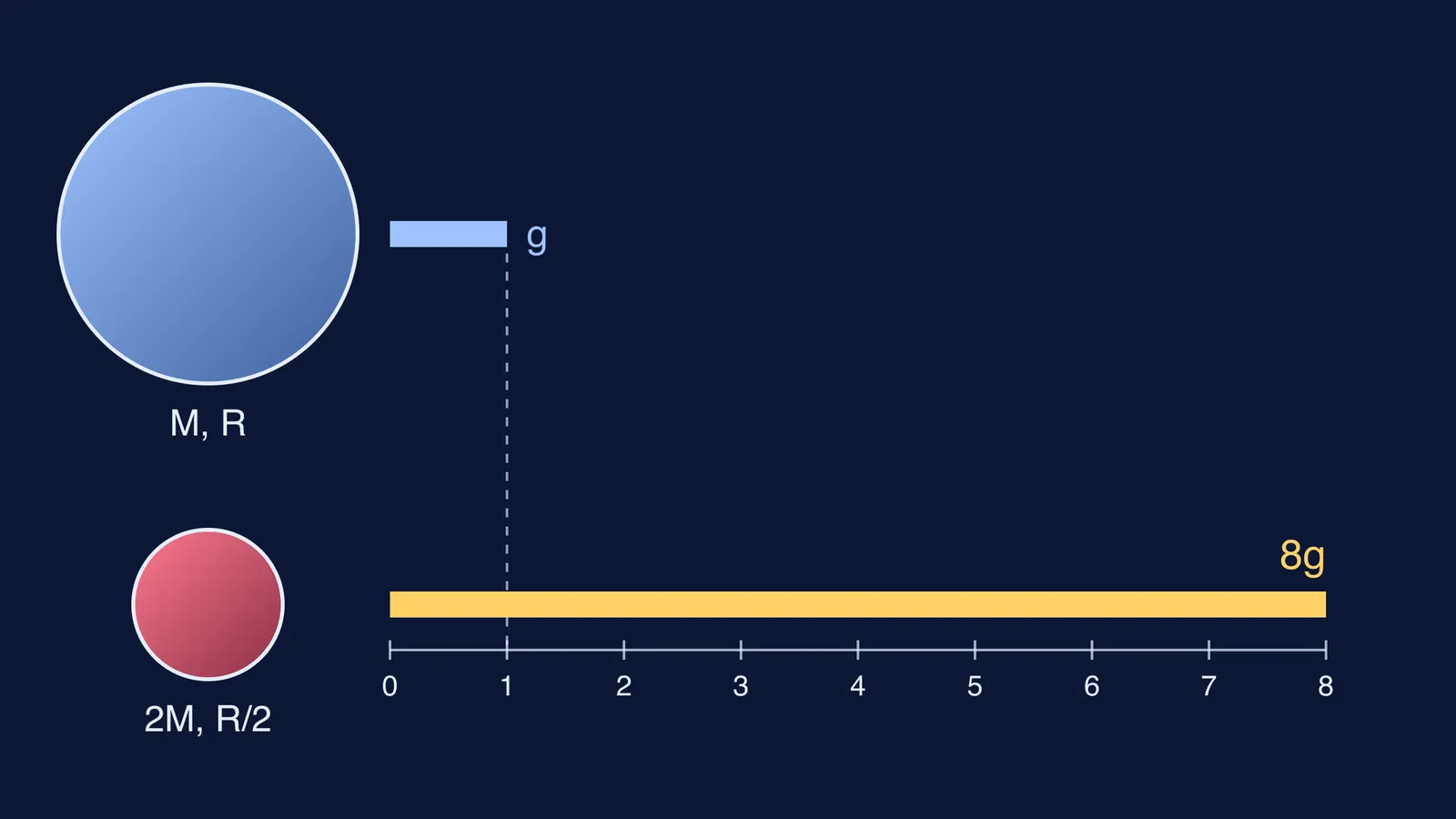
What is g on a planet with double mass and half radius?
NASA's planetary fact sheet gives Earth's surface gravity as 9.8 m/s² (NASA Planetary Fact Sheet). Here is the ratio method, step by step.
Write the mass ratio: M(planet)/M(Earth) = 2.
Write the radius ratio: R(planet)/R(Earth) = 1/2.
Square the radius ratio: (1/2)² = 1/4.
Divide: 2 ÷ 1/4 = 8.
Multiply Earth's value: 8 × 9.8 m/s² = 78.4 m/s².
Halving the radius matters more than doubling the mass, because the radius is squared and sits in the denominator. Halving R on its own would already make g four times larger.
If you want more problems like this, the Fermi Problem Library has worked problems with a step-by-step solver that explains the reasoning rather than printing an answer.
How does your weight on that planet compare with your weight on Earth?
Weight is the force W = mg. Mass is the amount of matter in you, and it does not change when you change planets. So weight scales exactly like g.
Take a student of mass 60 kg, using Earth's g of 9.8 m/s² from the NASA Planetary Fact Sheet:
On Earth: W = 60 × 9.8 = 588 N.
On the planet: W = 60 × 78.4 = 4,704 N, which is 8 times larger.
Mass in both places: 60 kg.
A bathroom scale is calibrated in kilograms for Earth, so on that planet it would read about 480 kg. The student has not gained anything; the scale is reading force and assuming Earth's g. We go through the mass and weight distinction in more detail in why you weigh less on the Moon but your mass stays the same.
Does the ratio method work for real planets?
Yes, and you can check it yourself. NASA lists each planet's mass, diameter and surface gravity as ratios to Earth (NASA ratio table). Diameter ratio equals radius ratio, so you can use it directly.
Mars: mass ratio 0.107, diameter ratio 0.532. The formula gives 0.107 ÷ 0.532² ≈ 0.378. NASA lists 0.377.
Moon: mass ratio 0.0123, diameter ratio 0.2724. The formula gives about 0.166. NASA lists 0.166.
Jupiter: mass ratio 317.8, diameter ratio 11.21. The formula gives about 2.53, but NASA lists 2.36.
The Jupiter gap is a useful lesson. NASA defines its gravity value as the acceleration at the equator including the effects of rotation, and for gas giants it is measured at the 1 bar pressure level (NASA fact sheet notes). Jupiter spins fast, and the simple formula ignores rotation, so treat it as the textbook answer for a non-spinning sphere.
What other versions of this question come up?
Examiners change the wording, not the physics. Four variants to practise:
Same density, half the radius. Mass goes as density × R³, so g goes as density × R. Half the radius means half the g.
Diameter given instead of radius. The ratio is identical; use it as it is.
Small changes. For small fractional changes, Δg/g ≈ ΔM/M − 2ΔR/R. If Earth's radius shrank slightly with the same mass, g would rise by about twice that fraction.
Height above the surface. Replace R with R + h; g falls with the square of the distance from the centre. Below the surface the rule is different, as our post on how gravity changes inside Earth shows.
If the jump from g = GM/R² to the density form feels shaky, the Fermi Concept Library covers every concept in physics, each with its own lesson. Try the four variants above on paper, then check each one with the ratio method.


