

On this page
You bang your elbow on a desk edge and a buzzing jolt shoots into your little finger. Not the elbow: the finger. That mismatch is the whole story.
What is the funny bone, really?
The funny bone is not a bone at all; it is the ulnar nerve, at the one spot on the elbow where it is unusually exposed, as Houston Methodist explains.
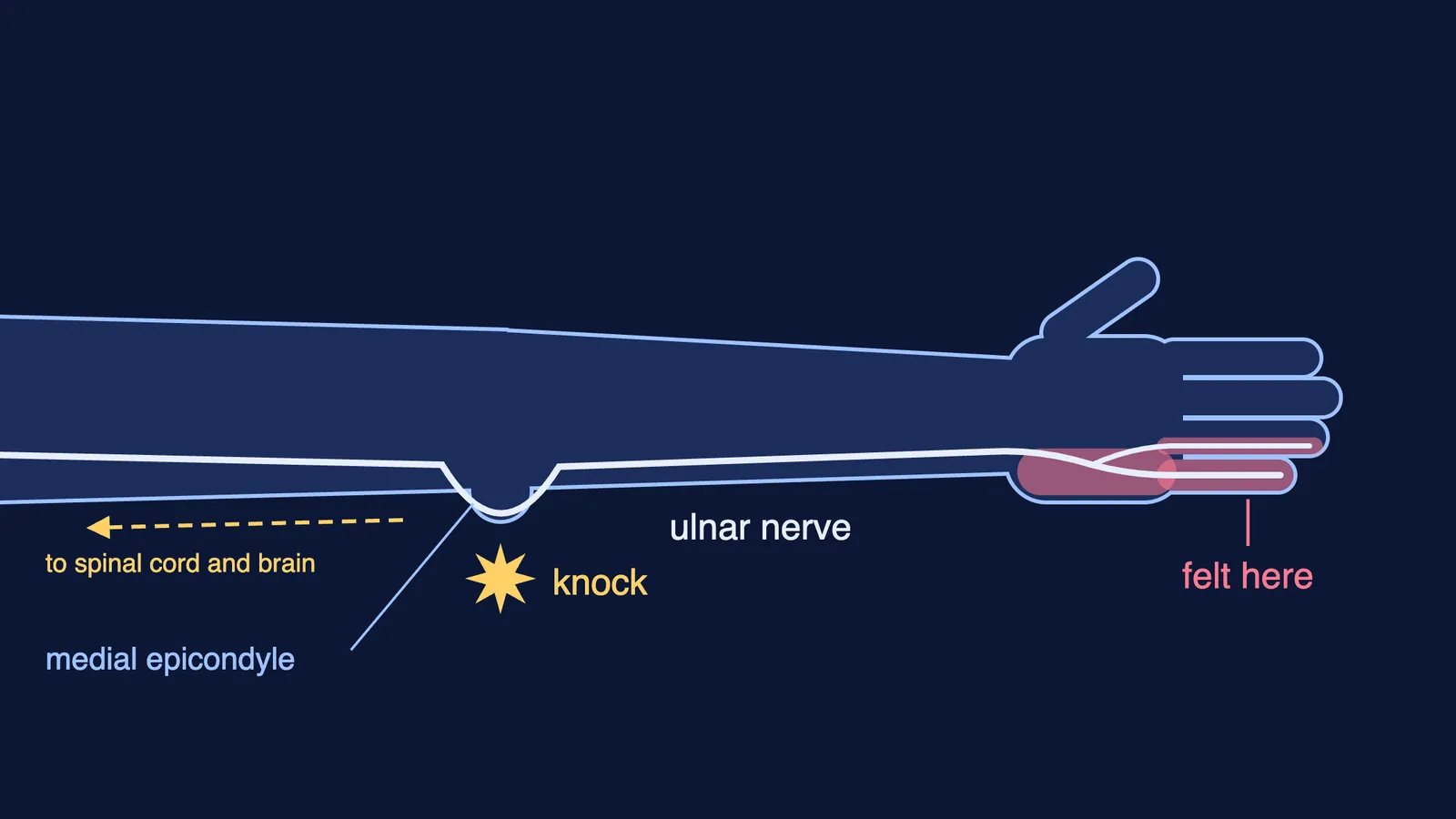
The ulnar nerve carries fibres from the C8 and T1 spinal nerve roots, and at the elbow it passes behind the medial epicondyle, the bony bump on the inner side of the humerus, before entering the cubital tunnel, according to a 2021 review in EFORT Open Reviews. Layers of muscle, fat and other tissue protect the rest of the nerve, but in the cubital tunnel there is much less protection, notes McGill University's Office for Science and Society.
The name? McGill gives two ideas: a pun on humerus and humorous, or the odd feeling the knock produces.
Why does hitting your funny bone hurt in your little finger?
The knock squashes the nerve against the medial epicondyle. Houston Methodist points out that the irritation happens to the nerve itself, not the surrounding tissue, so it feels unlike an ordinary bump.
The key idea: your brain cannot tell where along a sensory fibre an impulse started. Each fibre is wired to a patch of skin, and any signal arriving on that fibre is felt in that patch.
That was tested directly in 1983. Jose Ochoa and Erik Torebjörk placed fine electrodes into the median and ulnar nerves of awake volunteers and stimulated single fibres. When a fibre produced a sensation, the place the volunteer felt it matched the patch of hand skin that fibre served (Journal of Physiology).
The ulnar nerve supplies the skin of the little finger, the little-finger half of the ring finger and that edge of the hand, according to the EFORT Open Reviews review. So a knock at the elbow is felt in exactly those places.
Why does it feel like an electric shock?
A knock fires the nerve's fibres directly, skipping the receptors in your skin. Pain from irritating a nerve itself feels more electric, burning or stinging, explains Houston Methodist. The EFORT review lists tingling, pins and needles and electric shocks among the ways people describe an irritated ulnar nerve.
The good news: tapping your funny bone does no damage to your elbow, arm or ulnar nerve, says KidsHealth, and the unpleasant feeling usually passes in a minute or so (McGill OSS).
Try it: a two-minute map of your ulnar nerve
Bend your elbow and find two bony points: the bump on the inner side (the medial epicondyle) and the point of the elbow (the olecranon).
Before you press, predict where any tingle will land. Your answer should be the little finger and the half of the ring finger next to it.
Press lightly in the groove between the two points. Do not tap hard. The nerve runs here.
Compare a straight and a bent elbow. Tension in the nerve behind the medial epicondyle rises when the elbow bends (EFORT review), so the bent elbow is the touchier one.
Worked example, in the style of a NEET-UG question: after leaning on a desk edge, a student feels tingling in the little finger and the inner half of the ring finger. Which nerve is involved, and why is the feeling not at the elbow?
Read the skin map: little finger plus half the ring finger is ulnar nerve territory.
Find the likely pressure point: behind the medial epicondyle, where the nerve is least protected.
Apply the projection rule: the brain places the feeling in the fibre's patch of skin, not where the fibre was pressed.
If nerve, neuron and nerve fibre still blur together, start with our explainer on nerve vs neuron vs nerve fibre. The funny-bone jolt is a sensation, not a reflex, so compare it with the five components of a reflex arc.
If the chain from receptor to brain still feels shaky, the Fermi Concept Library covers every concept in physics, chemistry, biology, mathematics and computing. Fermi's AI tutor can notice where you are stuck and decide whether to explain, ask or show.
When is a tingling little finger worth a doctor's visit?
One knock that fades within a minute is ordinary. Tingling that keeps coming back without a knock is different.
Cubital tunnel syndrome, long-term compression of the ulnar nerve at the elbow, is the second most common compression neuropathy of the upper limb (EFORT Open Reviews). The same review reports 25 male and 19 female new cases per 100,000 people each year in the United Kingdom, and lists weakness of the hand muscles as a feature of moderate cases.
So if numbness or tingling in those two fingers lasts, keeps returning, or your hand starts to feel weak or clumsy, see a doctor rather than waiting it out.
Next time you hit your elbow, notice where the jolt lands: that is your nerve wiring map at work.


