

On this page
An old scooter and a new BS6 motorcycle answer one question differently: how much petrol goes into the air an engine breathes? A carburettor answers with fluid physics alone; fuel injection with a nozzle, a sensor and a small computer.
What is the difference between a carburettor and fuel injection?
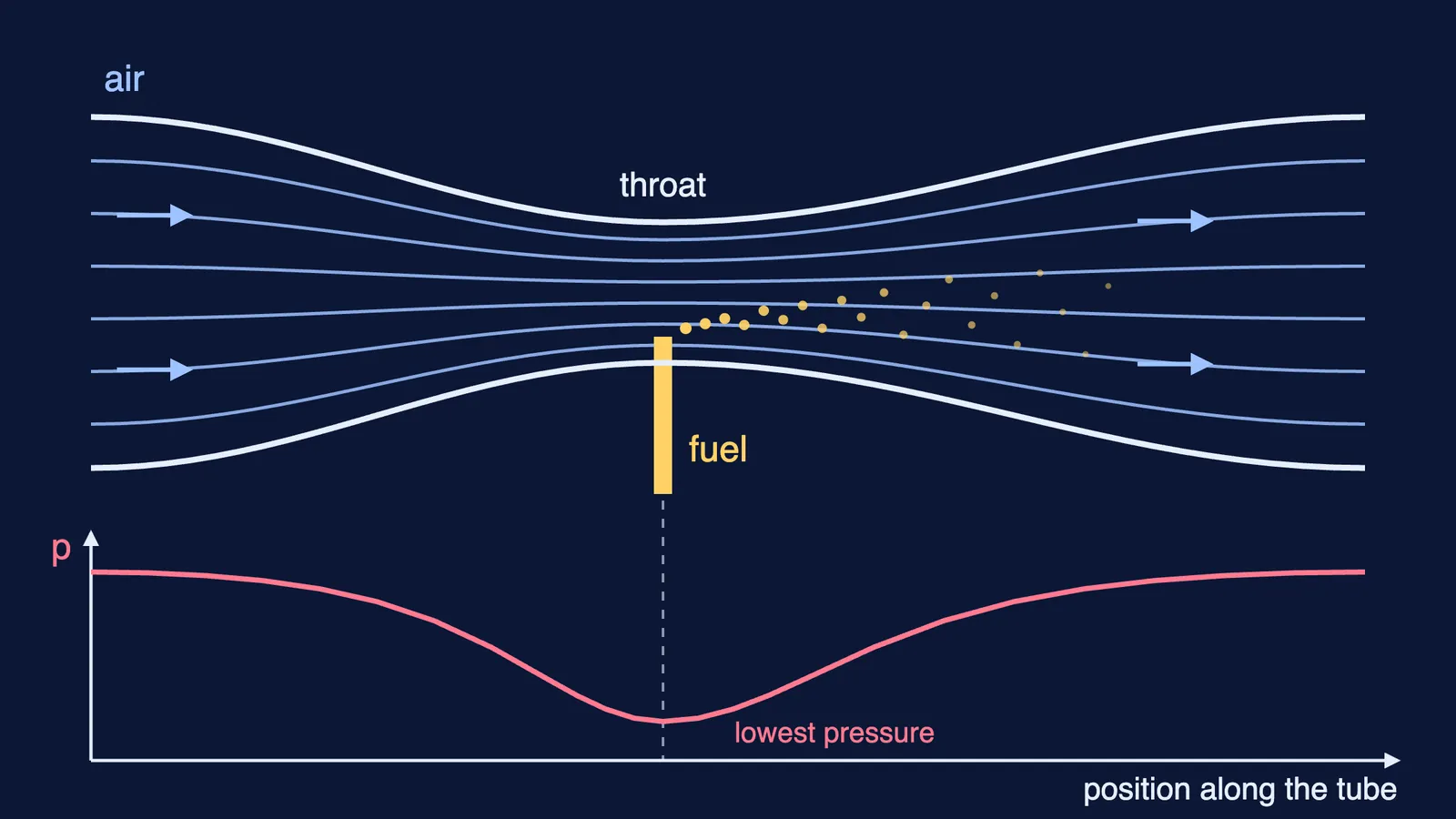
Carburettor: air rushes through a narrow throat, its pressure drops, and that low pressure draws petrol out of a jet into the airstream. Fuel follows airflow, and nothing checks the result.
Fuel injection: a nozzle sprays a measured amount of fuel and an engine control unit decides how much. In closed-loop control, an oxygen sensor in the exhaust reports on the burnt mixture and the control unit adjusts the fuelling to the ideal air-fuel ratio, as Bosch's guide to oxygen sensors shows.
In one line: a carburettor is open-loop and mechanical; fuel injection is closed-loop and electronic.
How does the Venturi effect work in a carburettor?
The equation of continuity, A1v1 = A2v2, holds for an incompressible fluid, so air speeds up where the tube narrows (OpenStax University Physics, section 14.5). Bernoulli's equation, p + ½ρv² + ρgh = constant, then says pressure drops as speed increases in a moving fluid (OpenStax University Physics, section 14.6). The same OpenStax section notes that paint sprayers and carburettors use very similar techniques to move their liquids. More on the name: Giovanni Venturi and why fluid speeds up in a narrow pipe.
Worked example. Air enters at 10 m/s and the throat has 1/2.5 of the inlet's area, the shape in the diagram above.
Continuity: v2 = 10 × 2.5 = 25 m/s.
Bernoulli at the same height: Δp = ½ρ(v2² − v1²).
Surface air density is 1.217 kg/m³, from NASA's Earth fact sheet, so Δp = 0.5 × 1.217 × (625 − 100) ≈ 319 Pa.
That suction at the throat pulls petrol up the jet (treating air as incompressible is fair at these low speeds). The catch: fuel depends only on airflow, so a carburettor cannot tell whether the mixture burned well.
If flow is easier to grasp when you watch it, the Fermi Simulation Lab has interactive simulations for ideas that are easier to see than to read.
Why is the air-fuel ratio 14.7 to 1?
The stoichiometric air-fuel ratio for petrol is 14.7 parts air to 1 part fuel by mass (Bosch). Stoichiometric means exactly enough oxygen to burn all the fuel, with none left over.
Worked example with iso-octane, a model petrol molecule.
Balance the equation: C8H18 + 12.5 O2 → 8 CO2 + 9 H2O.
Dry air is 78.08% nitrogen and 20.95% oxygen by volume, with 9,340 ppm argon (NASA). So each mole of O2 arrives with about 3.73 mol of N2 and 0.045 mol of Ar.
Mass of air carrying 1 mol of O2: 32.0 + 3.73 × 28.0 + 0.045 × 39.9 ≈ 138.2 g.
For 12.5 mol of O2: 12.5 × 138.2 ≈ 1,728 g of air for 114.2 g of octane.
Ratio: 1,728 ÷ 114.2 ≈ 15.1.
Real petrol is a blend of hydrocarbons, not pure octane; Bosch's figure for it is 14.7. When the ratio is not held, Bosch lists what can form in large amounts: nitrogen oxides, carbon monoxide and excess hydrocarbons. For the clean-up chemistry, see what a catalytic converter does in a car.
Why did BS6 bikes switch to fuel injection?
Bharat Stage VI (BS6) emission norms came into force nationwide on 1 April 2020, replacing BS4, as TVS Motor's explainer records. The International Council on Clean Transportation describes "the shift from carburetor technology to fuel injection" that came with BS VI (ICCT report, listed on the India Environment Portal). BS VI also brought on-board diagnostics (OBD) rules to two-wheelers for the first time (TransportPolicy.net).
The logic: cleaner exhaust needs the mixture held near the ideal ratio, in traffic and on the highway. That is far easier for a system that reads the exhaust and corrects itself. A carburettor meters fuel from airflow alone.
How do you explain this in an exam or viva?
A five-point answer you can write from memory:
Carburettor: continuity speeds up air in the throat, Bernoulli drops its pressure, petrol is drawn from the jet.
Fuel injection: a nozzle sprays a dose set by an engine control unit.
Target: 14.7 to 1 by mass for petrol (Bosch).
Feedback: an exhaust oxygen sensor reports rich or lean; a carburettor has no such loop.
Why the change: BS6 tightened emission limits, and with it two-wheelers moved from carburettors to fuel injection.
Try it: redo the Venturi example with a throat one-third of the inlet area and the same NASA air density. You should get v2 = 30 m/s and Δp ≈ 487 Pa. If the Bernoulli step trips you up, the Fermi Problem Library has worked problems with a step-by-step solver that explains the reasoning rather than printing an answer.


