

On this page
One of the most common questions biology students encounter is whether a tomato is a fruit or a vegetable. The answer changes entirely depending on whether you are standing in a laboratory or a kitchen.
What is the botanical definition of a fruit?
In botany, a fruit is defined as the seed-bearing structure in flowering plants that is formed from the ovary after fertilisation (Wikipedia). Its primary biological purpose is to protect the developing seeds and eventually help scatter them so they can grow into new plants.
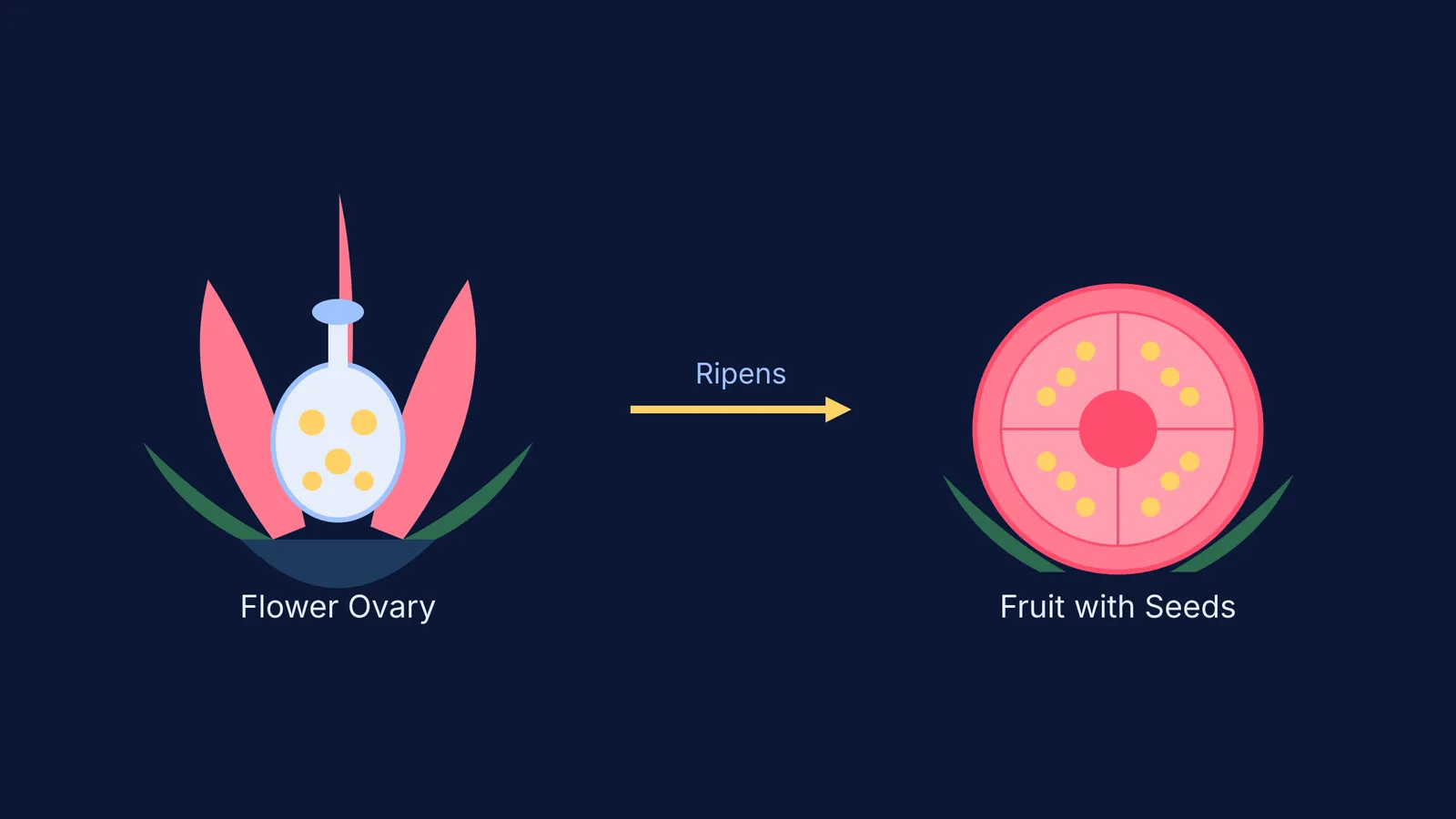
When you look closely at a tomato plant in a garden, you will first notice green buds that open into yellow flowers. Once pollinated, the base of that flower—the ovary—swells and ripens over several weeks into the red orb we eat. Because it grows from the ovary and houses the plant's seeds, a tomato is unequivocally a fruit.
This same botanical rule applies to many other foods we treat as savoury ingredients. Cucumbers, brinjals (eggplants), bell peppers, and pumpkins all start as flowers and hold seeds inside. Therefore, to a botanist, they are all classified as fruits.
When you are studying plant morphology, the Fermi Concept Library covers every concept in physics, chemistry, biology, mathematics and computing, each with its own lesson and its place in the map.
What makes a vegetable?
Strictly speaking, the word "vegetable" does not exist in plant morphology. It is a culinary term rather than a scientific one, used broadly to describe any edible part of a plant that is not a sweet fruit or a seed.
This encompasses an enormous variety of distinct plant organs. When you eat a carrot or a radish, you are eating a taproot that the plant uses to store energy underground. When you slice a potato, you are cutting into a tuber, which is a modified stem. Celery is a stalk, spinach is a leaf, and broccoli is a densely packed cluster of unopened flower buds.
Why do we lump tomatoes and cucumbers into this group? It comes down to sugar and how we eat them. Culinary fruits tend to be high in fructose and are eaten raw as snacks or in sweet desserts. Culinary vegetables are generally lower in sugar, cooked in savoury dishes, or eaten with oil and salt. For instance, raw cucumbers consist of 95% water (Wikipedia) and have a mild, savoury crunch, making them a salad staple rather than a pudding ingredient.
How did the 1893 Supreme Court rule on tomatoes?
The confusion between these definitions is so persistent that it once required legal intervention. In 1893, the Supreme Court of the United States had to decide the matter in a landmark case called *Nix v. Hedden* (Wikipedia).
At the time, the Tariff Act of 1883 imposed a tax on imported vegetables, but fruit could be imported duty-free. An importer sued the port's tax collector, arguing that his tomatoes were botanical fruits and should therefore not be taxed.
The Court unanimously ruled against the importer. They agreed that while a tomato is botanically a fruit, it is a vegetable in the "common language of the people" because it is served at dinner, not as a dessert. This legally established that ordinary culinary definitions overrule strict botanical definitions in matters of commerce.
Are there exceptions to the seed rule?
Nature rarely follows our rigid categories perfectly. Some fruits develop without fertilisation and never produce mature seeds, a phenomenon explored in our guide to false fruits and parthenocarpy. For example, commercial bananas are seedless, yet they are still botanical fruits because they grow from an ovary.
Furthermore, how seeds are arranged inside the fruit tells us exactly how the original flower was built. If you cut a tomato in half horizontally, you will see the seeds clustered in distinct compartments called locules. If you want to know why they arrange themselves this way, see our breakdown of placentation types in flowers.
How can you tell if a plant part is a fruit or a vegetable?
To quickly classify a plant part for your biology exam, skip the kitchen logic and ask yourself these three anatomical questions:
Did it start as a flower on the plant?
Is it the swollen, ripened ovary?
Does it have seeds on the inside?
If the answer is yes to these, you are looking at a fruit. If you are struggling to picture how an ovary ripens, Fermi's AI tutor can draw the figure and check understanding as it goes. By anchoring your definitions in the anatomy of the plant rather than the layout of a supermarket, you will never get this question wrong.


