

On this page
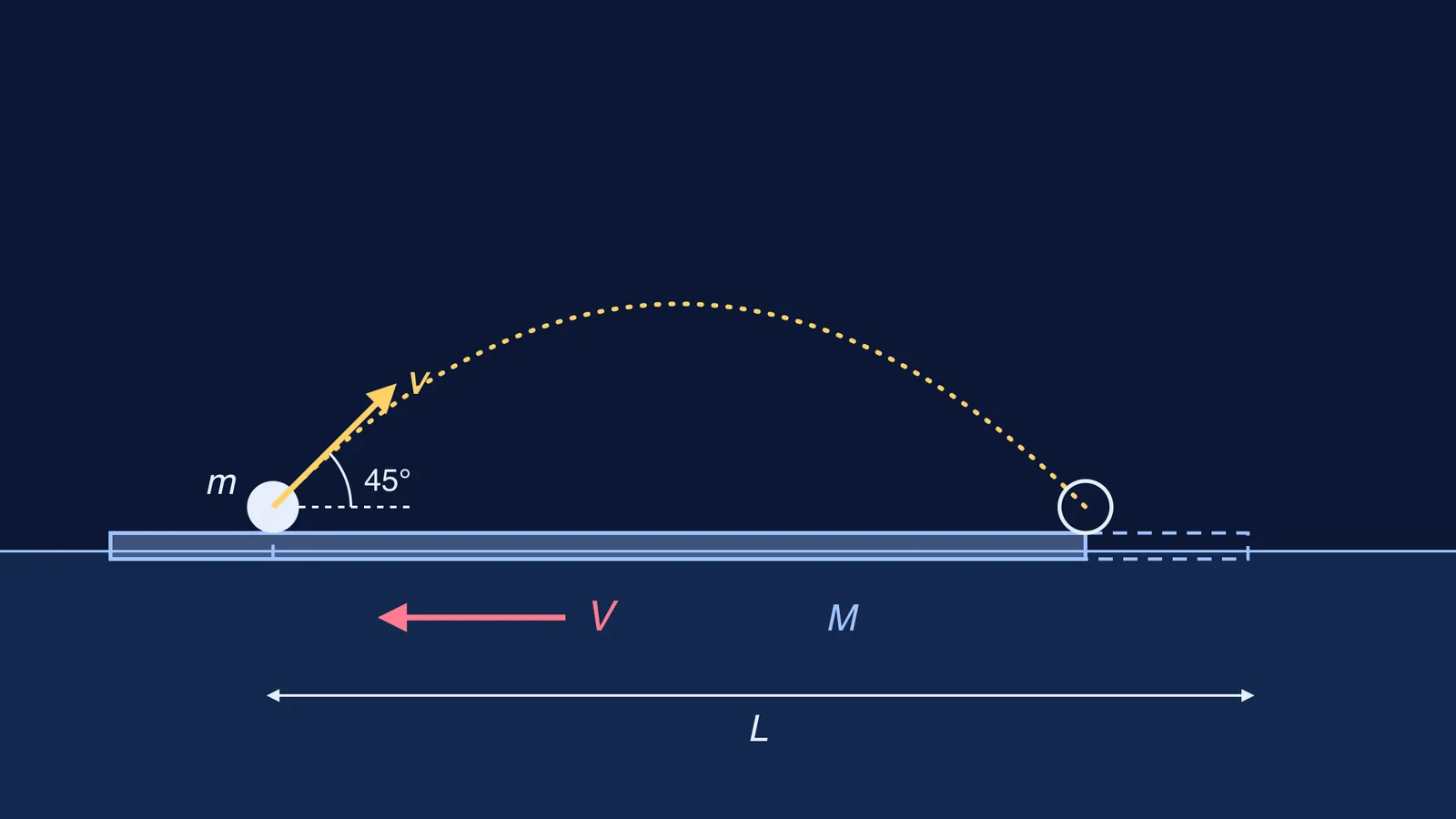
A frog sits on one end of a plank of length L and mass M floating on still water. Ignore friction between plank and water. What is the least speed with which the frog (mass m) must jump so that it lands on the other end? This is a common JEE-style question because it joins two chapters: conservation of momentum and projectile motion. Leave out the plank's recoil and you land on the usual wrong answer, √(gL).
Why does the plank move when the frog jumps?
Take the frog and the plank as one system. With no friction from the water, nothing outside the system pushes it sideways. OpenStax University Physics states that the total momentum of a closed system is conserved when the net external force on it is zero. The same textbook adds that conservation of momentum is true in each direction independently.
That second point matters here. Vertically, gravity and the water's push act on the system, so vertical momentum is not conserved. Horizontally, nothing acts. Both start at rest, so if the frog leaves with speed v at angle θ to the ground, the plank slides back with speed V:
m v cos θ = M V, so V = m v cos θ / M
It is the same recoil you see when a person on ice throws a ball and slides back.
How do you find the minimum speed of the frog?
Treat the plank as thin, so the frog lands at the height it left from. On level ground the time of flight is T = 2 v sin θ / g, from the OpenStax projectile chapter.
During T, the frog moves forward by v cos θ × T.
In the same time the plank moves backward by V × T, bringing its far end towards the frog.
The two distances together must cover the plank: (v cos θ + V) T = L.
Put in V = m v cos θ / M: v cos θ (1 + m/M) × 2 v sin θ / g = L.
Since 2 sin θ cos θ = sin 2θ, this becomes v² sin 2θ (M + m) / (M g) = L.
v is least when sin 2θ is largest, which is at θ = 45°, the same reason projectile range is maximum at 45°.
So v_min = √(MgL / (M + m)), with the jump at 45° to the horizontal.
What does the answer look like with numbers?
Take L = 1.0 m, M = 0.50 kg, m = 0.10 kg and g = 9.8 m/s². These are values chosen for practice, and the formulas are the OpenStax projectile results used above.
v_min = √(0.50 × 9.8 × 1.0 / 0.60) = √8.17 ≈ 2.86 m/s
On a plank nailed to a jetty, the frog would need √9.8 ≈ 3.13 m/s
Time in the air: 2 × 2.86 × 0.707 / 9.8 ≈ 0.41 s
The frog moves 0.83 m forward, and the plank slides 0.17 m back
The split is 5 to 1, which is M to m. The centre of mass of frog plus plank does not move horizontally, the same idea you meet when a man walks along a boat and the boat moves back.
Does the answer change if the speed is given relative to the plank?
Yes, so read the question carefully. Once the frog is in the air, the plank moves at a steady speed, so its frame is a fair one to work in. The plank never moves up or down, so the frog's vertical speed is the same in both frames. If the frog's speed relative to the plank is u at angle α, the plank-frame range is u² sin 2α / g. Setting this equal to L and taking α = 45° gives u_min = √(gL), with no masses in it at all.
So both √(gL) and √(MgL / (M + m)) can be correct. Which one is right depends on the words "with respect to the ground" or "relative to the plank".
Which mistakes cost marks on this problem?
Answering √(gL) when the speed is measured from the ground
Conserving vertical momentum as well as horizontal
Adding the plank's displacement with the wrong sign, so the gap looks longer instead of shorter
Using the jump angle seen from the moving plank in a ground-frame equation
If your working keeps landing on √(gL), the Fermi Problem Library has worked problems with a step-by-step solver that explains the reasoning rather than printing an answer, so you can see which step dropped the recoil. For a refresher before you start, read our guide to projectile range, height and time of flight on level ground.
Try it next with the frog jumping at 30° instead: keep L, M and m, and work out the speed needed.


