

On this page
Fraction word problems read like riddles, but they follow one script. The numerator and denominator are your two unknowns, and each sentence gives you one equation.
The CBSE Class 10 mathematics curriculum for 2026-27 lists "simple situational problems" under pair of linear equations in two variables, inside the Algebra unit, which carries 20 of the 80 marks.
How do you set up a fraction word problem?
Use the same five moves every time:
Name the unknowns. Write "Let the fraction be x/y, where x is the numerator and y is the denominator."
Translate each condition on its own. "1 is added to the numerator" changes only the top, giving (x + 1)/y. "Added to both" changes the top and the bottom.
Cross-multiply to clear the fractions, so each condition becomes a line of the form ax + by = c.
Solve the pair by elimination or substitution.
Check your answer against the original sentences, not against your equations.
Before writing step 2, underline what changes the numerator and what changes the denominator.
How do you solve the NCERT "fraction becomes 1" problem?
Here is the problem as printed in Exercise 3.3, Question 2(i) of NCERT Class 10 Mathematics, Chapter 3: Pair of Linear Equations in Two Variables: "If we add 1 to the numerator and subtract 1 from the denominator, a fraction reduces to 1. It becomes 1/2 if we only add 1 to the denominator. What is the fraction?"
Let the fraction be x/y.
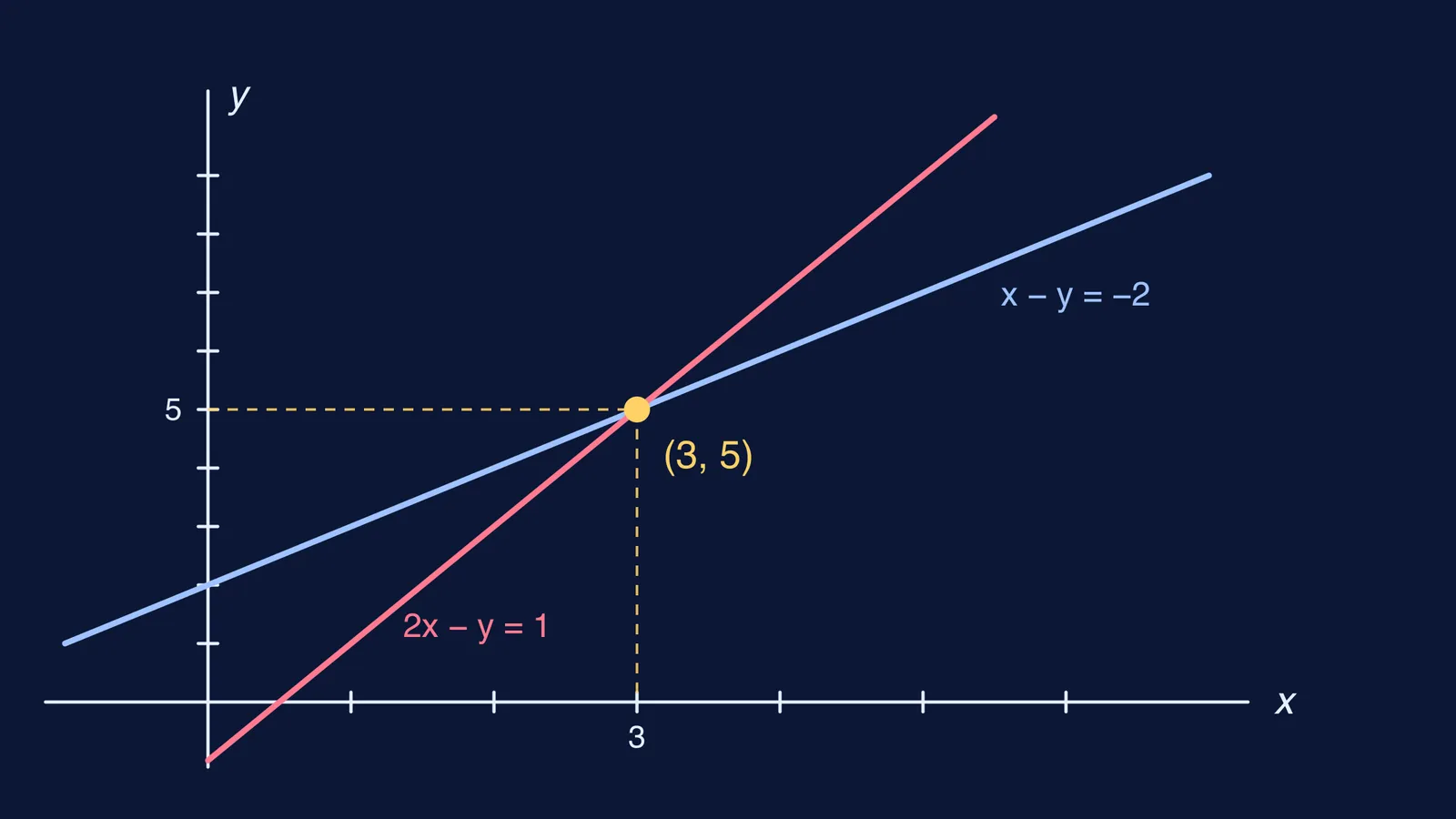
Condition 1: (x + 1)/(y - 1) = 1. A fraction equals 1 only when its top equals its bottom, so x + 1 = y - 1, which gives x - y = -2.
Condition 2: x/(y + 1) = 1/2. The word "only" tells you the numerator stays as x. Cross-multiply: 2x = y + 1, which gives 2x - y = 1.
Solve: The y terms already match, so subtract the first equation from the second. (2x - y) - (x - y) = 1 - (-2), so x = 3. Put x = 3 into x - y = -2 to get y = 5. The fraction is 3/5.
Check: (3 + 1)/(5 - 1) = 4/4 = 1. And 3/(5 + 1) = 3/6 = 1/2. Both sentences hold.
Drawn as lines, the two equations cross at (3, 5); see solving a pair of linear equations by graphing.
What if the same number is added to both numerator and denominator?
The same NCERT chapter has a second version in Exercise 3.2, Question 3(v): a fraction becomes 9/11 when 2 is added to both the numerator and the denominator, and 5/6 when 3 is added to both.
Condition 1: (x + 2)/(y + 2) = 9/11, so 11(x + 2) = 9(y + 2). Expand: 11x + 22 = 9y + 18, so 11x - 9y = -4.
Condition 2: (x + 3)/(y + 3) = 5/6, so 6(x + 3) = 5(y + 3). Expand: 6x + 18 = 5y + 15, so 6x - 5y = -3.
Make the y terms match: multiply the first by 5 and the second by 9. You get 55x - 45y = -20 and 54x - 45y = -27.
Subtract: x = 7. Then 6(7) - 5y = -3, so 5y = 45 and y = 9.
Check: 9/11 and 10/12 = 5/6. The fraction is 7/9.
The textbook asks you to solve this one by substitution, and you will reach the same 7/9. If you are unsure which method to use, read how to choose between substitution and elimination.
Which slips cost marks in fraction problems?
Changing the wrong part. "Add 1 to the denominator only" leaves the numerator as plain x.
Cross-multiplying the wrong way round. (x + 2)/(y + 2) = 9/11 gives 11(x + 2) = 9(y + 2), with each denominator multiplying the other side's numerator.
Dropping brackets. 11(x + 2) is 11x + 22, not 11x + 2.
Sign errors when moving terms. x + 1 = y - 1 becomes x - y = -2, not x - y = 2.
Skipping the check. A negative or zero denominator is a sign that a step went wrong.
If you get a different answer and cannot see why, the Fermi Problem Library has worked problems with a step-by-step solver that explains the reasoning rather than printing an answer, so you can find the exact line where your setup went off track. If cross-multiplying itself feels shaky, the Fermi Concept Library gives each mathematics concept its own lesson.
What should parents ask to check the work?
You do not need to solve it yourself. Ask, "What do x and y stand for?" and, pointing at an equation, "Which sentence gave you this line?" If your child can answer both, only the arithmetic is left to check.
Next, try the 7/9 problem without looking at the working, then read our guide to linear equations in two variables for Class 10.


