

On this page
Four leaves, a jar of Vaseline and an afternoon: this is one of the simplest plant experiments, and a common prediction question in school biology. You coat different surfaces of four similar leaves, watch which one goes limp first, and use the order to work out where a leaf keeps most of its pores.
What is the four-leaf Vaseline experiment?
Transpiration is the loss of water in the form of vapour from the aerial parts of a plant, as defined in NCERT's Class 10 Science chapter Life Processes. The same chapter explains that water lost through the stomata is replaced by water from the xylem vessels in the leaf. A plucked leaf has no supply to replace what it loses, so it wilts as it dries.
Vaseline (petroleum jelly) is waterproof. Spread on a leaf, it forms a film over the stomata beneath it, so you can switch off one surface at a time.
How to set it up:
Pluck four leaves of similar size and age from the same plant. A broad, net-veined leaf such as China rose (hibiscus) works well.
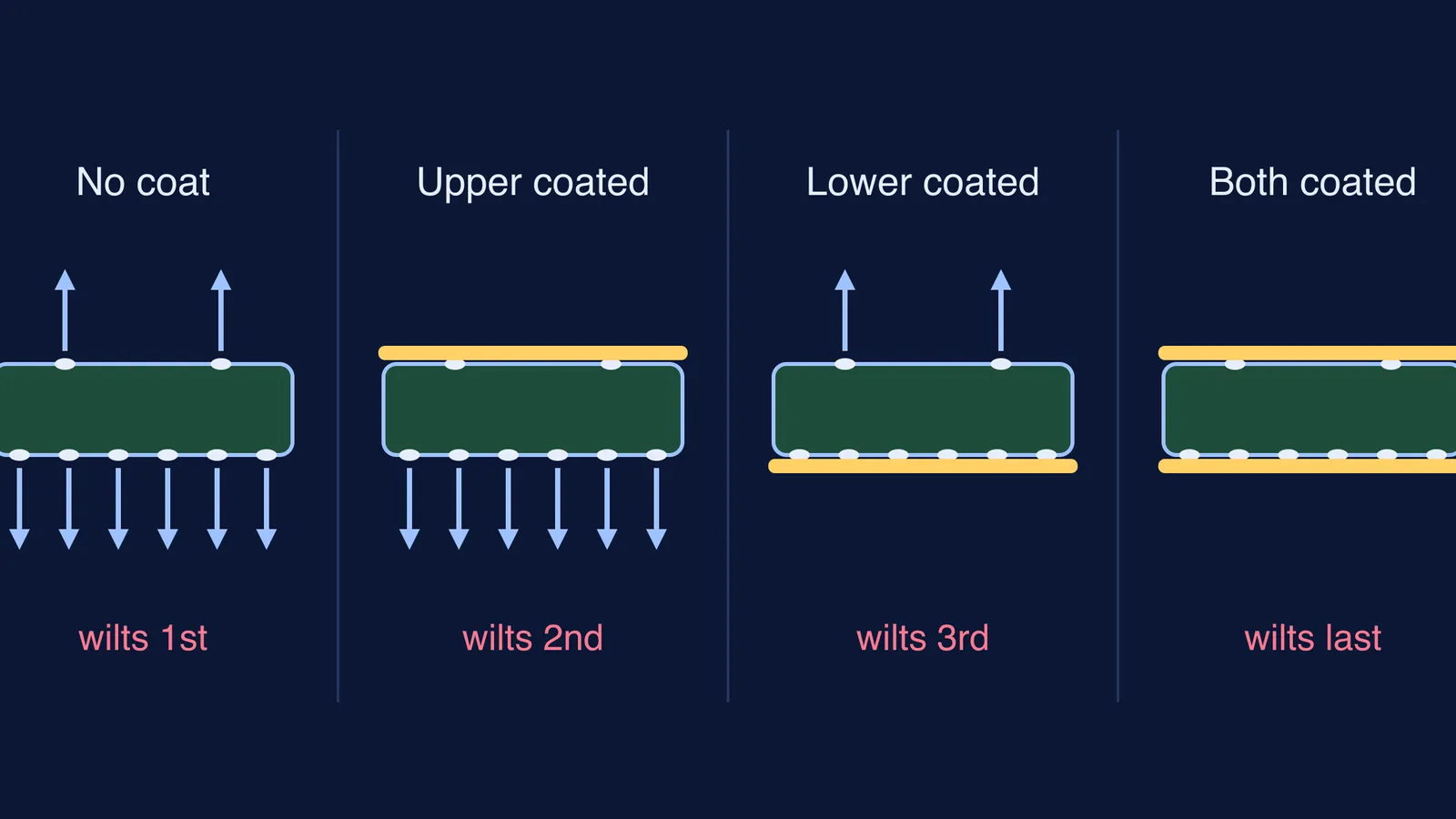
Label them A to D. Leave A uncoated as your control. Coat B on the upper surface only, C on the lower surface only, and D on both surfaces.
Hang all four from a string by their stalks, side by side, in the same light and air.
Check them every hour for a few hours and note which looks limp first. For a measurement instead of a judgement, weigh each leaf at the start and the end and record how much mass it lost.
Which leaf wilts first, and why?
The expected order, from first to last:
Leaf A (no coating) wilts first, because water vapour escapes from the stomata on both surfaces.
Leaf B (upper surface coated) wilts next. You have sealed the side with fewer stomata, so the underside keeps losing water.
Leaf C (lower surface coated) wilts later. You have sealed the side with most of the stomata, leaving only the few on top.
Leaf D (both surfaces coated) stays fresh longest. It is not watertight forever: a hand-spread coat has gaps and the cut stalk is open, so it also dries, just slowly.
The reason sits in NCERT's Class 11 chapter Anatomy of Flowering Plants. In a dorsiventral (dicot) leaf, it says, "the abaxial epidermis generally bears more stomata than the adaxial epidermis", and the upper surface "may even lack stomata". Abaxial means the lower surface; adaxial means the upper surface.
What does this experiment prove about stomata distribution?
It shows that, for the leaf you tested, the lower surface loses more water than the upper surface, and the simplest explanation is that it carries more stomata. That matches a wider pattern. A 2015 study by Christopher Muir in Proceedings of the Royal Society B used a global database of 599 plant species from 94 families and found that most plants have their stomata on the lower leaf surface, while species with half their stomata on each surface form a distinct second group.
That second group is your warning against over-generalising. NCERT's anatomy chapter notes that in an isobilateral (monocot) leaf, the stomata are present on both surfaces. Repeat the experiment with a grass leaf and you would expect B and C to wilt at a similar pace.
What the experiment does not do is count stomata. It infers where they are from water loss. To see them, prepare a temporary mount of a leaf peel from each surface, then calculate the stomatal index for both and check whether the numbers agree with your wilting order.
How do you write this up in an exam or practical record?
Use a three-line frame and fill it in from your own leaves:
Observation: Leaf A wilted first, then B, then C. Leaf D stayed fresh longest.
Inference: Blocking the lower surface reduced water loss more than blocking the upper surface.
Conclusion: The lower surface of this leaf has more stomata than the upper surface, and this leaf lost its water mainly through stomata.
Before you hand it in, check for these slips:
Writing that leaf D "never wilts". Write "wilts last" or "wilts slowest".
Swapping B and C. The leaf coated underneath is the one that lasts longer.
Leaving out the uncoated control, so you have nothing to compare against.
Stating the result as a rule for all plants. Your conclusion is about the plant you tested.
If abaxial, adaxial and isobilateral keep blurring into each other, the Fermi Concept Library gives every concept in biology its own lesson and its place in the map. To practise prediction questions like this one, the Fermi Problem Library has worked problems with a step-by-step solver that explains the reasoning rather than printing an answer.
Next time, change one thing only: use a grass leaf, or put two uncoated leaves in sun and shade, and write down your predicted order before you look.


