

On this page
When you look at a leaf peel under a microscope, you will see a landscape of ordinary epidermal cells dotted with stomata. These tiny, specialised pores open and close to let carbon dioxide in and oxygen and water vapour out.
If you simply count the number of stomata in a given area, you get the stomatal density. But there is a mathematical problem with raw density: if the leaf grows in a wet, shady environment, its epidermal cells absorb more water and expand. This expansion spreads the stomata further apart, dropping the density even though the plant has not actually lost any stomata. To find a number that stays reliable regardless of how the leaf grew, biologists calculate the stomatal index instead.
What is the stomatal index formula?
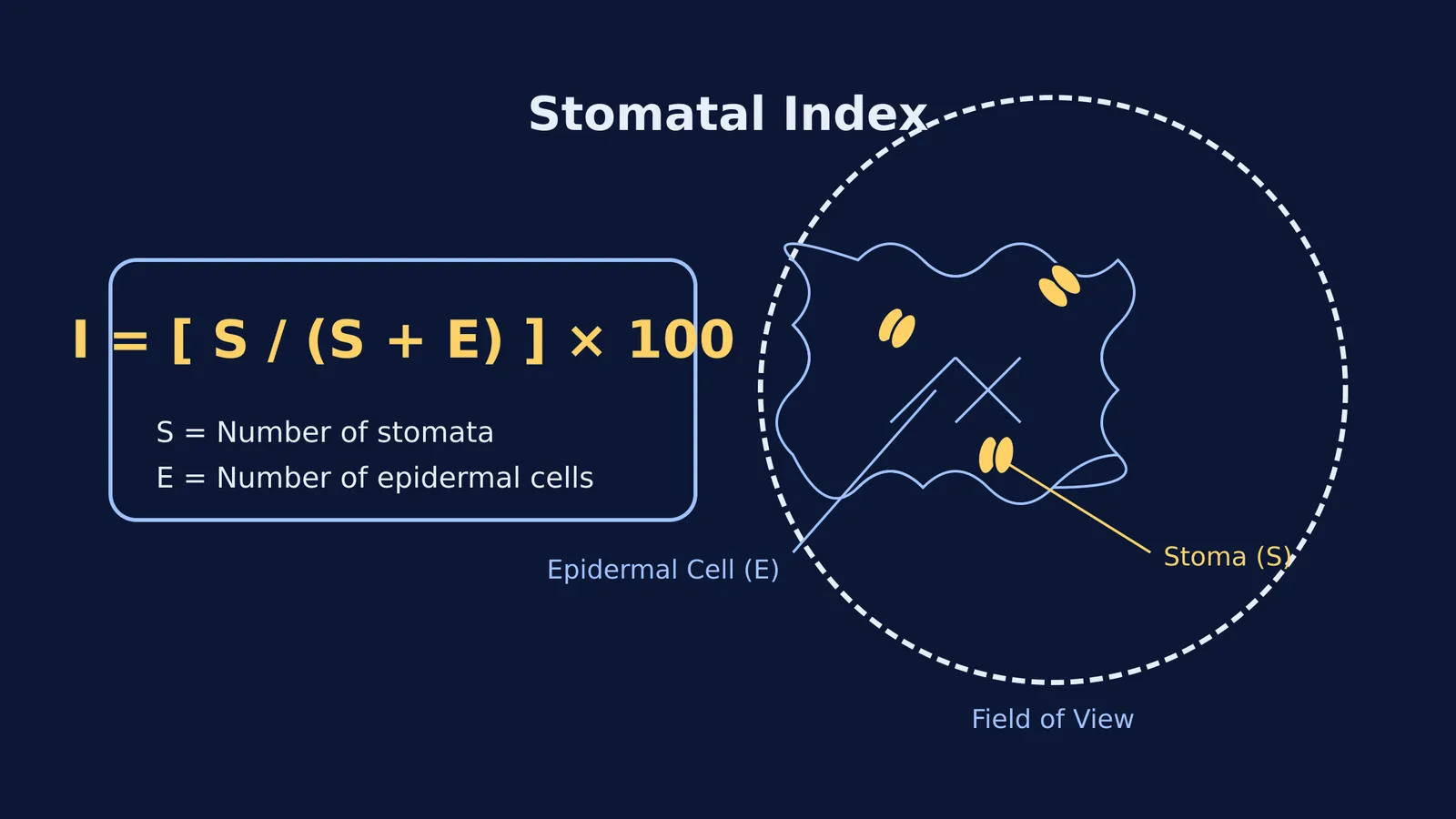
The stomatal index is the percentage of epidermal cells that have differentiated into stomata. The standard formula is:
I = [ S / (S + E) ] × 100
Here is what the symbols mean:
I is the Stomatal Index.
S is the number of stomata in a given microscopic field of view.
E is the number of ordinary epidermal cells in the exact same field of view.
When you are counting, you must treat each entire stoma—which consists of the central pore and the two kidney-shaped guard cells that surround it—as a single unit. Do not count the two guard cells as separate epidermal cells, or your calculation will be wrong.
How do you prepare a leaf peel and count cells?
To calculate the index yourself, you need a clear, one-cell-thick view of the leaf's surface. In most dicot plants, the lower epidermis has more stomata than the upper surface.
Peel the leaf: Tear a fresh leaf obliquely to pull away a thin, transparent layer of the lower epidermis. Alternatively, you can use the replica method: paint a patch of clear nail polish on the leaf, let it dry for ten minutes, and gently peel it off with clear tape.
Mount the sample: If you are using a real tissue peel, stain it with a drop of Safranin, place it on a glass slide with a drop of glycerine, and cover it carefully with a coverslip to avoid air bubbles.
Count the stomata (S): Look through your compound microscope (usually at 10x or 40x magnification). Count every stoma you can see in the circular field of view.
Count the epidermal cells (E): In the same field of view, count all the ordinary epidermal cells.
If you have cells sitting right on the edge of your field of view, you will need a consistent rule to avoid double-counting. A standard laboratory practice is to count the cells touching the top and left borders, but ignore the ones touching the bottom and right borders. Take readings from three to five different fields of view across the leaf and calculate the average to get a precise, representative result.
Why use stomatal index instead of stomatal density?
Stomatal density measures how many stomata exist per square millimetre. However, a leaf surface is structurally like a balloon with dots drawn on it. As the leaf expands due to abundant water or shade, the epidermal cells stretch. The dots (stomata) move further apart, which lowers the stomatal density.
Because the stomatal index compares the stomata to the total number of cells in that specific layer (which shares the exact same cell wall expansion), it factors out the stretching entirely. The index reveals the plant's developmental blueprint—the initial proportion of cells the plant originally committed to turning into stomata before any physical expansion took place.
Because this ratio is relatively fixed by genetics rather than temporary weather, paleobotanists use the stomatal index of fossilised leaves to estimate ancient atmospheric carbon dioxide levels. When carbon dioxide was highly concentrated millions of years ago, plants needed fewer stomata to capture the gas, leading to a permanent evolutionary drop in the stomatal index.
If you are struggling to remember the difference between developmental traits and physical adaptations in botany, you can find every concept in biology explained in the Concept Library.
How do you calculate the index in a worked example?
Imagine you are looking at a peel from a balsam leaf under a microscope, trying to spot a chloroplast inside the guard cells.
In your first field of view, you count exactly 18 stomata. Then, you carefully count the jigsaw-puzzle-shaped epidermal cells around them and find 72 of them.
Identify S and E: S = 18, E = 72.
Find the total cell count: S + E = 18 + 72 = 90 total cells in the field of view.
Divide S by the total: 18 / 90 = 0.20.
Convert to a percentage: 0.20 × 100 = 20%.
The stomatal index for this specific field of view is 20%. You would then repeat this exact process for three more fields of view and average the percentages to find the final stomatal index for the leaf.


