

On this page
Food security asks one question: can every person in India get enough food, every day, even in a bad year? Here are the three dimensions, the buffer stock and the public distribution system (PDS), with a plan for a 5-mark answer.
What does food security mean in Class 9 economics?
The definition most textbooks build on comes from the 1996 World Food Summit: food security exists when "all people, at all times, have physical and economic access to sufficient, safe and nutritious food" (FAO).
Class 9 economics breaks this into three dimensions:
Availability: enough food exists in the country, from what farmers grow, what is imported and what the government has stored from earlier years.
Accessibility: food is within reach of every person.
Affordability: a person has enough money to buy sufficient, safe and nutritious food to meet their dietary needs.
A simple test: availability is the country, accessibility is the route to your plate, affordability is your pocket. A household can fail on any one.
What is a buffer stock and why does India keep one?
"Buffer stock refers to a reserve of a commodity that is used to offset price fluctuations and unforeseen emergencies" (Arthapedia, Indian Economic Service). In India this means wheat and rice bought by the Food Corporation of India (FCI) and held in its godowns.
It feeds the PDS every month, covers crop failures and disasters, and can be released to calm market prices. The Cabinet Committee on Economic Affairs fixes the minimum norms for 1 April, 1 July, 1 October and 1 January, and the page lists a strategic reserve of 30 lakh tonnes of wheat and 20 lakh tonnes of rice (Arthapedia).
How the stock fills: the government announces a minimum support price (MSP) before the growing season, and FCI buys grain from farmers at that price. It then releases the grain to ration shops at a lower issue price, and the gap is a subsidy for poorer households.
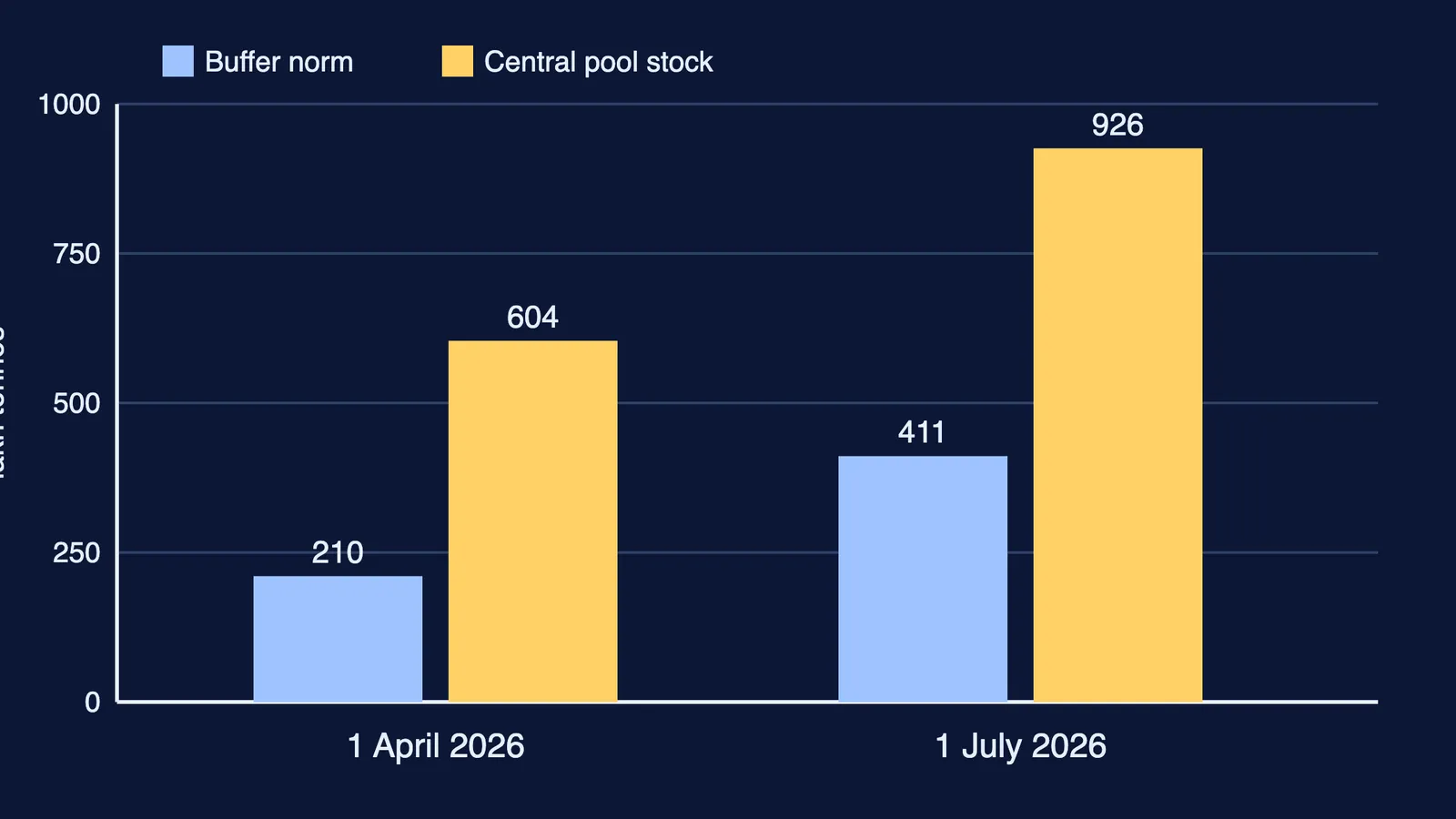
Right now the godowns hold far more than the minimum. On 1 April 2026 the central pool held 604.02 lakh tonnes of rice and wheat against a norm of 210.40 lakh tonnes (The Pioneer, citing official data). On 1 July 2026 it held 925.85 lakh tonnes against a norm of 411.20 lakh tonnes, of which 275.80 lakh tonnes is wheat (Business Today, citing government data).
How does the public distribution system work?
Follow one sack of wheat: a farmer sells it to FCI at MSP, FCI stores it as buffer stock, the state government lifts it, and a fair price shop, the ration shop, hands it to a family with a ration card.
The National Food Security Act, 2013 made this a legal entitlement. It covers up to 75% of the rural population and 50% of the urban population (NFSA portal, Government of India). Priority households are entitled to 5 kg of foodgrains per person per month, and the poorest families, under Antyodaya Anna Yojana (AAY), get 35 kg per family per month (NFSA portal).
Today this grain is free. In November 2023 the Cabinet decided to give free foodgrains to about 81.35 crore beneficiaries under the Pradhan Mantri Garib Kalyan Anna Yojana for five years from 1 January 2024, at an estimated cost of Rs 11.80 lakh crore (Governance Now). For the exam, use your textbook's prices unless a question asks about recent policy.
Why can India have full godowns and still have hungry people?
Full godowns solve availability. On their own they do not solve accessibility (a family left off the ration list, or far from a working ration shop) or affordability (a daily-wage worker who loses work for a season). Wheat and rice also do not cover every nutritional need, which is why pulses and grains such as millets and their nutrition science come up in debates about what the PDS should supply.
Affordability links this chapter to the one before it on poverty. To see how India decides who counts as poor, read how the poverty line is measured.
How do you write a 5-mark answer on food security?
Take a typical question: "Explain how the buffer stock and the PDS together help ensure food security." Use this plan, one point per mark:
Define food security in one line and name the three dimensions.
Define buffer stock and say who builds it: FCI, buying from farmers at MSP.
Explain how the stock protects availability in a drought or flood year.
Explain how the PDS turns stored grain into access and affordability through ration shops at subsidised or zero prices.
Close with one limit, such as families missing from ration lists, so the answer shows judgement.
If you are not sure where to start a revision session, Fermi's AI tutor can work out what you already know and build a plan for the session, so you sit down to a clear next step. For the geography side of the same story, read our guide to resources and development for Class 10.


