

On this page
Your fingerprint ridges are fully formed months before you are born, and barring injury or disease their sequence never changes. That permanence, plus ridge details that examiners treat as unique to each finger, is why police in Buenos Aires (1891) and British India (1897) adopted fingerprints, the US National Institute of Justice's Fingerprint Sourcebook records.
What are loops, whorls and arches?
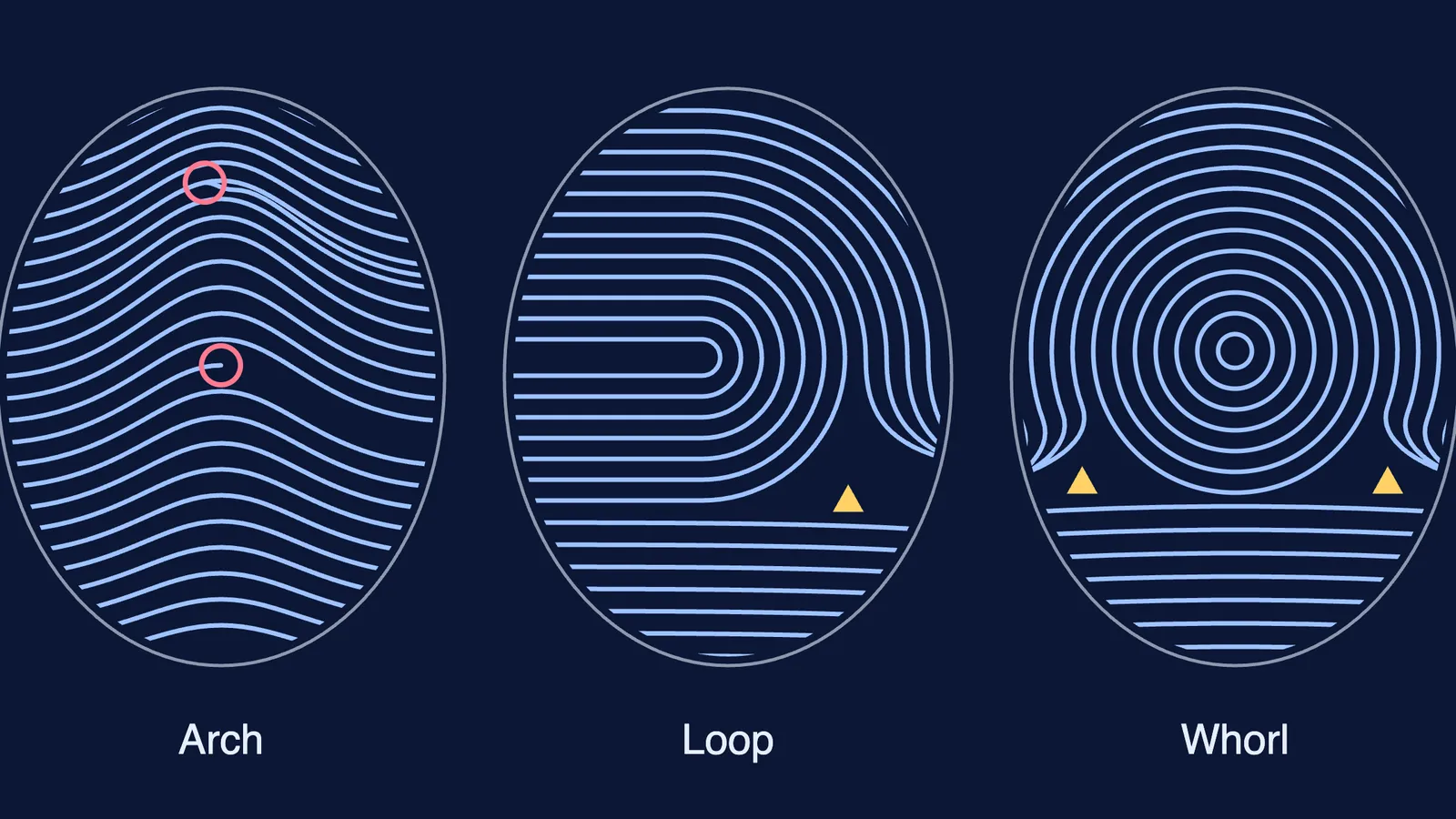
Fingerprints fall into three pattern families. The FBI's manual The Science of Fingerprints defines them using the delta, the point where ridges split and flow around the pattern.
Loop: one or more ridges enter from one side, turn back and leave on the same side, with one delta. Loops are the most common pattern, about 65 percent of all prints, the manual says.
Whorl: a pattern with at least two deltas, its ridges curving around the centre. Whorl-type patterns make up about 30 percent of fingerprints.
Arch: in the plain arch, the simplest pattern, ridges enter on one side, rise in a wave in the middle and flow out the other side.
Indian officers did key classification work. By 1897, Azizul Haque and Hem Chandra Bose of the Calcutta Anthropometric Bureau, working on Edward Henry's project, had devised a mathematical method of dividing fingerprint records into many primary groups, the Sourcebook records. In Argentina, a parallel system grew from Juan Vucetich's work on dactyloscopy.
How do fingerprints form before birth?
Ridges begin at around 10 to 10.5 weeks of gestation, when cells in the basal layer of the fetal epidermis start dividing rapidly, according to the embryology chapter of the NIJ Fingerprint Sourcebook. The same chapter describes primary ridges deepening until about 16 weeks and secondary ridges maturing between 16 and 24 weeks.
The pattern type depends on small swellings called volar pads on the fetal fingertips. The chapter says pad symmetry influences the pattern and pad size the ridge count, by changing tension across the growing skin. Genetics plays a role in the pattern but does not determine where minutiae fall; those come from random "developmental noise" in each patch of skin.
A 2023 Cell study by Glover and colleagues found that the spatial pattern of ridges is established by a Turing reaction-diffusion system based on signals between the EDAR, WNT and BMP pathways, and that ridges spread as waves from several starting sites on the fingertip. Where those waves start and meet decides whether you get a loop, a whorl or an arch.
How are fingerprints matched?
Examiners read three levels of detail: overall ridge flow, the paths of individual ridges, and the fine shape of a ridge. Details along ridge paths are called minutiae:
ridge endings, where a ridge stops;
bifurcations, where one ridge splits into two;
dots, ridges so short they look like a point.
The established method is ACE-V, the Sourcebook's examination chapter explains.
Analysis: study the unknown print on its own. Is it clear enough to use?
Comparison: set it beside a known print and check ridge flow, then the order and position of minutiae.
Evaluation: decide whether the prints share a source, come from different sources, or hold too little detail to say.
Verification: a second examiner checks the conclusion.
The chapter calls a fixed count of matching points "a simplistic and limited explanation"; examiners use training and experience to judge whether the agreeing detail is sufficient.
How accurate is fingerprint matching?
In the first large-scale study of its kind, 169 latent print examiners each compared about 100 pairs of prints. Five examiners made false positive errors, an overall false positive rate of 0.1%, while the false negative rate was 7.5%, the 2011 PNAS study by Ulery and colleagues found. Independent examination of the same pairs by different participants caught every false positive in the study.
The authors note that real casework adds safeguards beyond the decisions they tested. Still, small error rates add up when one print is compared with many candidates, as in a database search. Our explainer on Bayes' theorem and positive test results shows the same counting logic with a medical test.
Try it: classify and match your own prints
You need a pencil, clear tape, white paper and a magnifier.
Shade paper with pencil, press a fingertip on it, then onto tape, and stick the tape down.
Find the centre of the pattern and count the deltas: one for a loop, two or more for a whorl. Ridges that only rise in a wave, with none turning back, make a plain arch.
Circle five minutiae and label each as an ending, a bifurcation or a dot.
Have a friend collect three unlabelled prints, one of them yours. Use ACE-V to find yours, then let a third person verify.
Note what made it hard: smudging, small area or pressure.
If reaction-diffusion feels abstract, the Fermi Concept Library has every concept in biology, chemistry and physics, each with its own lesson. If you are fitting this into board revision, Fermi's AI tutor can work out what you already know and build a plan for the session.
Next time you press your thumb on a phone sensor, count the deltas first.


