

On this page
Finished a Gauss's law problem? Here is a one-line test. At every charged surface, compare the field just on one side with the field just on the other. The difference in the perpendicular part must be σ/ε₀, where σ is the surface charge density at that spot. If it is not, something has gone wrong.
What is the electric field just inside and outside a charged shell?
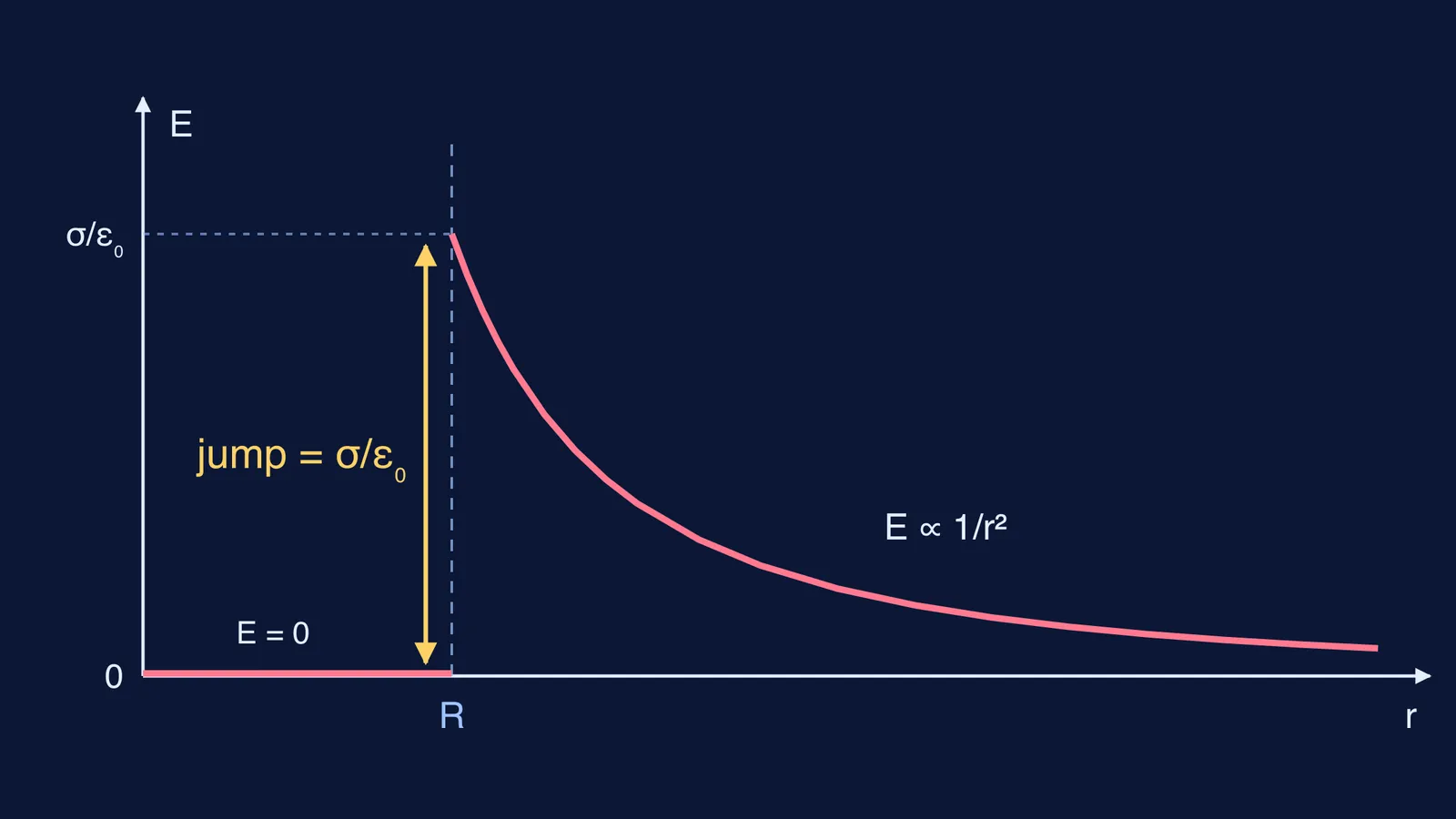
Take a thin spherical shell of radius R with charge Q spread evenly over it. Inside, the field is zero; outside, the shell acts like a point charge at its centre. OpenStax University Physics, section 6.4 gives exactly this for a charged conducting sphere: E = 0 for r < R, and E = Q/(4πε₀r²) for r ≥ R.
Now put r = R into the outside formula. The surface charge density is σ = Q/(4πR²), so Q/(4πε₀R²) = σ/ε₀. Just inside: 0. Just outside: σ/ε₀. The field jumps by exactly σ/ε₀ as you cross the shell, which is the graph at the top of this page. For the full picture with potential as well, see our walkthrough of the electric field and potential graph of a charged conducting sphere.
Why does the field jump by σ/ε₀ at any charged surface?
Draw a tiny pillbox: a flat cylinder with one face of area A on each side of the surface. It encloses charge σA. Shrink its height towards zero so the curved side carries no flux. Gauss's law then says (E₂ − E₁)A = σA/ε₀, where E₁ and E₂ are the perpendicular field components on the two sides, both measured in the direction from side 1 to side 2.
The University of Edinburgh lecture notes on Gauss's law state this directly: for both a thin insulating sheet and a conductor's surface, the field is discontinuous across the charge with a discontinuity of σ/ε₀. The part of the field along the surface does not jump; the interface conditions for electromagnetic fields say the tangential component of E is continuous across a boundary.
Nothing in the pillbox argument depends on shape, so the rule holds for spheres, cylinders, sheets and conductors alike. If you want a refresher on the law itself, start with what Gauss's law says in Class 12.
How do you use the jump to check a Gauss's law answer?
Run this four-step check when you finish a problem:
List every charged surface and its σ, with sign.
Write the perpendicular component of your field just on each side, both measured in the direction from the near side to the far side.
Subtract: far side minus near side.
Check that the result is σ/ε₀, sign included. If you get σ/2ε₀ or 2σ/ε₀, look for a factor-of-two slip.
Check 1: a shell with numbers
Put Q = 2.0 nC on a shell of radius R = 0.10 m. Then σ = Q/(4πR²) ≈ 1.59 × 10⁻⁸ C/m². With ε₀ = 8.854 × 10⁻¹² F/m from NIST's CODATA value, σ/ε₀ ≈ 1.80 × 10³ N/C. Your outside formula at r = R, with 1/(4πε₀) ≈ 8.99 × 10⁹, gives (8.99 × 10⁹)(2.0 × 10⁻⁹)/(0.010) ≈ 1.80 × 10³ N/C, and inside is 0. The jump matches.
Check 2: a single flat sheet
OpenStax section 6.3 gives σ/(2ε₀) for an infinite charged plane, pointing away from it on each side. Measure along +x across the sheet: −σ/2ε₀ on the left, +σ/2ε₀ on the right. The difference is σ/ε₀.
Check 3: the surface of a conductor
Inside the metal E = 0, and just outside E = σ/ε₀, according to OpenStax section 6.4. The jump is again σ/ε₀. That is why the conductor result is twice the sheet result, which we unpack in the factor of 2 between a conductor and a charged sheet.
Check 4: two parallel plates
Add two sheet fields from Check 2, one with +σ and one with −σ. Between the plates you get σ/ε₀; outside, zero. Crossing the positive plate the field rises from 0 to σ/ε₀. Crossing the negative plate it falls from σ/ε₀ to 0, a change of −σ/ε₀, which is exactly what a negative σ requires.
Where does the rule seem to fail?
A solid charged sphere. If charge is spread through the volume, there is no surface charge, so there should be no jump. OpenStax's uniformly charged sphere gives ρ₀r/(3ε₀) inside and Q/(4πε₀r²) outside (section 6.3). Since Q = (4/3)πR³ρ₀, both give ρ₀R/(3ε₀) at r = R. No jump, as predicted.
The field along the surface. Tangential parts never jump.
If the check fails and you cannot see why, the Fermi Problem Library has worked problems with a step-by-step solver that explains the reasoning rather than printing an answer, so you can find the step that introduced the slip. For flux and surface charge themselves, each idea in the Fermi Concept Library has its own lesson and its place in the map.


