

On this page
When preparing for electrostatics in JEE Main, JEE Advanced, or NEET-UG, sketching the field and potential around a spherical conductor is an essential skill. The physics rests on Gauss's law and potential gradients, but the core intuition becomes simple once you separate what happens inside the metal boundary from what happens in empty space outside.
Why is the electric field zero inside a charged conducting sphere?
When you deposit charge q onto an isolated conducting sphere—solid or hollow—conduction electrons redistribute rapidly until reaching electrostatic equilibrium. In electrostatic equilibrium, charges repel to the outer surface, leaving no excess charge inside the bulk, as established in OpenStax University Physics Volume 2.
If an electric field existed inside, it would exert force F = qE on free electrons, driving a current. Because charges are at rest in static equilibrium, the internal electric field cancels completely: E = 0 for all r < R.
As shown in the NCERT Class 12 Physics curriculum, Gauss's law confirms this. A concentric Gaussian surface of radius r < R encloses zero net charge, giving flux ∮ E · dA = E(4πr²) = 0, so E = 0 everywhere inside.
How does the electric field behave across the surface and outside?
At the boundary r = R, the field undergoes an abrupt step. Crossing the surface charge layer causes the field to jump from zero to its peak value:
E(R) = 1/(4πε₀) × q/R² = σ / ε₀
where σ = q / (4πR²) is the uniform surface charge density, as derived in OpenStax University Physics.
Outside the sphere (r ≥ R), a spherical Gaussian surface of radius r encloses the total charge q. Gauss's law yields:
E(r) = 1/(4πε₀) × q/r²
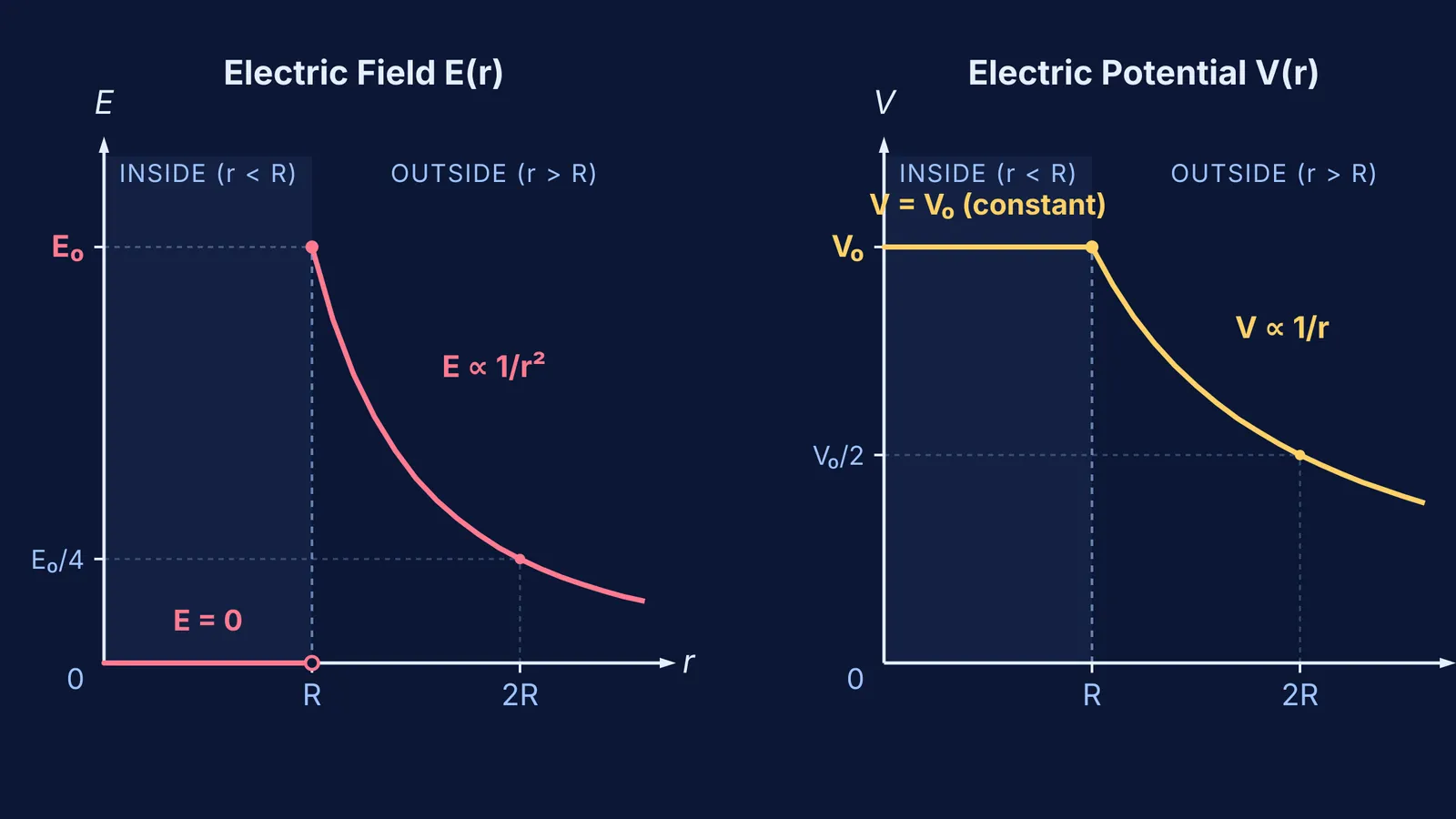
To external observers, the sphere acts as a point charge at the origin. On an E-r graph, the curve stays at zero for r < R, jumps at r = R, and decays as an inverse-square curve proportional to 1/r².
Why is the electric potential constant inside rather than zero?
A common mistake is assuming zero field means zero potential. The two connect via the gradient formula E = −dV/dr, examined in our guide on finding E from potential gradient.
Because E = 0 inside, the spatial derivative dV/dr is zero for r < R:
dV/dr = 0 implies V(r) = constant for r ≤ R
The value of this constant equals the work done bringing a unit test charge from infinity to the surface. As shown in OpenStax University Physics on equipotentials:
V(R) = 1/(4πε₀) × q/R
Moving the charge inside requires zero additional work because no field opposes it. Thus, interior potential equals surface potential: V(r) = 1/(4πε₀) × q/R. As confirmed in the NCERT Class 12 Electrostatics syllabus, the conductor forms an equipotential volume.
How do the E-r and V-r graphs compare side by side?
Plotting both functions highlights three clear contrasts:
Inside (r < R): The E-r curve lies flat on the axis at E = 0. The V-r curve forms a flat horizontal plateau at height V₀ = 1/(4πε₀) × q/R.
Boundary (r = R): The E-r curve has a sharp vertical jump discontinuity. The V-r curve is continuous, joining its plateau smoothly to the external curve.
Outside (r > R): The E-r curve drops as 1/r², falling to 25% of its surface value at r = 2R. The V-r curve drops as 1/r, retaining 50% of its surface value at r = 2R, as outlined in OpenStax University Physics.
By contrast, an insulating solid sphere has a linearly rising internal field and reaches 1.5 times the surface potential at the centre, as explained in OpenStax University Physics and our guide on potential inside a uniformly charged solid sphere. For students connecting these ideas, the Fermi Concept Library maps every concept in physics, chemistry, biology, mathematics and computing, each with its own lesson and its place in the map.
How do you calculate electric field and potential for a conducting sphere?
To calculate the field and potential at specific distances, apply the piecewise formulas established in NCERT Class 12 Physics. Consider an isolated conducting sphere of radius R = 10 cm (0.1 m) carrying charge q = +4 nC (4 × 10⁻⁹ C) in air, with Coulomb constant 1/(4πε₀) = 9 × 10⁹ N·m²/C²:
Inside at r = 5 cm (r < R): E = 0 N/C; V = 9 × 10⁹ × (4 × 10⁻⁹) / 0.1 = 360 V.
At the surface r = 10 cm (r = R): E = 9 × 10⁹ × (4 × 10⁻⁹) / (0.1)² = 3,600 N/C; V = 360 V.
Outside at r = 20 cm (r = 2R): E = 3,600 / 2² = 900 N/C; V = 360 / 2 = 180 V.
For concentric shells and grounded conductors, consult our walkthrough on concentric spherical shells and earthing. When working through multi-step boundary problems, the Fermi Problem Library provides worked problems with a step-by-step solver that explains the reasoning rather than printing an answer. For visualising electric field lines and equipotential surfaces interactively, the Fermi Simulation Lab provides interactive simulations for the ideas that are easier to see than to read.


