

On this page
Ethylbenzene is benzene with a CH2CH3 group on it. Styrene, also called phenylethene or vinylbenzene, is benzene with a CH=CH2 group. To get from one to the other you have to take two hydrogens off the side chain, one from each carbon, and turn the single bond into a double bond. You can't do that in one move with school reagents, so the standard answer uses two steps: add a leaving group, then eliminate.
What are the two steps to convert ethylbenzene to styrene?
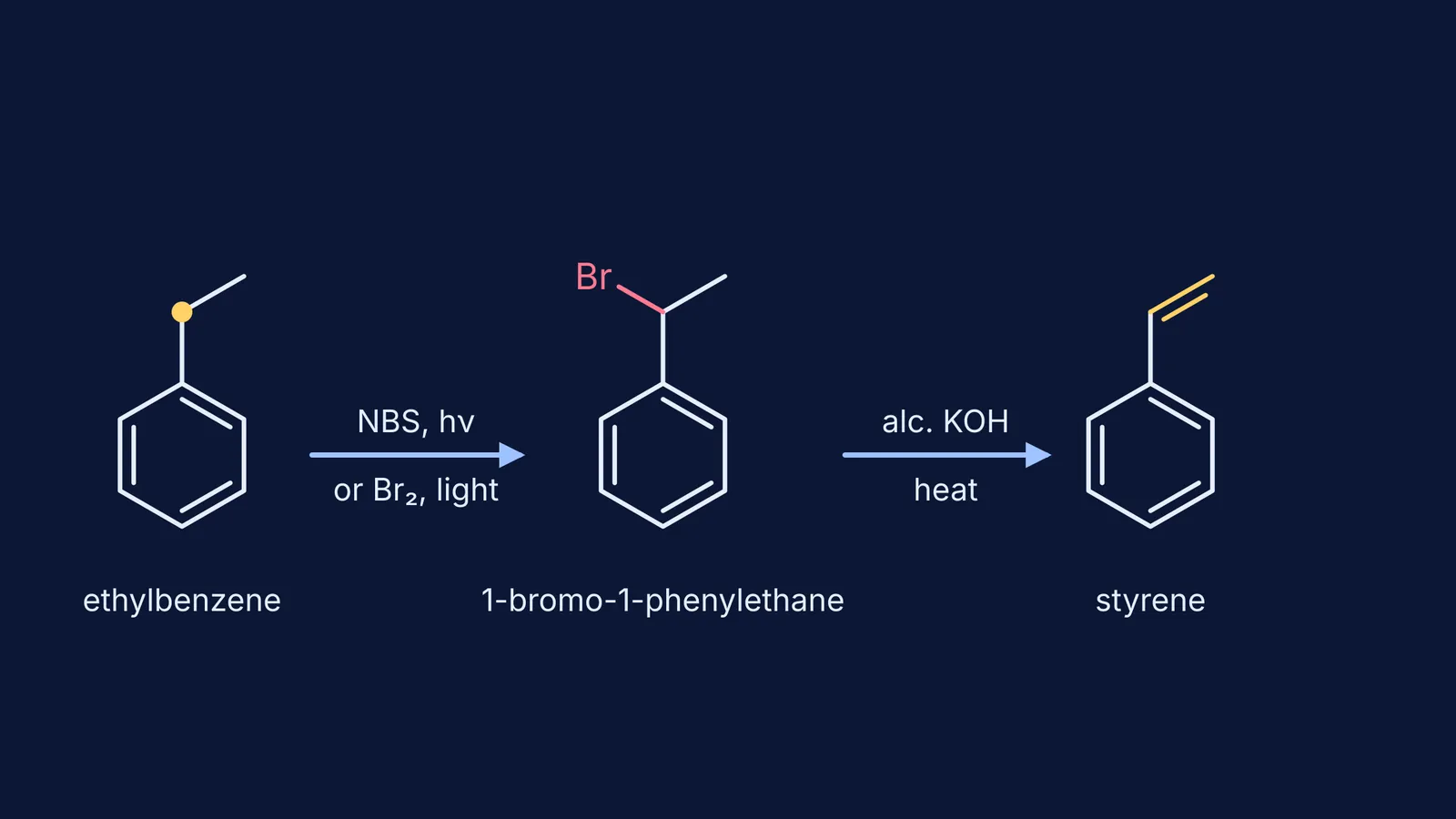
Benzylic bromination. Treat ethylbenzene with N-bromosuccinimide (NBS) in light, or with a peroxide initiator. The bromine replaces one hydrogen on the carbon attached to the ring and gives 1-bromo-1-phenylethane, C6H5CH(Br)CH3. LibreTexts lists (1-bromoethyl)benzene as the product of this reaction. Br2 with light or heat and no catalyst does the same job, though less cleanly.
Dehydrohalogenation. Heat that bromide with KOH dissolved in ethanol. The base pulls off a hydrogen from the CH3 group, bromide leaves, and you get C6H5CH=CH2. A Purdue organic chemistry text on LibreTexts shows an alkyl halide giving an alkene with KOH and ethanol.
In one line: C6H5CH2CH3 → (NBS, light) → C6H5CH(Br)CH3 → (alcoholic KOH, heat) → C6H5CH=CH2 + HBr.
Why does bromine go to the benzylic carbon?
Benzylic C–H bonds are weaker than the other C–H bonds in a molecule like this. Ethylbenzene itself is not in LibreTexts' table of homolytic bond energies, but its close relatives are: the table gives 375.3 kJ/mol for the benzylic C–H in toluene (C6H5CH2–H), against 423.0 kJ/mol for CH3CH2–H in ethane and 472.4 kJ/mol for a C–H on the benzene ring.
A bromine radical takes the hydrogen that costs least to remove. The radical left behind is stabilised by resonance, because its p orbital overlaps with the ring's π electrons, as the OpenStax textbook explains/16%3A_Chemistry_of_Benzene_-_Electrophilic_Aromatic_Substitution/16.08%3A_Oxidation_of_Aromatic_Compounds). That is why side-chain bromination with NBS happens only at the benzylic position.
NBS matters because it keeps the Br2 concentration low: it reacts with traces of HBr to release small amounts of Br2 as the reaction goes (LibreTexts). The same trick shows up in allylic bromination with NBS, and the difference between vinylic, allylic and benzylic halides explains why the product counts as a benzylic halide.
The ring route is in OpenStax's chapter on aromatic bromination: Br2 does not react with benzene at room temperature, and a catalyst such as FeBr3 is needed.
Why use alcoholic KOH and not aqueous KOH?
In water, hydroxide can act as a nucleophile, so substitution to the alcohol 1-phenylethanol competes, and benzylic halides substitute readily. In ethanol with heat, hydroxide and ethoxide act mainly as bases, which favours elimination. Your answer should say "alcoholic" every time.
There is no regiochemistry choice here. Only one carbon next to C–Br carries hydrogens (the CH3), so only one alkene can form. The new double bond is also conjugated with the ring, which makes styrene a stable product. In longer chains you do have to choose, and the Saytzeff (Zaitsev) rule tells you which alkene wins.
How do you write this in an exam answer?
Here is a full answer laid out the way an examiner wants to read it:
Draw ethylbenzene and circle the benzylic carbon.
Write NBS, hν (or Br2, hν) over the first arrow. Name the product: 1-bromo-1-phenylethane.
Write alc. KOH, Δ over the second arrow. Show HBr leaving.
Name the final product: styrene (phenylethene).
Add one line of reasoning: benzylic radical stabilised by resonance; alcoholic KOH causes β-elimination.
To check you've got the pattern, try these variations:
Propylbenzene: bromination gives C6H5CH(Br)CH2CH3, and elimination gives C6H5CH=CHCH3 (1-phenylpropene), conjugated with the ring.
Cumene (isopropylbenzene): you get C6H5C(Br)(CH3)2, then C6H5C(CH3)=CH2.
tert-Butylbenzene: no reaction at the side chain, because the benzylic carbon has no hydrogen to remove.
If you keep picking the wrong conditions on conversions like these, the Fermi Problem Library has worked problems with a step-by-step solver that explains the reasoning rather than printing an answer. If the gap is in the ideas underneath, such as radical stability or E2 elimination, the Fermi Concept Library gives each concept its own lesson.
Is this how styrene is made in industry?
No. Factories don't make styrene through a bromide. Most of it is made by removing hydrogen from ethylbenzene directly, using superheated steam over an iron oxide catalyst, as Wikipedia's styrene article summarises. Coulter, Goodman and Moore (Catalysis Letters, 1995) studied the kinetics of this dehydrogenation over model iron oxide catalysts with and without potassium. A 2015 ACS Catalysis study tested a different catalyst, ceria, with CO2 as a mild oxidant. Styrene formed on the surface can polymerise; without CO2, that polymer turned into graphite-like coke above 500 °C, while CO2 helped burn the coke off. The bromination–elimination route is the one to learn for your exam, because it uses reagents from your syllabus and shows the reasoning step by step.
Next time you see a "convert A to B" question where the side chain gains a double bond, think halogenate, then eliminate.


