

On this page
If you add a high concentration of molecular bromine (Br₂) directly to an alkene, it will typically undergo electrophilic addition to form a vicinal dibromide. To force substitution at the allylic position instead, the concentration of Br₂ must be kept extremely low.
In 1953, a paper in *Nature* by Jean Adam, P.A. Gosselain and P. Goldfinger showed that N-bromosuccinimide (NBS) achieves exactly this. It is not the direct brominating agent. Instead, NBS acts as a chemical reservoir that constantly produces a tiny, steady-state amount of Br₂.
Why does radical substitution win at low concentrations?
When the Br₂ concentration is low, the ionic addition reaction slows down drastically. The radical substitution pathway takes over. The reaction starts when a trace amount of bromine radicals (Br•) is triggered by an initiator like light, heat, or a peroxide which causes the homolytic cleavage of Br₂.
Abstraction: A Br• radical removes a hydrogen atom from the allylic position (the carbon next to the double bond), forming hydrogen bromide (HBr) and an allylic radical.
Generation: The HBr immediately reacts with NBS to release one molecule of Br₂ and succinimide.
Bromination: The allylic radical reacts with the newly formed Br₂ to create the final allylic bromide, releasing a fresh Br• radical to continue the chain.
Because NBS sweeps up HBr as soon as it forms, the Br₂ concentration stays low, preventing the unwanted addition reaction. You can see a similar chain process in the free radical chlorination of methane, though that reaction uses molecular chlorine.
If you have concept gaps when mapping reaction mechanisms or telling addition from substitution apart, the Fermi Concept Library provides a lesson for every chemistry concept and shows its place in the map.
Why abstract the allylic hydrogen?
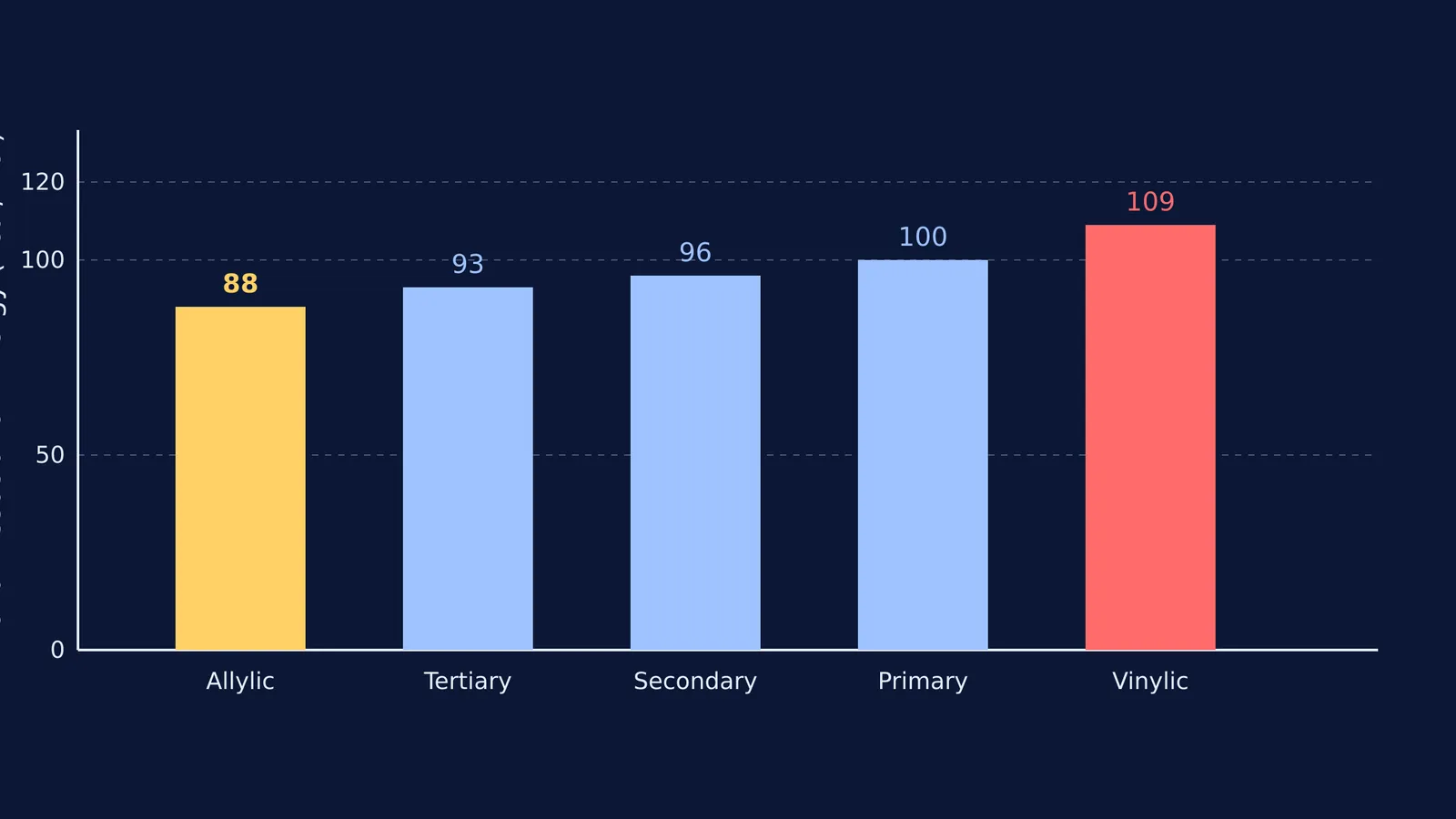
Bromine radicals are highly selective. They abstract the hydrogen atom that is easiest to remove. We measure this using Bond Dissociation Energy (BDE) — the energy required to break the C–H bond homolytically.
According to Master Organic Chemistry, the BDE of a primary alkyl C–H bond is about 100 kcal/mol, a secondary C–H bond is about 96 kcal/mol, and a tertiary C–H bond is around 93 kcal/mol. In contrast, the BDE of an allylic C–H bond is significantly lower, at approximately 87 to 89 kcal/mol. Vinylic C–H bonds, which are directly on the double bond, are much stronger at about 108 to 110 kcal/mol.
This difference exists because the resulting allylic radical is stabilized by resonance. The unpaired electron is delocalized over the adjacent double bond's π system, lowering the energy of the intermediate. Because the allylic C–H bond is the weakest link in the molecule, the bromine radical targets it exclusively.
This is completely different from electrophilic aromatic substitution, such as the bromination of phenol, where the benzene ring itself attacks the bromine.
A checklist for predicting the major product
When you see a reaction asking for the major product of an alkene with NBS, follow these steps:
Find the allylic carbons: Look for the sp³ carbons directly attached to the double bond.
Check for symmetry: If the alkene is not symmetrical, the radical will delocalize over three carbons. Draw the resonance structures of the intermediate radical.
Pick the most stable alkene: Bromine can attach to either end of the delocalized radical. The major product is usually the one that results in the most substituted, most stable double bond, following Zaitsev's Rule.


