

On this page
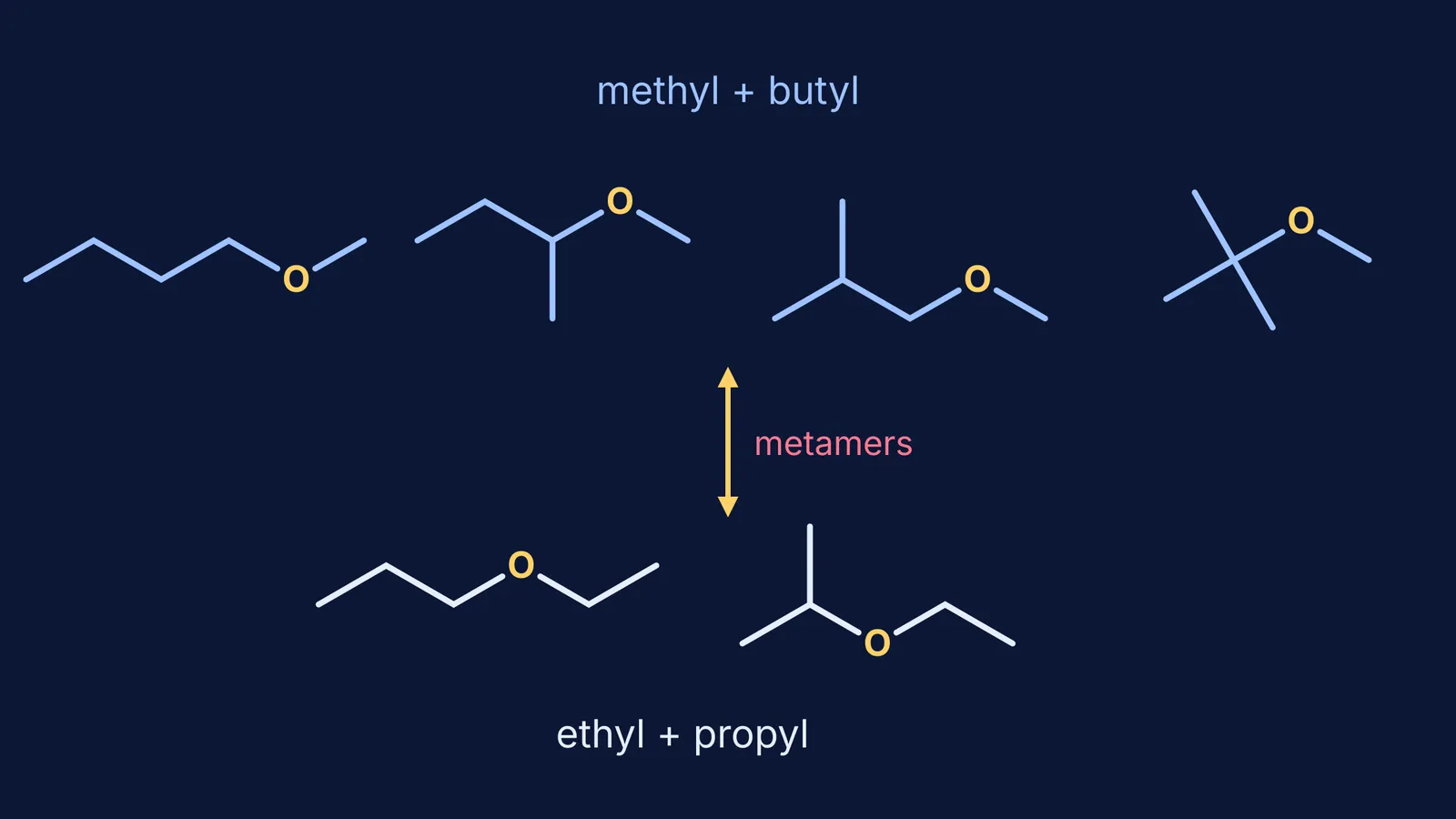
"Write all the ether isomers of C5H12O" is a common school and JEE-style question. Marks go in two ways: a missed branched butyl group, or the same molecule drawn twice from opposite ends. Here is the full list, with both names and the metamer pairs.
Why does C5H12O have exactly six ethers?
An ether is R–O–R′, with two carbon groups bonded to one oxygen atom. In C5H12O those two groups share five carbons, and each side needs at least one. So there are only two ways to split them:
1 + 4: a methyl group and a butyl group
2 + 3: an ethyl group and a propyl group
A split of 3 + 2 or 4 + 1 is the same molecule read from the other end, so it adds nothing new.
Now count the shapes each group can take. Methyl and ethyl have one shape each. Propyl has two: n-propyl and isopropyl. Butyl has four: n-butyl, sec-butyl, isobutyl and tert-butyl. If the prefixes iso, sec and tert are hazy, our guide to what iso, neo, sec and tert mean in organic names covers them.
That gives 4 × 1 = 4 methyl butyl ethers and 2 × 1 = 2 ethyl propyl ethers: six in all.
What are the IUPAC and common names of all six?
For the common name, you name the alkyl groups bonded to oxygen in alphabetical order and add the word "ether". For the IUPAC name, the smaller group becomes the alkoxy substituent and the larger group gives the parent alkane. Both rules are set out in LibreTexts' guide to naming ethers. For a longer walk through the IUPAC rule, see how to name ethers as alkoxy alkanes.
Family A: methyl + butyl (CH3–O–C4H9)
CH3CH2CH2CH2–O–CH3: 1-methoxybutane, common name butyl methyl ether (n-butyl methyl ether).
CH3CH2CH(CH3)–O–CH3: 2-methoxybutane, common name sec-butyl methyl ether.
(CH3)2CHCH2–O–CH3: 1-methoxy-2-methylpropane, common name isobutyl methyl ether.
(CH3)3C–O–CH3: 2-methoxy-2-methylpropane, common name tert-butyl methyl ether, often written MTBE.
Family B: ethyl + propyl (C2H5–O–C3H7)
CH3CH2CH2–O–CH2CH3: 1-ethoxypropane, common name ethyl propyl ether.
(CH3)2CH–O–CH2CH3: 2-ethoxypropane, common name ethyl isopropyl ether.
Each PubChem entry linked above gives the molecular formula as C5H12O and the IUPAC name used here.
Which C5H12O ethers are metamers?
Metamers have the same formula and the same functional group, but the carbon chains attached to it differ. Wikipedia's page on metamerism in chemistry) calls it an older term that IUPAC does not recognise, and says the examples cited in the literature are mainly ethers.
In Indian school and JEE questions, the usual test is the carbon split around the oxygen. If the split changes, from 1 + 4 to 2 + 3, the two ethers are metamers. If the split stays the same and only the branching or the point of attachment changes, they are called chain or position isomers.
That makes every Family A ether a metamer of every Family B ether. These are the eight pairs:
1-methoxybutane and 1-ethoxypropane
1-methoxybutane and 2-ethoxypropane
2-methoxybutane and 1-ethoxypropane
2-methoxybutane and 2-ethoxypropane
1-methoxy-2-methylpropane and 1-ethoxypropane
1-methoxy-2-methylpropane and 2-ethoxypropane
2-methoxy-2-methylpropane and 1-ethoxypropane
2-methoxy-2-methylpropane and 2-ethoxypropane
If a question asks for just one metamer pair, the cleanest answer is the two straight-chain ethers: 1-methoxybutane (methyl n-butyl ether) and 1-ethoxypropane (ethyl n-propyl ether). Pairs from the same family, such as 1-methoxybutane and 2-methoxybutane, keep the 1 + 4 split, so they are not metamers under this test. Definitions vary between books, so if a question gives an example pair, follow the definition it uses.
How do you check your answer for duplicates?
Run this five-step check on any "ethers of CnH2n+2O" question before you move on:
List the carbon splits around the oxygen, from 1 + (n − 1) up to the halfway point.
For each side, write down every shape that alkyl group can take.
Multiply the shapes on each side for every split. If both sides have the same number of carbons, count unordered pairs only.
Name each ether with the smaller group as the alkoxy part. Two drawings with the same IUPAC name are one compound.
Mark the metamers. Pick one ether from each split and pair them across splits.
For C5H12O, step 3 gives 4 + 2 = 6. Step 4 catches the usual slip: CH3CH2–O–CH2CH2CH3 and CH3CH2CH2–O–CH2CH3 both come out as 1-ethoxypropane.
If you keep drawing an isomer twice, check steps 2 and 4. The Fermi Problem Library has worked problems with a step-by-step solver that explains the reasoning, so you can see where your count went wrong. If alkyl groups or isomer types still feel shaky, the Fermi Concept Library has a lesson on each concept in chemistry.
The same formula also gives alcohols, which are functional isomers of these ethers. For the other half of this question, see the eight alcohol isomers of C5H12O.


