

On this page
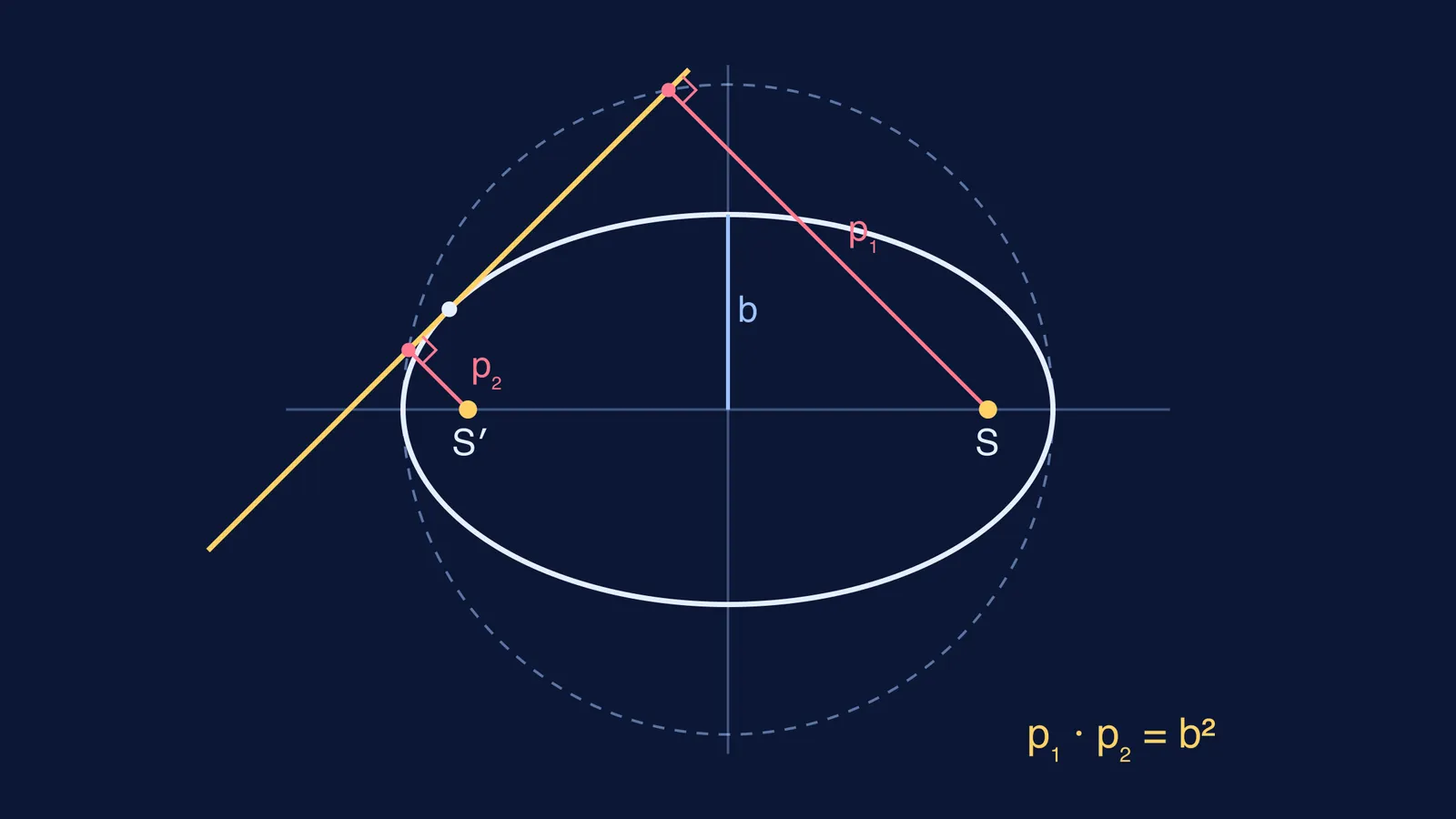
Pick any tangent to an ellipse, drop a perpendicular onto it from each focus, and multiply the two lengths. You always get the same number: b², the square of the semi-minor axis. It is a standard result in the conics chapter you study for JEE Main, and the proof takes five lines once you know the slope form of the tangent.
What is the product of perpendiculars from the foci to a tangent?
Take the standard ellipse x²/a² + y²/b² = 1 with a > b. Its foci are S(c, 0) and S′(−c, 0), where c is the distance from the centre to a focus and c² = a² − b² (Wikipedia: Ellipse). Wolfram MathWorld gives the same relation as b² = a² − c² (MathWorld: Ellipse).
Now draw any tangent. Call the perpendicular distance from S to it p₁, and from S′ to it p₂. The theorem says p₁ · p₂ = b² for every tangent.
How do you prove p₁p₂ = b² using the slope form?
You need two tools: the tangent condition and the distance from a point to a line. A line y = mx + k touches the ellipse exactly when k² = a²m² + b², so every non-vertical tangent can be written y = mx ± √(a²m² + b²) (Wikipedia: Ellipse). If either tool is rusty, read our posts on the condition for a line to touch an ellipse or hyperbola and the perpendicular distance from a point to a line.
Write the tangent as mx − y + k = 0, where k² = a²m² + b².
Distance from S(c, 0): p₁ = |mc + k| / √(1 + m²).
Distance from S′(−c, 0): p₂ = |−mc + k| / √(1 + m²).
Multiply: p₁p₂ = |(k + mc)(k − mc)| / (1 + m²) = |k² − m²c²| / (1 + m²).
Substitute k² and c²: k² − m²c² = a²m² + b² − m²(a² − b²) = b²m² + b² = b²(1 + m²). So p₁p₂ = b²(1 + m²) / (1 + m²) = b².
Because the proof uses only k², it covers both tangents of slope m. It misses the vertical tangents x = ±a, which have no slope, so check them by hand: the foci are a − c and a + c from x = a, and (a − c)(a + c) = a² − c² = b². The theorem holds for every tangent.
Does the product really come to b² on a real ellipse?
Take x²/25 + y²/9 = 1. Here a = 5, b = 3, c² = 25 − 9 = 16, so c = 4 and the foci are (4, 0) and (−4, 0). The theorem predicts p₁p₂ = 9.
Slope m = 1: k = √(25 + 9) = √34, so the tangent is x − y + √34 = 0. Then p₁ = (4 + √34)/√2 ≈ 6.952 and p₂ = (√34 − 4)/√2 ≈ 1.295. The exact product is (34 − 16)/2 = 9.
Slope m = 0: the tangent is y = 3. Both foci sit on the x-axis, so p₁ = p₂ = 3 and the product is 9.
Vertical tangent x = 5: p₁ = 5 − 4 = 1 and p₂ = 5 + 4 = 9, and the product is 9.
The feet of the two perpendiculars also lie on the auxiliary circle x² + y² = a², because the pedal curve of an ellipse taken from a focus is that circle (Wikipedia: Pedal curve). For the m = 1 tangent, the feet are about (−0.916, 4.916) and (−4.916, 0.916). Square and add the coordinates of either one and you get 25.
What mistakes cost marks on this question?
Not converting to standard form first. For 16x² + 25y² = 400, divide by 400 to get x²/25 + y²/16 = 1, so the answer is 16, not 400 or 25.
Using the hyperbola relation. For an ellipse, c² = a² − b², not a² + b². Our post on why c² changes sign between the ellipse and the hyperbola explains the difference.
Answering a² when the major axis is vertical. The product is always the square of the semi-minor axis, whichever letter that is in the given equation.
If you get stuck on a variant of this question, the Fermi Problem Library has worked problems with a step-by-step solver that explains the reasoning rather than printing an answer. To revise tangents and the auxiliary circle, the Fermi Concept Library covers every concept in mathematics, each with its own lesson.
Next step: close this page, take x²/16 + y²/4 = 1 and the tangent of slope 2, and check that the product comes to 4.


