

On this page
Stretch a thick rubber band slowly, then let it come back slowly, measuring the force at each extension. You get two curves, not one. That gap is elastic hysteresis. It explains why tyres cost fuel and why rubber pads sit under heavy machines.
What is elastic hysteresis in rubber?
A US National Academies report on tyres defines hysteresis as "a characteristic of a deformable material such that the energy of deformation is greater than the energy of recovery" (Transportation Research Board, Special Report 286). In plain words: rubber takes more work to stretch than it gives back when it relaxes.
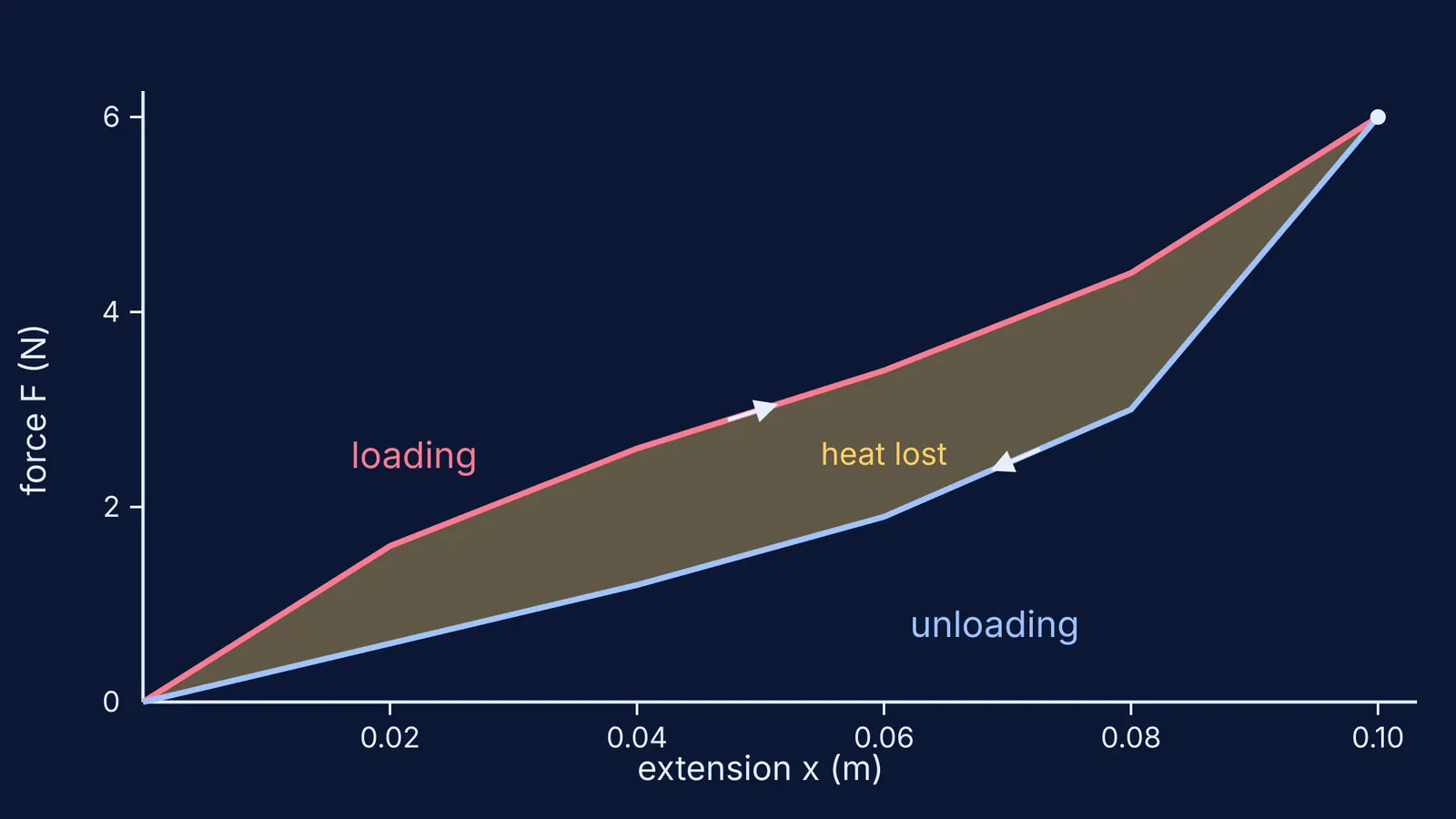
On a force-extension graph, the loading curve (stretching) sits above the unloading curve (relaxing). In the textbook picture, both start at zero and meet at the maximum stretch, forming a closed loop. If these graphs feel shaky, start with our guide to reading the stress-strain curve of a wire.
Why is the area between the loading and unloading curves heat?
The area under a force-extension graph is work. The area under the loading curve is the work you do stretching the rubber. The area under the unloading curve is the work the rubber does on your hand as it returns. The difference, the area enclosed by the loop, is energy that went in and did not come back out.
Rubber is made of long, tangled polymer chains. As they uncoil and slide past each other, internal friction turns part of the mechanical work into heat inside the material. In a classroom experiment published by the sensor maker Vernier, a rubber band was stretched and released on a force sensor, and "there was more force applied during the loading than the unloading of the rubber band, indicating that the system lost energy", visible as the space between the two curves (Vernier). The same experiment found the band did not follow Hooke's law, so neither curve is a straight line.
That instant warming is explained in why a rubber band feels warm when stretched.
Worked example: how much energy does one stretch lose?
Practice readings for a rubber band (invented, not from a study). Each line gives extension, force while stretching, force while releasing:
0.00 m: 0 N, 0 N
0.02 m: 1.6 N, 0.6 N
0.04 m: 2.6 N, 1.2 N
0.06 m: 3.4 N, 1.9 N
0.08 m: 4.4 N, 3.0 N
0.10 m: 6.0 N, 6.0 N
Use the trapezium rule with strip width h = 0.02 m:
Work in (loading): 0.02 x (0/2 + 1.6 + 2.6 + 3.4 + 4.4 + 6.0/2) = 0.02 x 15.0 = 0.30 J.
Work out (unloading): 0.02 x (0/2 + 0.6 + 1.2 + 1.9 + 3.0 + 6.0/2) = 0.02 x 9.7 = 0.194 J.
Energy lost as heat per cycle: 0.30 - 0.194 = 0.106 J, about 35% of the work put in.
The diagram at the top plots these readings, with the lost energy shaded. If the trapezium step is where you slip, the Fermi Problem Library has worked problems with a step-by-step solver that explains the reasoning rather than printing an answer.
Where is rubber hysteresis used in shock absorbers and tyres?
Whether a big loop is good or bad depends on the job the rubber is doing.
Wanted: damping. The loop turns part of every shock into heat instead of bouncing it back. A 2017 study in Engineering Review examined symmetrical rubber buffers on a track-type bulldozer, which are "used in passive damping for the reduction of vibrations", and modelled the heat that builds up in them through hysteresis (Wang and colleagues, Engineering Review). In the simulated earthmoving case, the peak temperature somewhat exceeded the allowed range, so heat build-up matters when such buffers are designed.
Unwanted: rolling resistance. A car tyre is squashed and released on every turn. The Transportation Research Board report says the tyre "dissipates the hysteresis energy loss as heat" and that "hysteresis is the main cause of energy loss associated with rolling resistance" (Special Report 286). For a tyre, a smaller loop is the goal.
Magnetism has the same idea; see hysteresis loops in ferromagnetic materials.
What should you remember for exams?
A quick checklist for board and JEE-style questions on this graph:
For rubber, the loading curve lies above the unloading curve, and they meet at both ends.
Area under the loading curve = work done on the rubber; area under the unloading curve = work recovered.
Loop area = energy lost per cycle as heat.
On a stress-strain graph the loop area is energy per unit volume (J/m3); multiply by volume to get joules.
Rubber does not follow Hooke's law, so find the area instead of using one-half k x squared.
Good shock absorbers want a large loop; tyres and springs want a small one.
If work and area under a graph still feel tangled, the Fermi Concept Library gives every physics concept its own lesson.


