

On this page
Have you ever stretched a rubber band quickly and held it against your lips? If you do, you will feel a distinct burst of heat. Let it snap back to its original shape, and it suddenly feels cold.
This simple party trick is a clear demonstration of thermodynamics in action, specifically a phenomenon known as the Gough-Joule effect.
Who discovered the Gough-Joule effect?
John Gough, a blind English natural philosopher, first recorded this temperature effect in 1805. He discovered it by using his own lips to sense the temperature changes, as his blindness had heightened his sense of touch.
Decades later, James Prescott Joule—the physicist after whom the standard unit of energy is named—studied the phenomenon mathematically in the 1850s. Joule was able to tie the strange behaviour of rubber to the newly emerging laws of thermodynamics, giving the effect its modern name.
Why does a rubber band get warm when stretched?
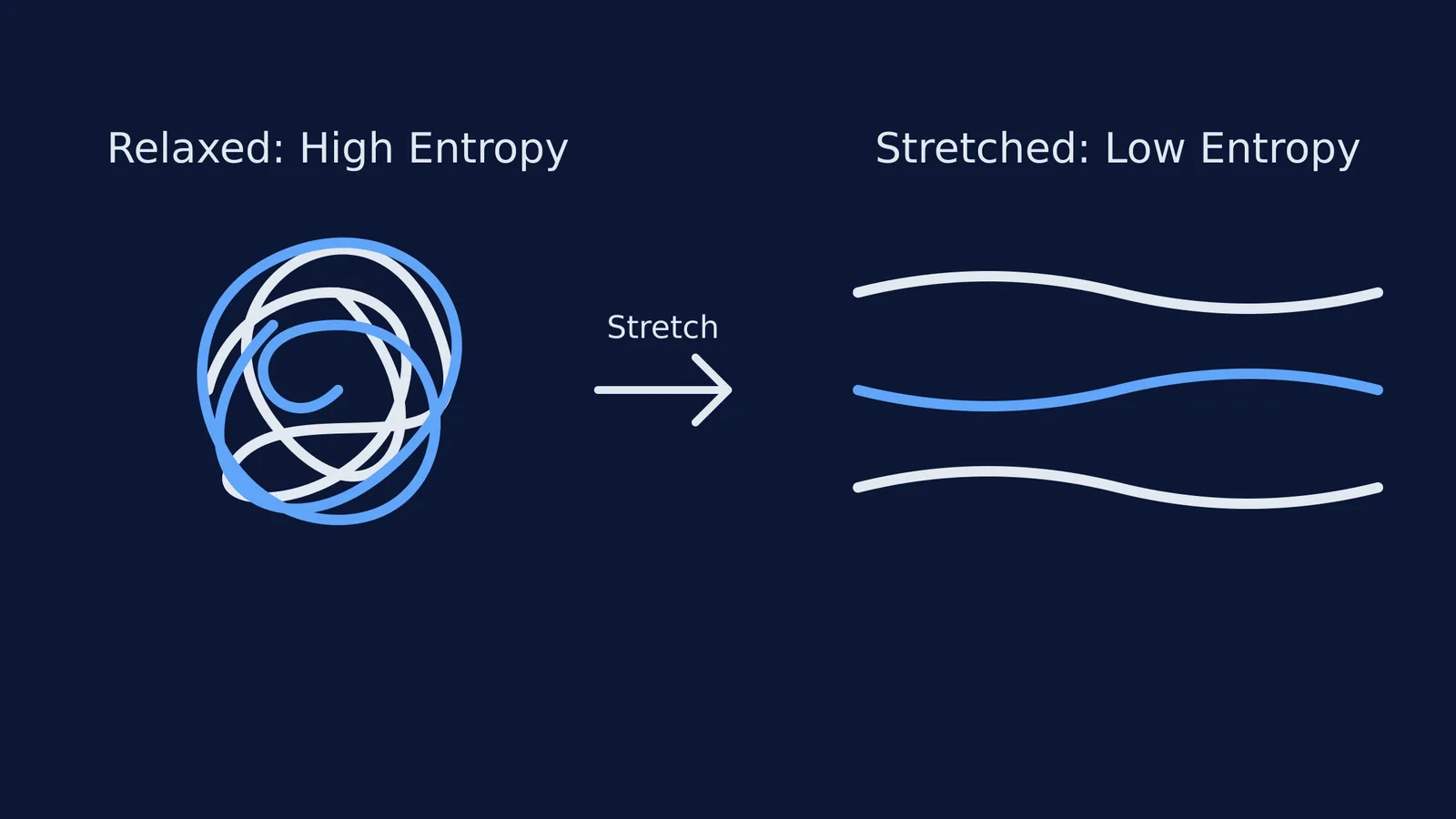
Rubber is an elastomer made up of long, flexible polymer chains. In a relaxed state, these chains are highly tangled and randomly coiled, much like a messy plate of spaghetti. Because the chains are constantly moving and sliding past one another due to natural thermal energy, they naturally adopt the most disordered state possible. In physics, this state of maximum disorder is called high entropy.
When you pull the rubber band, you force these chains to uncoil, straighten out, and align perfectly in the direction of the stretch. Because the chains are now highly ordered and restricted in their movement, the system has far fewer possible configurations. The entropy has drastically decreased.
According to the laws of thermodynamics, energy cannot simply disappear. The mechanical work you do by stretching the band forcefully reduces the internal entropy of the polymer chains, and that energy must be released into the surroundings as heat. If you stretch the rubber rapidly (an adiabatic process), the heat does not have time to dissipate into the surrounding air, and the temperature of the rubber band itself rises.
How does strain-induced crystallization affect temperature?
If you stretch certain types of natural rubber to an extreme degree, the chains align so perfectly that they form temporary, highly ordered crystal lattices.
This phase change, called strain-induced crystallization, releases a significant amount of latent heat. Research shows that while the loss of conformational entropy accounts for some of the warming, the latent heat of crystallization increases the temperature further.
If picturing how heat affects molecular chains is difficult, the Fermi Simulation Lab offers interactive simulations for the ideas that are easier to see than to read. You can watch how temperature changes the random motion of particles and polymers in real time.
Why does a stretched rubber band contract when heated?
Because a rubber band's elasticity is driven by entropy rather than the internal energy of atomic bonds, it behaves backwards compared to most solids when heated.
Usually, heating a solid makes its atoms vibrate and push apart, causing the material to expand. But if you heat a *stretched* rubber band, it actually contracts. Adding thermal energy makes the polymer chains agitate and thrash around more violently. They "want" to return to their natural, high-entropy tangled state. This increased random motion pulls the ends of the chains closer together, increasing the tension and causing the rubber band to shrink.
This is exactly why work in an irreversible expansion and the elastic potential energy in a stretched wire are such distinct concepts. A metal wire stores energy in the stretched bonds between its atoms (enthalpy), while a rubber band stores energy by restricting the shape of its chains (entropy).


