On this page
Every summer the same claim does the rounds online: the Eiffel Tower grows. It is true, and it is a clean example of thermal expansion. You can check it with one line of Class 11 physics, then use the same tower to see why it sways and why it is so light.
Why does the Eiffel Tower grow in summer?
When iron warms, its atoms vibrate harder and sit slightly further apart, so every metre of metal gets a little longer. For a long, thin object, the change in length is given by ΔL = αLΔT, where α is the coefficient of linear expansion, L is the original length and ΔT is the temperature change.
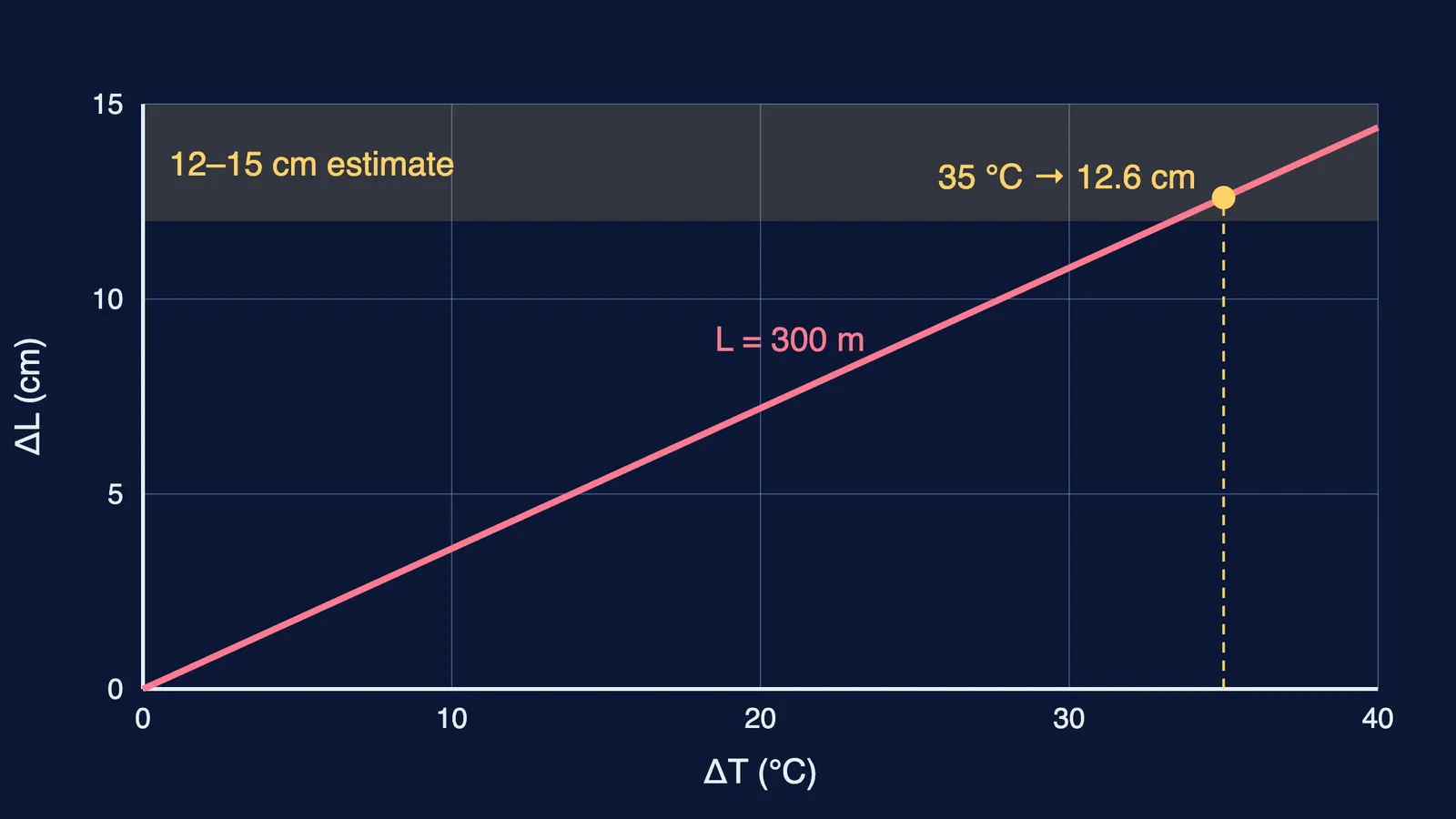
The tower is built from puddled iron, with a coefficient of around 12 × 10⁻⁶ per °C, according to Federico de Isidro Gordejuela's explainer, republished by Phys.org. The same article gives the tower's height as 300 m and reports that specialists estimate it grows between 12 and 15 cm from cold winter days to the hottest days of summer.
There is a second effect. On a sunny day the sun shines on one side of the tower, so that side expands more and the tower curves slightly, as if leaning away from the sun, the Phys.org explainer notes.
How much taller does the Eiffel Tower get in summer?
Write the formula: ΔL = αLΔT.
Put in the numbers: α = 12 × 10⁻⁶ per °C and L = 300 m, the values in the Phys.org explainer.
Choose a temperature change. Suppose the iron goes from 0 °C on a winter morning to 35 °C in summer sun, so ΔT = 35 °C.
Multiply: 12 × 10⁻⁶ × 300 × 35 = 0.126 m, or about 12.6 cm.
Sanity-check: 12.6 cm out of 300 m is about 0.04%. Small, but not nothing.
Our answer lands inside the specialists' 12 to 15 cm range. But the formula assumes all 300 m of iron warms by the same amount at once. A real tower has shaded faces, so the real change can be smaller.
So read numbers carefully. A Snopes fact check republished by Yahoo quotes the tower's official website as saying heat makes it "a few millimeters taller", far less than the specialists' estimate. Snopes says the viral 6-inch figure seems to come from a different line on that site: over a clear day, the sun's movement can make the top of the tower move in a roughly circular curve about 15 cm in diameter. Height change and sideways movement are two different measurements.
The Fermi Simulation Lab has interactive simulations for ideas that are easier to see than to read.
How much does the Eiffel Tower sway in the wind?
Wind can make the top of the tower sway side to side by up to 7 cm, according to Science News Explores.
The shape is a response to wind. Patrick Weidman and Iosif Pinelis analysed the tower's profile in Comptes Rendus Mécanique in 2004, starting from Eiffel's 1885 communication to the French Civil Engineering Society about wind loads. Their abstract quotes Eiffel: "in reality the curve exterior of the tower reproduces, at a determined scale, the same curve of the moments produced by the wind". Their model gives an exponential profile; the real tower follows two exponential curves with different growth rates, which they explain by the wind safety factors Eiffel's company built in.
In plain words: the legs spread out at the bottom, where the turning effect of the wind is largest, and narrow at the top, where it is smallest.
Why does a lattice use so little metal?
A lattice puts iron only where forces travel and leaves the rest open, so wind blows through instead of pushing on a solid wall. The tower has 18,038 pieces of iron held together with 2,500,000 rivets, says the American Society of Civil Engineers.
The result is startlingly light. Its weight of 7,300 tonnes is close to the weight of the air contained within it, around 6,300 tonnes, according to the Phys.org explainer.
Here is a second worked example. Shrink the tower to 30 cm tall, which is 1/1000 of 300 m. Mass scales with volume, so it falls by 1000 × 1000 × 1000. Then 7,300 tonnes, or 7,300,000 kg, divided by 10⁹ is about 7.3 g. John Lienhard of the University of Houston reached a similar answer on his radio programme Engines of Our Ingenuity from a heavier tower weight: an exact one-foot scale model would weigh "only a third of an ounce", about 9 g.
What should you take from this for exams?
Write ΔL = αLΔT and check units before you substitute.
Estimate the size of the answer first: a fraction of a percent for metals over tens of degrees.
State your assumption, such as a uniform temperature, in one line.
For scaling questions, remember that length goes as k, area as k² and volume or mass as k³.
If you want to practise thermal expansion step by step, Fermi's AI tutor works out what you already know, builds a plan for the session and checks your understanding as it goes.