

On this page
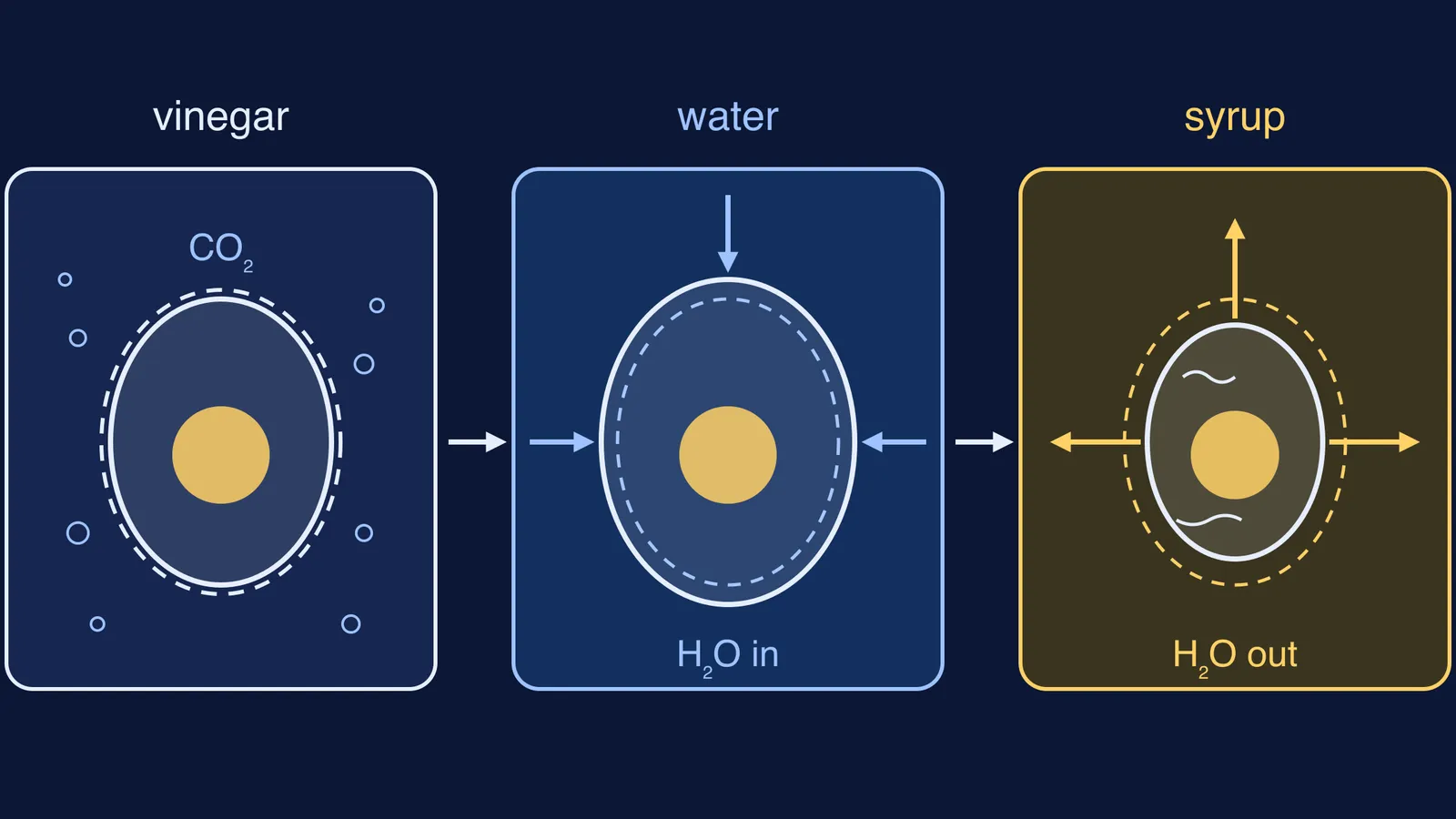
A raw egg left in white vinegar loses its hard shell and becomes a soft, see-through ball. Put that "naked" egg in water and it swells; put it in syrup and it shrivels. It turns a textbook definition of osmosis into something you can weigh on a kitchen scale.
How do you get the shell off an egg with vinegar?
The shell is almost all mineral. A 2023 review in Frontiers in Veterinary Science reports that the mineral layer of an eggshell is 95% minerals, with calcium carbonate making up 93.5% of it. Household white vinegar is usually about 4% acetic acid, says Steve Spangler Science, and the acid reacts with the carbonate:
2 CH3COOH + CaCO3 → Ca(CH3COO)2 + H2O + CO2
The carbon dioxide is the fizz of bubbles on the shell. What remains is the shell membrane. The same Frontiers review describes the inner and outer membranes as layers of fibres made mainly of protein, about 70 μm thick in total.
The method, following Spangler's naked egg instructions:
Put a raw egg in a tall glass or jar and cover it completely with white vinegar.
After the first day, pour the old vinegar away and add fresh vinegar.
Leave it undisturbed. Spangler's version: a full 24 hours in the first vinegar, then 7 more days in fresh. You are done when no hard shell is left.
Rinse the egg gently. Only the membrane holds it together now.
Why does the naked egg swell in water and shrink in syrup?
Osmosis is the flow of water through a semipermeable membrane, as Steve Spangler Science explains in its write-up of this experiment. Water crosses the egg membrane. The proteins inside the egg and the sugar in the syrup mostly stay where they are.
The key numbers come from the AACT soft eggs demonstration: egg white is about 90% water, and corn syrup is about 25% water.
In plain water, there is more water outside the egg than inside, so the net flow is into the egg. It swells and goes firm.
In corn syrup, there is less water outside than inside, so the net flow is out of the egg. It shrivels and goes floppy.
In textbook terms, water is hypotonic to the egg and syrup is hypertonic; see our explainer on isotonic, hypotonic and hypertonic solutions and what happens to cells.
How much vinegar does the shell actually use?
Here is a worked example per gram of shell, using the 93.5% calcium carbonate figure from the Frontiers review and the 4% acetic acid figure from Spangler. Molar masses: CaCO3 100.1 g/mol, CH3COOH 60.1 g/mol, CO2 44.0 g/mol.
1.00 g of shell × 0.935 = 0.935 g of calcium carbonate.
0.935 g ÷ 100.1 g/mol = 0.00934 mol of calcium carbonate.
The equation needs 2 mol of acid per mol, so 0.0187 mol of acetic acid, which is 1.12 g.
At about 4 g of acid per 100 g of vinegar, that is roughly 28 g of vinegar for every gram of shell.
Carbon dioxide released: 0.00934 mol × 44.0 g/mol = 0.41 g per gram of shell.
Weigh a cracked egg's shell and multiply by 28 g to estimate what a whole shell needs; fresh vinegar after day one tops up the acid.
How do you measure the change instead of just looking?
The AACT version measures the length of each egg with a tape measure before and after its soak; this plan adds mass. A plan for home or the school lab:
Pat each naked egg dry and weigh it. Measure the widest part with a string.
Predict for each egg: heavier or lighter, and why.
Put egg A in water and egg B in syrup for about a day, as in the AACT version.
Pat dry and weigh again. Percentage change = (final mass − starting mass) ÷ starting mass × 100. With made-up numbers to show the arithmetic: 60 g to 66 g is a 10% gain.
Then move the shrunken syrup egg into water and record whether it gains mass back.
In your notebook, record what you changed, what you kept the same (time, temperature, egg size) and your readings with units, then explain using "selectively permeable membrane" and "net movement of water". The same mass-change method appears in our guide to finding the percentage of water absorbed by raisins.
If hypotonic and hypertonic still blur together, the Fermi Concept Library has a lesson for every concept in biology and chemistry, with its place in the map. To see water cross a membrane in seconds, try our osmosis simulation that predicts which way water crosses a membrane, or the Fermi Simulation Lab for other ideas that are easier to see than to read.
Start the vinegar soak tonight, and you will have a naked egg to test next week.


