

On this page
The egg drop challenge looks like a craft project, but it is really one equation. The egg arrives with a fixed momentum, and your device decides how long it takes to lose it.
Why does padding stop an egg from breaking?
Impulse is force multiplied by the time it acts, and it equals the change in momentum: F × Δt = Δp. For a given drop, Δp is the same whether the egg lands on concrete or on foam. Only Δt is yours to choose.
Hard floor: the egg stops in a fraction of a millimetre, so Δt is tiny and F is huge. Foam, crumpled paper or a cup of rice: the egg sinks in a few centimetres, Δt grows, and F shrinks in the same ratio. It is the same reason a fielder pulls their hands back while taking a catch.
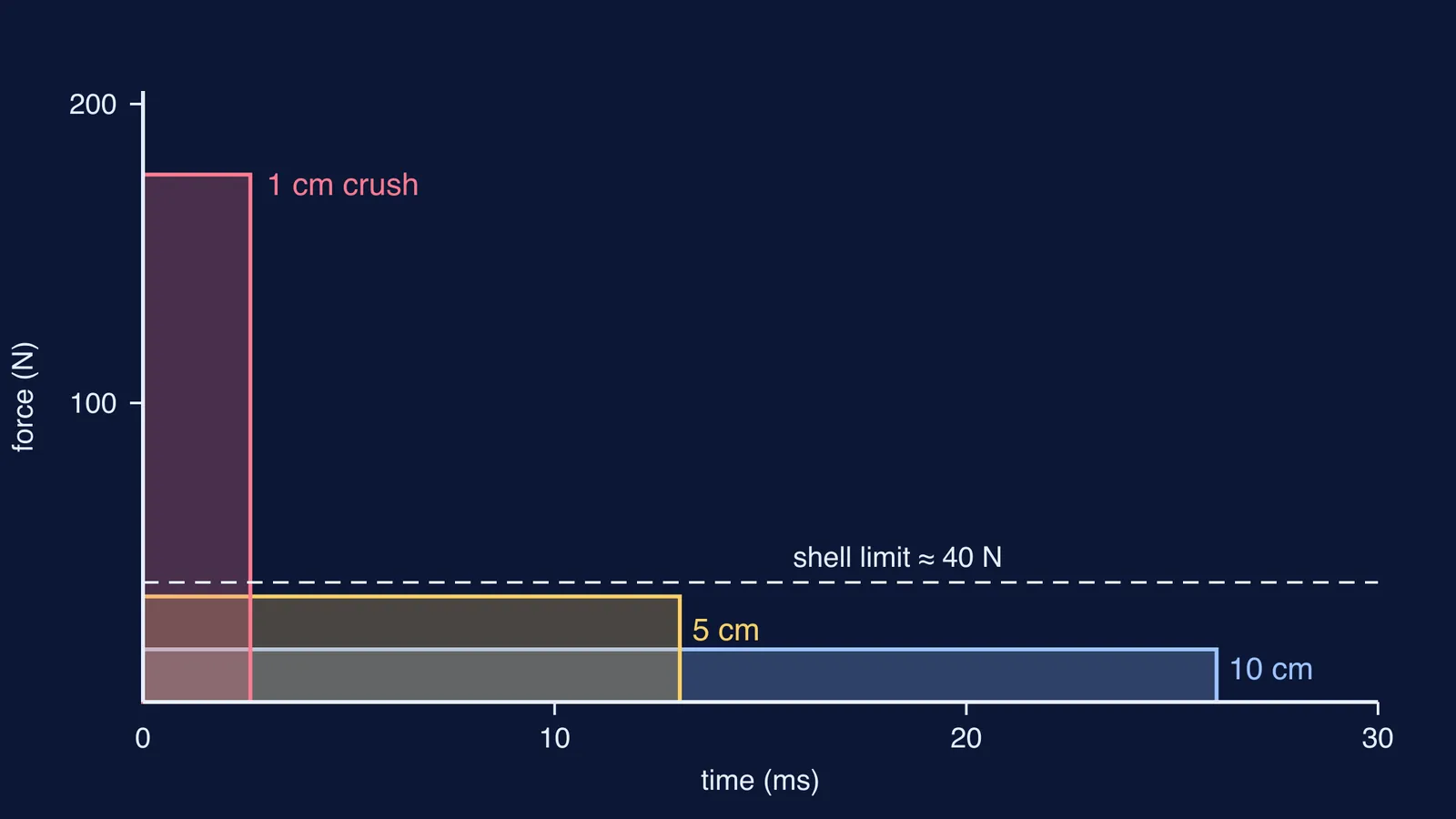
How much force can a shell take? In a 2019 study in the South African Journal of Animal Science, hen eggs squeezed slowly between plates needed an average of 37.68 N to 44.14 N to rupture, depending on how the hens were housed. Treat about 40 N as a rough ceiling. A real impact can concentrate force on one point of the shell, so aim well below it.
How much padding does an egg need? A worked example
Take a 60 g egg dropped from 3 m, about a first-floor balcony. Ignoring air drag, it lands at v = √(2gh) = √(2 × 9.8 × 3) ≈ 7.7 m/s, carrying momentum p = 0.06 × 7.7 ≈ 0.46 kg m/s.
If the padding brings it to rest at a steady rate over a crush distance d, the stopping time is Δt = 2d/v and the average force is F = p/Δt. That gives:
Crush of 1 mm (bare floor): Δt ≈ 0.26 ms, F ≈ 1,760 N
Crush of 1 cm: Δt ≈ 2.6 ms, F ≈ 176 N
Crush of 5 cm: Δt ≈ 13 ms, F ≈ 35 N
Crush of 10 cm: Δt ≈ 26 ms, F ≈ 18 N
The egg's own weight adds only about 0.6 N. The lesson: every centimetre of crush counts.
For the force-time graph, see why a cushion stops an egg breaking.
Does a parachute help in an egg drop?
Yes: it cuts the landing speed, and so the momentum to remove. As NASA explains on its terminal velocity page, when drag equals weight the object stops accelerating and falls at a steady speed, V = √(2W / (Cd ρ A)). NASA's drag equation shows drag grows with the square of speed and directly with area.
From that formula, terminal speed falls as one over the square root of area: doubling the canopy area cuts landing speed by a factor of about 1.4. Suppose your parachute brings the egg in at 3 m/s instead of 7.7 m/s. With the same 5 cm of padding, the average force falls to about 5 N. But a parachute needs height to open, so from a short drop rely on padding. For why air resistance changes the fall time, see does a ball take longer to fall with air resistance.
What is a crumple zone, and how do you build one for an egg?
A crumple zone is a part of a structure designed to collapse on impact so the stop takes longer. According to TÜV NORD's history of vehicle safety, engineer Béla Barényi was granted a patent for the idea in 1952: a yielding front and rear around a strong passenger cell. It first reached series production on the 1959 Mercedes-Benz W 111. Airbags add more stopping time on top, which is covered in how a car airbag inflates in milliseconds.
For an egg, copy the same layout:
A firm inner cell: a paper cup or small box that holds the egg snugly so it cannot rattle.
A soft outer zone below it: straws, folded card or crumpled paper that crush over several centimetres.
No bounce: springy foam can throw the egg up for a second hit, so prefer materials that stay squashed.
Land the right way up: keep weight low and the crumple zone at the bottom so the device does not tip.
How do you test an egg drop design?
Start at 1 m and raise the height in steps until the first crack.
Press a heavy book on your padding and measure how far it squashes; use that d to predict the force.
Change one thing at a time: padding depth, canopy size or cell fit.
Film the landing in slow motion and look for bounces or tipping.
Impulse is easier to see than to read, which is what the interactive simulations in the Fermi Simulation Lab are for. For numericals on impulse and momentum, the Fermi Problem Library has a step-by-step solver that explains the reasoning rather than printing an answer.


