

On this page
How does a car airbag inflate in milliseconds?
In a collision, a vehicle decelerates suddenly. Accelerometers placed throughout the vehicle measure this deceleration continuously. They send this data to the airbag control unit (ACU), which acts as the brain of the system to evaluate if the deceleration is severe enough to warrant deployment. A high-speed crash where the car slides or grazes an object might not trigger deployment, while a lower-speed direct impact might. If the crash meets the threshold, the ACU sends an electrical signal to fire an initiator, often called an electric match, which activates in less than 2 milliseconds (Wikipedia). This entire decision phase takes just 15 to 30 milliseconds (Wikipedia). The igniter then triggers a pyrotechnic chemical reaction that rapidly expands the bag. According to the National Highway Traffic Safety Administration (NHTSA), a frontal airbag inflates in less than 1/20th of a second (NHTSA).
How does sodium azide make nitrogen gas?
The rapid inflation is historically driven by the decomposition of a solid chemical called sodium azide (NaN₃). When heated by the igniter, a small amount of solid sodium azide decomposes almost instantly into sodium metal and nitrogen gas (2NaN₃ → 2Na + 3N₂) (Wikipedia). This primary reaction produces enough nitrogen gas to instantly inflate the folded nylon bag.
Because sodium metal is highly reactive, the system includes potassium nitrate (KNO₃) to neutralise it. This secondary reaction produces even more nitrogen gas and metal oxides (Wikipedia). Finally, silicon dioxide (SiO₂) reacts with the metal oxides to form harmless, glass-like silicates (Wikipedia).
The powdery "smoke" you might see after an airbag deploys is usually cornstarch, talcum powder, or french chalk used to lubricate the bag and help it unfurl smoothly, though older systems may leave residual baking soda (Wikipedia). Modern systems often use guanidine nitrate instead, which breaks down into water vapour, nitrogen gas and carbon (Wikipedia).
Why must an airbag deploy so fast?
In a crash, the occupant continues moving forward at the vehicle's original speed due to inertia. For the airbag to protect you, it must be fully deployed and inflated before you strike the steering wheel, dashboard, or windshield. Frontal airbags are designed to deploy in moderate to severe crashes. This impact threshold is roughly equivalent to hitting a parked car of similar size at 16 to 28 mph (NHTSA).
The timing must be perfectly calibrated. They are typically fully inflated within 60 to 80 milliseconds of the first vehicle contact with the obstacle (Wikipedia). Side-impact airbags inflate even faster, often within 20 to 30 milliseconds, because there is less space between the occupant and the vehicle's side (Wikipedia). Advanced airbag systems even test with dummies representing 12-month-old infants, 3-year-old toddlers, and 6-year-old children to ensure the system can suppress the airbag if a child is seated incorrectly or is too small to withstand the deployment safely (NHTSA).
How does an airbag reduce the force of impact?
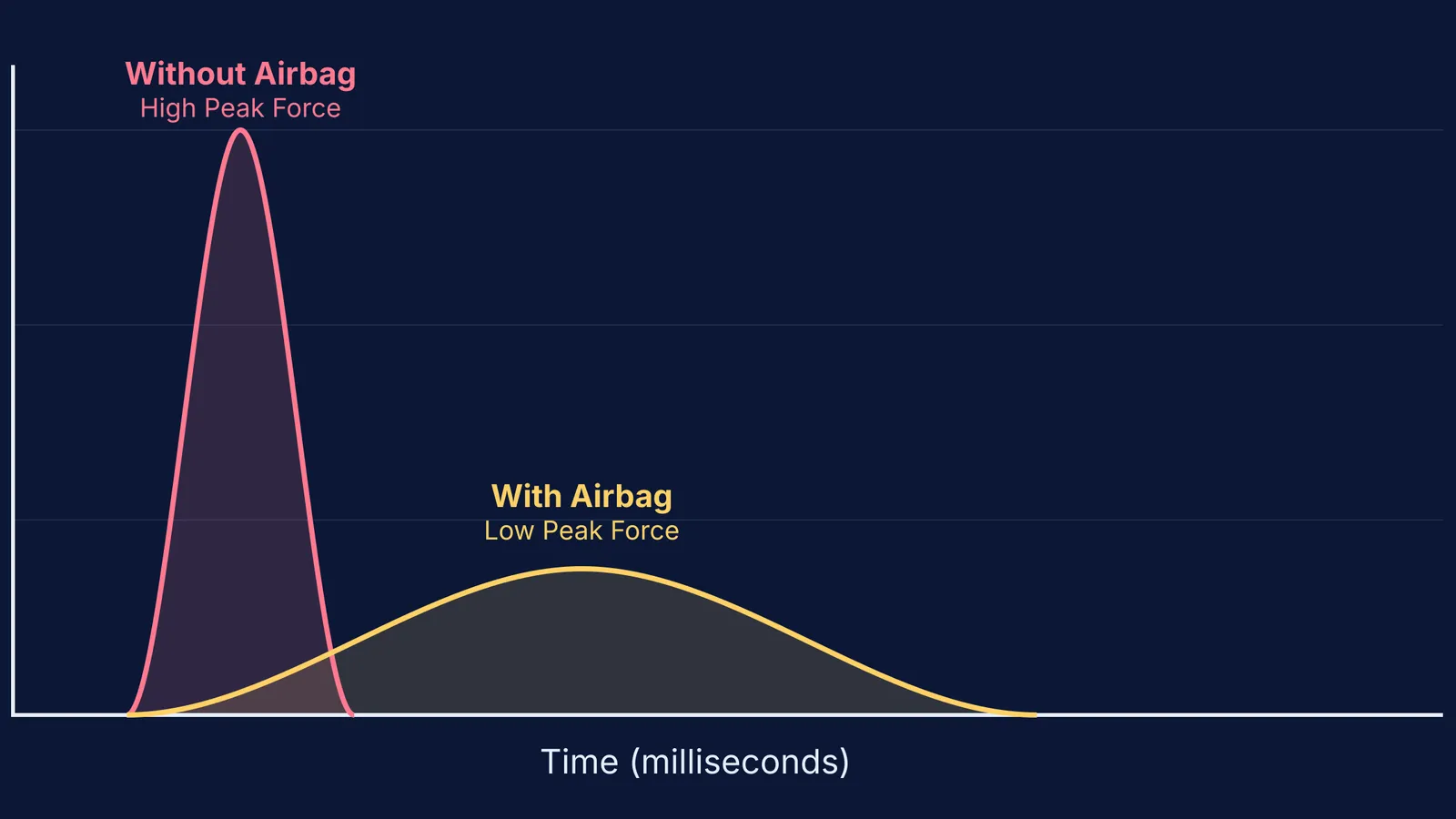
An airbag protects you using the core physics principles of impulse and momentum. According to the impulse-momentum theorem derived from Newton's second law, the change in momentum (Δp) is equal to the average force (F) multiplied by the time interval (Δt) over which the collision occurs.
To safely bring your body to a halt and change your momentum to zero, the airbag dramatically increases the time (Δt) of your deceleration. As your body hits the bag, the nitrogen gas escapes through small vent holes in a controlled deflation (Wikipedia). This critical deflation phase prevents you from simply bouncing off the inflated bag, which could cause severe whiplash. By extending the collision time over which the impact occurs, the peak force applied to your body drops sharply. To see how different forces and times affect momentum, you can explore the interactive simulations in the Fermi Simulation Lab.
Frontal airbags have saved more than 50,000 lives over a 30-year period (NHTSA). Whether you are studying the impulse and force-time graphs of a catch or working through collisions and momentum, the humble airbag is a perfect example of chemistry and physics working together in real time to save lives.


