

On this page
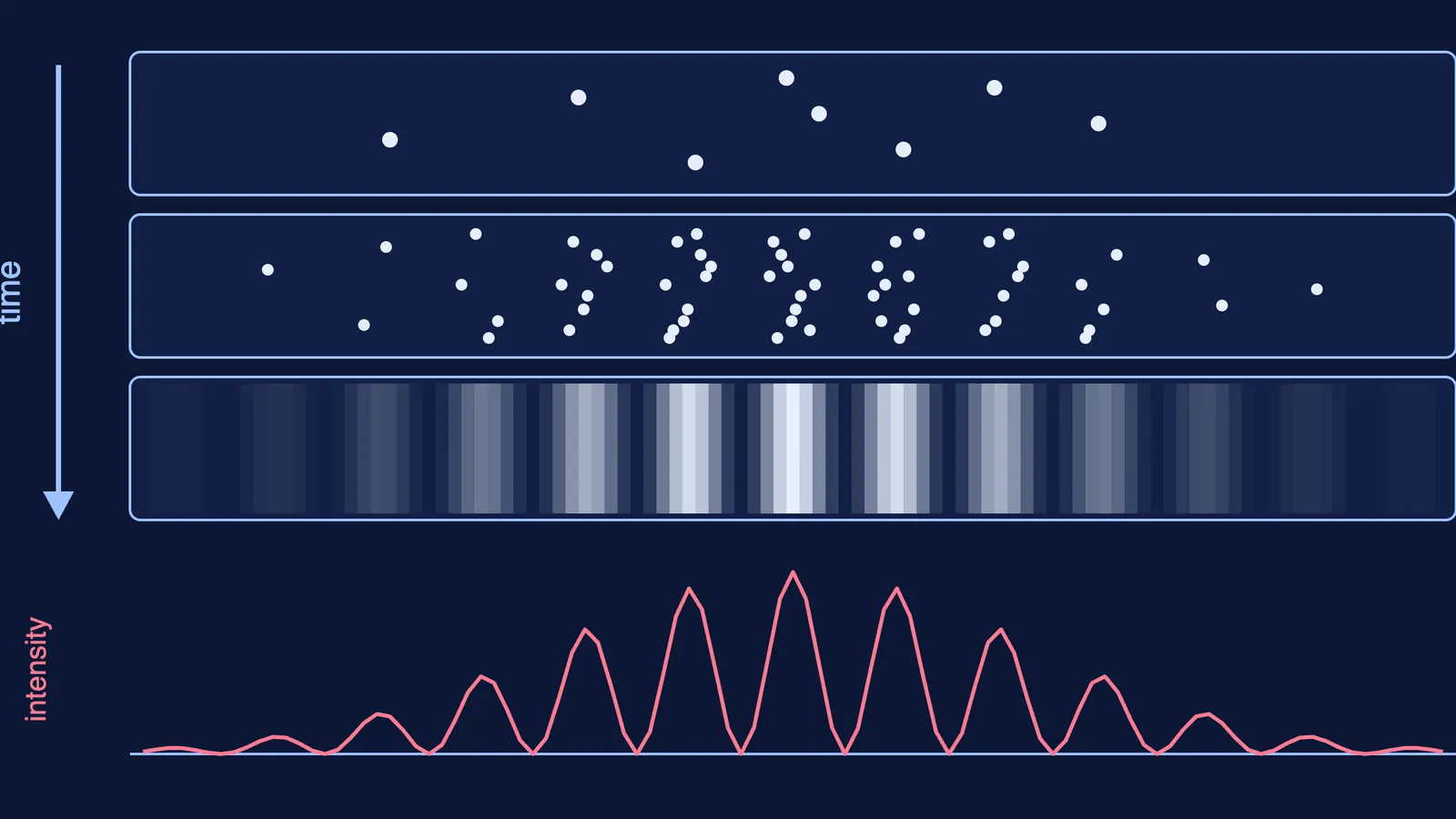
Fire electrons at two narrow openings, one at a time, and each arrives on the screen behind as a single sharp dot. Yet thousands of dots draw bright and dark stripes, the pattern of two overlapping waves. In 1989 a team at Hitachi filmed this happening (Tonomura et al., 1989).
What is the double-slit experiment?
The double-slit experiment sends a beam through two closely spaced openings onto a screen and looks at where it lands. With light, the result is a row of evenly spaced bright and dark fringes: waves from the two slits add up in some places and cancel in others. You meet it as Young's experiment in wave optics, with fringe width β = λD/d; our Young's double slit simulation post has you predict β and then measure it.
The surprise comes with electrons, which we picture as tiny balls. They have a wavelength too, λ = h/p, first confirmed by diffraction from a crystal, which we work through in the Davisson-Germer experiment explained.
What happens when electrons go through one at a time?
Turn the source down so low that only one electron is in the apparatus at any moment. Then:
Each electron lands at one point. It is never smeared out and never split into halves.
Early on, the dots look random.
As dots pile up, they avoid some places and crowd into others, and stripes appear.
Every electron follows the same odds, set by two waves interfering.
What did Tonomura record in 1989?
Akira Tonomura and colleagues at Hitachi's Advanced Research Laboratory and Gakushuin University reported recording "the actual buildup process of the interference pattern with a series of incoming single electrons in the form of a movie" (Tonomura et al., 1989). They used an electron microscope fitted with an electron biprism and a position-sensitive electron-counting system.
The biprism stands in for the two slits. According to Hitachi's description of the experiment, it is two parallel plates with a filament thinner than 1 micron at the centre; electrons pass on both sides of it. The electrons were accelerated through 50,000 V to about 120,000 km per second, with only 10 emitted per second.
Hitachi's build-up figure shows frames with 8, 270 and 2,000 electrons: scattered dots, then hints of order, then visible stripes. A final frame, after 20 minutes of total exposure, shows clear fringes.
Tonomura's team was not the first: Pier Giorgio Merli, GianFranco Missiroli and Giulio Pozzi did double-slit interference experiments with single electrons in Bologna in the 1970s (Physics World, 2002; their 1976 paper). That Physics World article, by its editor Peter Rodgers, reports that more than 200 readers answered Robert Crease's question about the most beautiful experiment in physics, and names Young's double slit applied to single electrons as that experiment.
Worked example: is each electron really alone?
A common objection is that the electrons might interfere with each other. Check it with Hitachi's own numbers:
Rate: about 10 electrons per second, so the average gap between electrons is 1/10 = 0.1 s.
Speed: 120,000 km/s. In 0.1 s an electron covers 120,000 × 0.1 = 12,000 km.
The microscope is about 1 m long, so one flight takes 1 m ÷ (1.2 × 10^8 m/s) ≈ 8 × 10^-9 s, matching Hitachi's "1/100,000,000 of a second".
Compare: 0.1 s ÷ 10^-8 s = 10^7. On average, the next electron sets off about ten million flight-times after the last one landed.
Successive electrons are, on average, about 12,000 km apart inside a 1 m instrument, so each electron's own wave goes both ways around the filament. Even at 1,000 electrons per second, the 1 ms gap would still be about 100,000 flight-times.
How do you write this in an exam answer?
If a board or JEE question asks what the single-electron experiment shows, five lines cover it:
Setup: electrons sent one at a time towards two slits (or a biprism) and a detecting screen.
Observation: each electron is recorded as one localised dot.
Build-up: thousands of dots form an interference pattern of fringes.
Inference: electrons spread like waves (λ = h/p) and are detected like particles; the pattern gives the probability of where each one lands.
Evidence: Tonomura and colleagues filmed this build-up in 1989.
Mistakes to avoid:
Saying the electron splits in half. Every detection is one whole electron.
Saying the electrons interfere with each other. The worked example rules this out.
What should you explore next?
The Fermi Simulation Lab has interactive simulations for ideas that are easier to see than read. If wave-particle duality is one of several gaps before your exam, Fermi's AI tutor can work out what you already know and build a plan for the session. Curious where single-particle quantum behaviour leads? Read our simple explanation of qubits.


