

On this page
A double inequality packs two conditions into one line, such as −4 < 2 − 3x ≤ 11. You meet it in Class 11 linear inequalities and in JEE Main questions about domains. The method is short, and the step that trips people up is dividing by a negative.
What is a double inequality?
OpenStax's Intermediate Algebra 2e defines it plainly: "A double inequality is a compound inequality such as a < x < b. It is equivalent to a < x and x < b." (OpenStax Intermediate Algebra 2e, section 2.6)
So 1 ≤ x < 5 says two things at once: x is at least 1, and x is less than 5.
How do you solve a double inequality step by step?
OpenStax gives the rule: "perform the same operation on all three 'parts' of the double inequality with the goal of isolating the variable in the center." (OpenStax, section 2.6)
OpenStax's College Algebra 2e works through 3 ≤ 2x + 2 < 6 this way: subtract 2 from all three parts to get 1 ≤ 2x < 4, then divide all three parts by 2 to get 1/2 ≤ x < 2, which is the interval 1/2, 2) ([OpenStax College Algebra 2e, section 2.7).
Here is an order that works:
Clear fractions first by multiplying all three parts by a positive denominator.
Add or subtract the constant in all three parts, so only the x-term is left in the middle.
Divide all three parts by the coefficient of x. If that number is negative, reverse both signs.
Rewrite the result with the smaller number on the left.
Write the interval, matching each bracket to its sign.
What happens when you multiply or divide by a negative?
The textbook property is: "If a < b and c < 0, then ac > bc." (OpenStax College Algebra 2e, section 2.7) The same section adds that multiplying or dividing by a negative number "reverses the inequality symbol".
You can see why with plain numbers: 2 < 5, but −2 > −5. A double inequality has two symbols, so both reverse. For all the flip rules in one place, see our guide on when the inequality sign flips.
Worked example: −4 < 2 − 3x ≤ 11
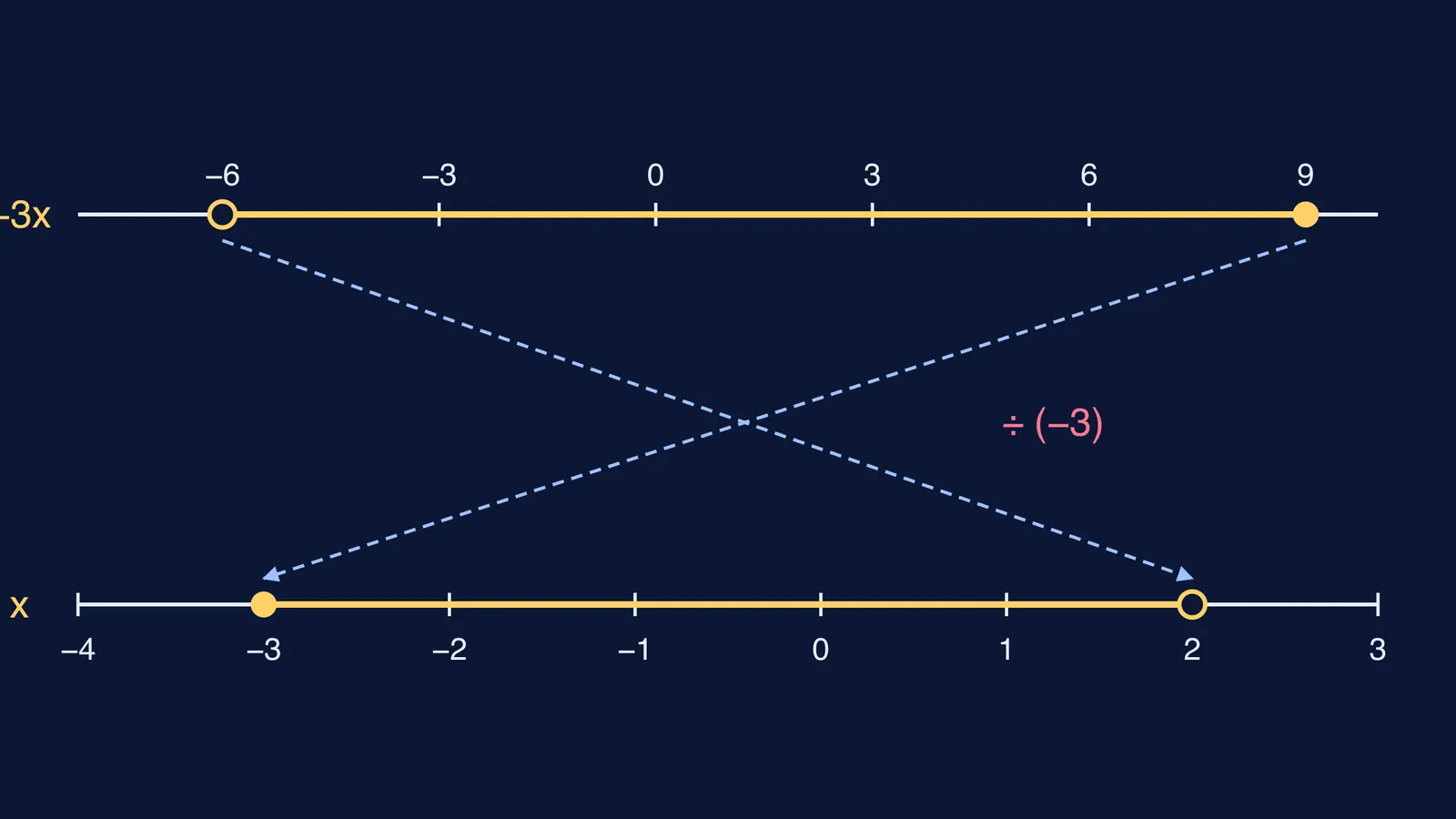
Subtract 2 from all three parts: −6 < −3x ≤ 9.
Divide all three parts by −3 and reverse both signs: 2 > x ≥ −3.
Read it from the smaller end: −3 ≤ x < 2.
Interval: [−3, 2).
Watch the signs. The strict "<" began beside −4 and ended beside 2; the "≤" began beside 11 and ended beside −3. Each sign travels with its number, so 2 gets a round bracket and −3 a square one.
Now check the ends. At x = −3, 2 − 3(−3) = 11, and 11 ≤ 11 is true, so −3 is included. At x = 2, 2 − 3(2) = −4, and −4 < −4 is false, so 2 is left out.
Worked example with a fraction: −5 ≤ (5 − 3x)/2 ≤ 8
Multiply all three parts by 2 (positive, so no flip): −10 ≤ 5 − 3x ≤ 16.
Subtract 5 from all three parts: −15 ≤ −3x ≤ 11.
Divide by −3 and reverse both signs: 5 ≥ x ≥ −11/3.
Rewrite smallest-first: −11/3 ≤ x ≤ 5, so the interval is [−11/3, 5].
How do you write the answer as an interval?
Put the smaller number on the left, always. Use a square bracket for ≤ or ≥, because that end is included. Use a round bracket for < or >, because that end is left out. So −3 ≤ x < 2 becomes [−3, 2), just as OpenStax writes 1/2 ≤ x < 2 as [1/2, 2).
For more on bracket choices, including infinity, read square vs round brackets in interval notation. To draw the same answer with filled and open dots, see how to show a linear inequality on a number line.
A quick check before you move on
Did every step change all three parts?
Did you flip both signs, and only when the number was negative?
Is the smaller number written first?
Does each bracket match its sign: square for ≤ or ≥, round for < or >?
Substitute both endpoints back: the included one should work, the excluded one should fail.
If you keep losing marks at the same step, practise on questions where every move is explained. The Fermi Problem Library has worked problems with a step-by-step solver that explains the reasoning rather than printing an answer, so you can check each step against your own. If inequalities themselves still feel shaky, the Fermi Concept Library gives each mathematics concept its own lesson.
Tonight, try three double inequalities from your textbook, one with a negative coefficient, and run the checklist on each.


