On this page
A two-metre molecule packed inside a nucleus about a millionth of a metre across sounds impossible, but the NCERT Class 12 Biology textbook shows you can check it with one multiplication. The calculation tests two things at once: whether you remember the structure of the double helix, and whether you can handle powers of ten without slipping.
What numbers do you need for DNA length questions?
All three come from Chapter 5, Molecular Basis of Inheritance, in the NCERT Class 12 Biology textbook.
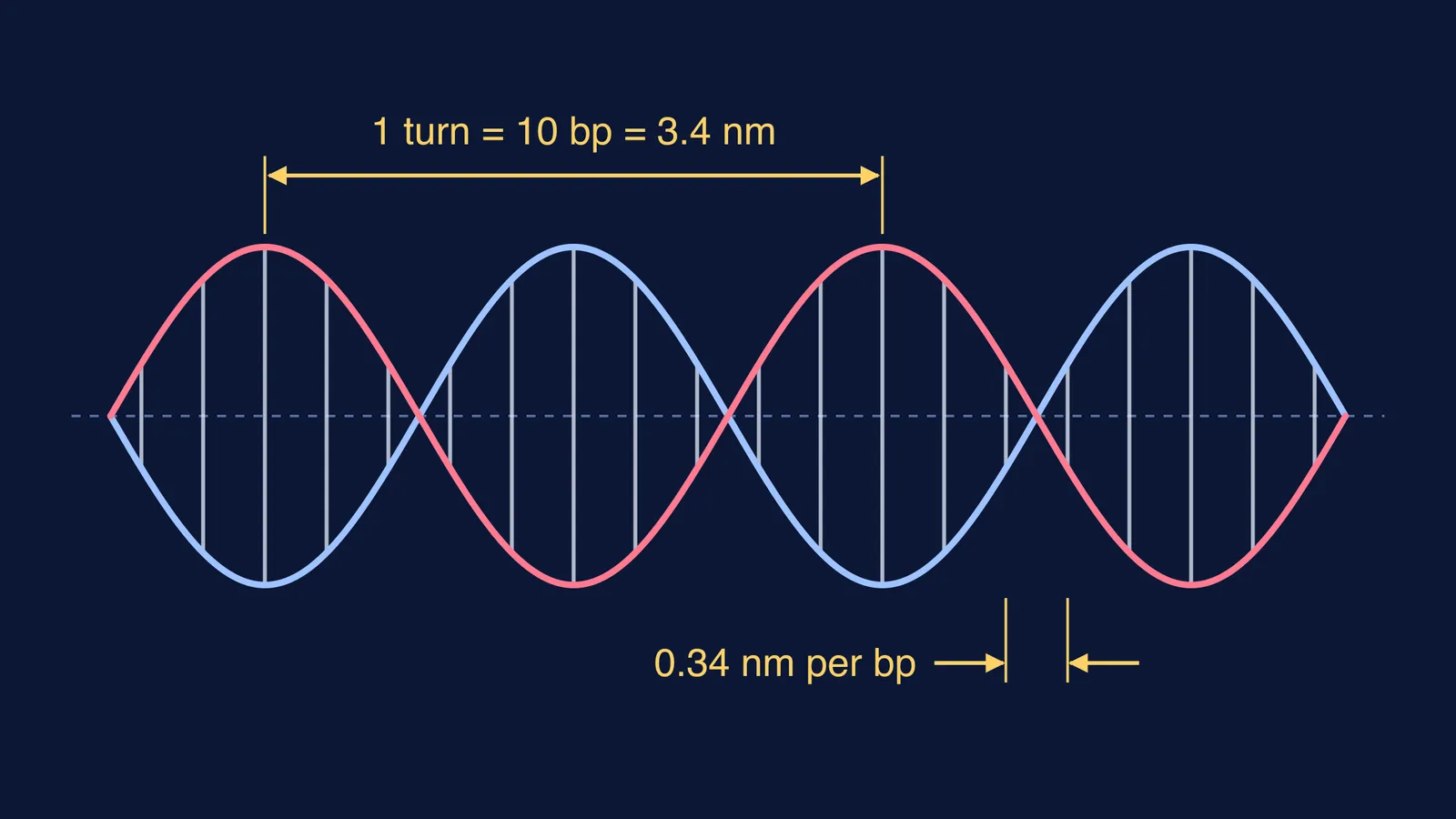
Rise per base pair: the distance between two neighbouring base pairs in the helix is approximately 0.34 nm, or 0.34 × 10^-9 m.
Pitch: one full turn of the helix is 3.4 nm long.
Base pairs per turn: there are roughly 10 bp in each turn, which is why 3.4 nm ÷ 10 = 0.34 nm.
The same chapter gives the haploid content of human DNA as 3.3 × 10^9 bp, and uses 6.6 × 10^9 bp, twice that figure, for a typical mammalian cell.
How do you calculate the length of DNA in a cell?
Here is the calculation the NCERT chapter sets out, written in full so you can copy the layout in an exam.
Write the data: number of bp = 6.6 × 10^9; distance per bp = 0.34 × 10^-9 m.
Multiply the plain numbers: 6.6 × 0.34 = 2.244.
Add the powers of ten: 10^9 × 10^-9 = 10^0 = 1.
Length = 2.244 m, or about 2.2 m.
The textbook compares this with a typical nucleus of about 10^-6 m. Dividing 2.2 m by 10^-6 m tells you the DNA in one cell is about 2.2 million times longer than the nucleus that holds it. That is the reason the chapter goes straight on to packaging: DNA wraps around histone octamers to form nucleosomes, each holding about 200 bp, so a mammalian cell has roughly 6.6 × 10^9 ÷ 200 = 3.3 × 10^7 nucleosomes.
How many turns does the DNA helix make?
Using the NCERT figure of about 10 bp per turn:
Turns = 6.6 × 10^9 ÷ 10 = 6.6 × 10^8.
Check another way: 2.244 m ÷ (3.4 × 10^-9 m) = 0.66 × 10^9 = 6.6 × 10^8.
Use the textbook value of 10 bp per turn unless a question gives you another. If you go further in biology, you will meet a more precise figure: a 1979 study by J. C. Wang in PNAS measured the helical repeat of DNA in solution as 10.4 ± 0.1 bp per turn under physiological conditions, against 10.0 bp per turn for the B-form measured in fibres.
Three more worked examples to practise
Cover the answers and try each one first. The data are from the NCERT chapter.
Bacteriophage lambda, 48,502 bp. Length = 48,502 × 0.34 nm = 16,490.68 nm, about 16.5 µm. Turns = 48,502 ÷ 10, about 4,850.
E. coli, working backwards. The textbook asks: if E. coli DNA is 1.36 mm long, how many base pairs does it have? bp = 1.36 × 10^-3 m ÷ 0.34 × 10^-9 m = 4 × 10^6 bp. That gives 4 × 10^5 turns.
Human haploid set, 3.3 × 10^9 bp. Length = 3.3 × 10^9 × 0.34 × 10^-9 m, about 1.1 m, exactly half the diploid answer.
The same chapter lists E. coli as 4.6 × 10^6 bp elsewhere, so the two figures do not quite match. In an exam, use the numbers the question gives you.
What mistakes cost marks in DNA length numericals?
Run through this checklist before you write the final answer. The figures are from the NCERT chapter.
Haploid or diploid? 3.3 × 10^9 bp gives about 1.1 m; 6.6 × 10^9 bp gives about 2.2 m. Read which one the question means.
Nanometres to metres. 1 nm = 10^-9 m. Forgetting this gives an answer a billion times too big.
Base pairs or nucleotides? NCERT gives bacteriophage φX174 as 5,386 nucleotides, not base pairs. Check the unit before you multiply.
Millimetres in reverse questions. 1 mm = 10^-3 m. Convert before you divide.
Units in the answer. Give the length in m, mm or µm, and give turns as a plain number with no unit.
If the arithmetic is fine but the biology behind it feels shaky, such as why base pairing keeps the helix a constant width, or what a nucleosome is, the Fermi Concept Library has a lesson for each concept in biology, chemistry, physics and mathematics, each placed in its map. For more practice with scientific notation and unit conversion, the Fermi Problem Library has worked problems with a step-by-step solver that explains the reasoning rather than printing an answer.