

On this page
When rain cuts a one-day match short, you cannot just ask the chasing side to score at the same rate in fewer overs. The ICC formally adopted the Duckworth-Lewis-Stern (DLS) method to set a fair revised target when weather interrupts a match. Here is how it works, with two targets you can check with a pencil.
Who invented the DLS method?
Frank Duckworth and Tony Lewis set out the method in the Journal of the Operational Research Society in 1998, in a paper titled A fair method for resetting the target in interrupted one-day cricket matches. According to Wikipedia's history of the method, it was first used in an international in 1997, adopted officially by the ICC in 1999, and renamed in November 2014 after the Australian statistician Steven Stern became its custodian. Stern described his update in 2016 in The Duckworth-Lewis-Stern method: extending the Duckworth-Lewis methodology to deal with modern scoring rates.
How does the DLS method work?
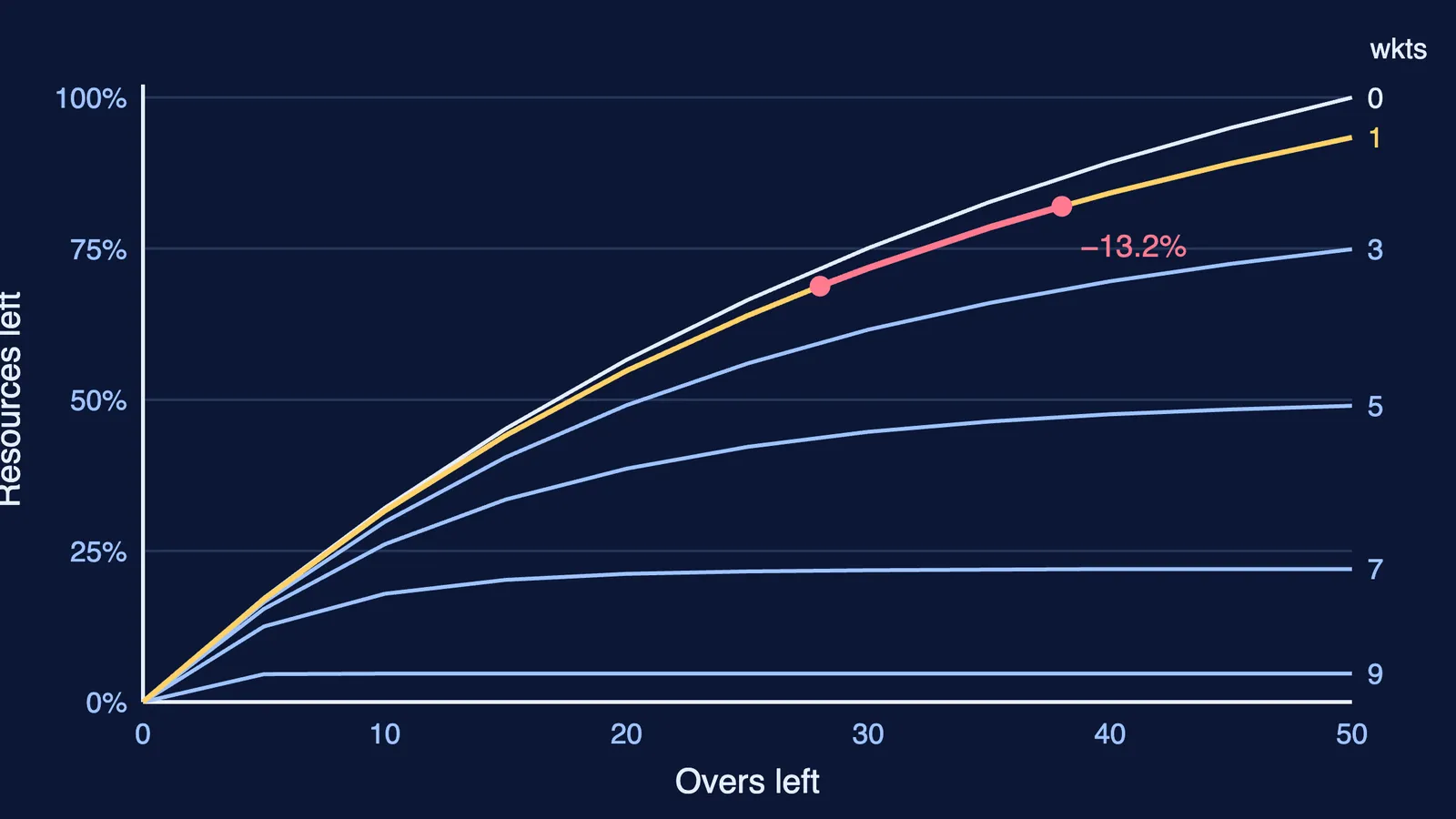
The key word is resources. The ICC's methodology document says a side's run-scoring resources are not in direct proportion to the overs left; they depend on how many overs are to go and how many wickets are down.
A side starting a 50-over innings with all ten wickets has 100% of its resources. Every over bowled and every wicket lost uses some up. The ICC's Standard Edition table lists what is left for every combination: with 25 overs left and no wickets down, a side still has 66.5% of its resources, not 50%.
Half the overs with all ten wickets is worth more than half an innings, because batters with wickets in hand can take more risks.
Behind the table sits an exponential curve. The original model, as Wikipedia summarises it, is Z(u, w) = Z0(w)(1 − e^(−b(w)u)), where u is overs left, w is wickets lost, Z0 is the average total a side would reach with unlimited overs and b is a decay constant. If you have solved exponential growth numericals, this uses the same exponential function, but here the curve rises and levels off as u grows.
How is a rain-reduced target calculated?
Here is Example 3 from the ICC's methodology document, step by step. Team 1 scores 250 in a full 50 overs, so R1 = 100%. Team 2 reach 40 for 1 after 12 overs, then rain costs 10 overs.
At the stoppage: 38 overs left, 1 wicket down. The table gives 82.0%.
At the restart: 28 overs left, still 1 wicket down. The table gives 68.8%.
Resources lost: 82.0 − 68.8 = 13.2%.
Team 2's resources: R2 = 100 − 13.2 = 86.8%.
Target: 250 × 86.8/100 = 217, plus 1, gives 218. Team 2 need 178 more from 28 overs.
A plain run-rate fix is different. Team 1 scored 5 runs an over; 40 overs at that rate gives a target of 201. DLS asks for 17 more because Team 2 lost overs but not wickets: with nine wickets in hand for 28 overs, they can attack.
If rain ends the match instead, the ICC compares Team 2's score with the par score, the same calculation without the extra run. Ahead of par, Team 2 win; level, it is a tie; behind it, Team 1 win.
Why do wickets matter as much as overs?
Try one yourself with the same ICC table. Team 1 makes 280 in 50 overs, and rain shortens Team 2's innings to 30 overs before it starts.
Run-rate method: 280 × 30/50 = 168, so the target is 169.
DLS: 30 overs left and no wickets down is 75.1%. 280 × 0.751 = 210.28, which rounds down to 210, so the target is 211.
Now watch the wickets. With 30 overs left, the table gives 75.1% with no wickets down, 44.7% with five down and 11.9% with eight down. A collapse costs far more than a few lost overs.
The same document says the Stern edition, run through the ICC's DLS calculator software, is used in all matches, and the Standard Edition table is the back-up when the software is unavailable. So your table answer is an estimate that can differ from the official figure.
What does DLS teach a maths student?
Proportion: the target scales by R2/R1.
Functions of two variables: resources depend on overs and wickets together.
Rounding rules matter: round down to the par, then add one run.
Modelling: a curve fitted to match data, turned into a table usable under pressure.
For another sports rule that becomes a short calculation, see the probability of winning from deuce in tennis. If the step from percentages to a final answer trips you up, the Fermi Problem Library has worked problems with a step-by-step solver that explains the reasoning rather than printing an answer.
And if a big match lands in exam week, our family plan for watching cricket during exams helps you keep both.


