

On this page
A fraction like (3 + 2i)/(1 − 2i) looks unfinished, and in an exam it is. Examiners expect a single complex number in the form a + ib, with no i left in the denominator. The conjugate gets you there in four lines.
How do you divide complex numbers by multiplying by the conjugate?
The complex conjugate of a + bi is a − bi: you change the sign of the imaginary part and nothing else, as OpenStax College Algebra 2e defines it.
The same OpenStax section sets out division in four steps:
Write the division as a fraction.
Find the conjugate of the denominator.
Multiply the numerator and the denominator by that conjugate.
Simplify. In practice that means using i² = −1 and splitting the result into a real part and an imaginary part.
Multiplying top and bottom by the same thing is multiplying by 1, so the value does not change. Only its appearance does. If you have rationalised a surd like 1/(√3 − 1), this is the same move, and the idea also shows up in limits with square roots, where you rationalise to remove a 0/0.
Why does multiplying by the conjugate work?
OpenStax puts the key fact in one line: a complex number multiplied by its complex conjugate gives a real number (OpenStax College Algebra 2e).
You can see why by expanding it yourself:
(a + ib)(a − ib) = a² − iab + iab − i²b²
The middle terms cancel.
Because i² = −1, the last term becomes +b².
So (a + ib)(a − ib) = a² + b², which is real and never negative.
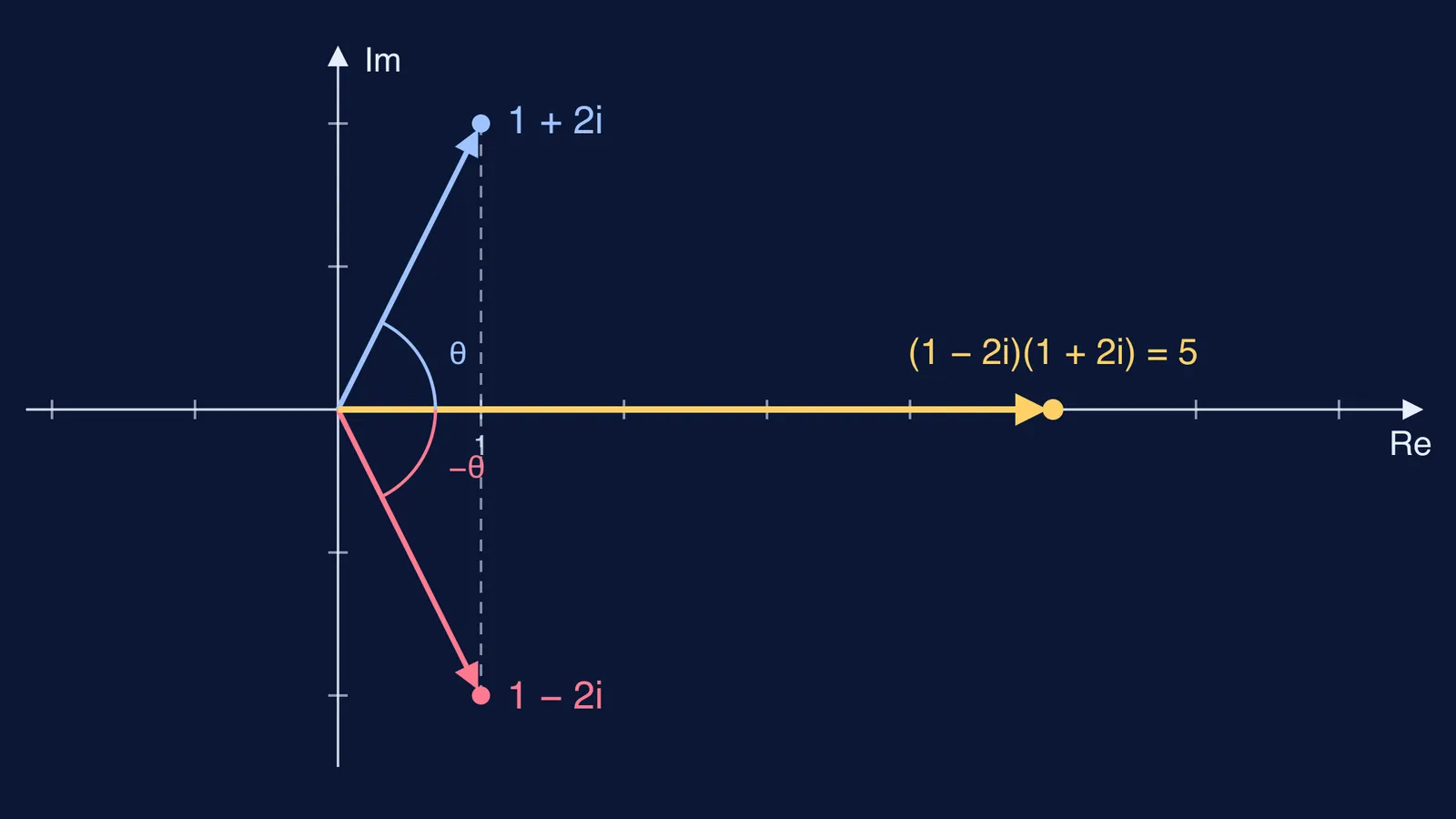
Once the denominator is real, you can divide each part of the numerator by it. On the Argand plane, a + ib and a − ib are mirror images across the real axis. Their angles are equal and opposite, so the angles cancel when you multiply them and the product sits on the real axis.
Worked example: what is (3 + 2i) ÷ (1 − 2i) in a + ib form?
The conjugate of 1 − 2i is 1 + 2i. Multiply top and bottom by it.
Denominator: (1 − 2i)(1 + 2i) = 1² + 2² = 5.
Numerator: (3 + 2i)(1 + 2i) = 3 + 6i + 2i + 4i² = 3 + 8i − 4 = −1 + 8i.
Divide each part: (−1 + 8i)/5 = −1/5 + (8/5)i.
So a = −1/5 and b = 8/5.
If you want to compare with a textbook example, OpenStax works (2 + 5i) ÷ (4 − i) by multiplying by 4 + i, and reaches 3/17 + (22/17)i (OpenStax College Algebra 2e). Try it before you look.
If the denominator has only i in it, such as 5/(2i), the conjugate of 2i is −2i. The denominator becomes (2i)(−2i) = −4i² = 4, and the numerator becomes −10i. The answer is 0 − (5/2)i. A common slip is to write +5i/2 here; the sign flips because 1/i = −i, which comes straight from the cycle of powers of iota.
What are the common mistakes when dividing complex numbers?
Multiplying only the denominator. Whatever you do to the bottom, do to the top, or you have changed the value.
Using the conjugate of the numerator. It is always the denominator's conjugate.
Forgetting that i² = −1. In the example, 4i² must become −4, not +4.
Writing a² − b² in the denominator. That is the surd pattern. With complex numbers the i² turns the minus into a plus.
Stopping at (−1 + 8i)/5. That is correct but not in a + ib form. Split it.
If one of these keeps catching you, it helps to see each line of a solution with the reason for it. The Fermi Problem Library has worked problems with a step-by-step solver that explains the reasoning rather than printing an answer, so you can find the exact line where your working went wrong.
How do you check your answer in under a minute?
Multiply your answer by the original denominator. You should get back the numerator.
For the example: (−1/5 + (8/5)i)(1 − 2i) = −1/5 + (2/5)i + (8/5)i − (16/5)i² = (−1/5 + 16/5) + (10/5)i = 3 + 2i. That matches the numerator, so the answer is right.
A short practice plan for this week:
Day 1: five divisions with integer parts, checking each by multiplying back.
Day 2: five with a pure imaginary denominator, like 5/(2i) or (1 + i)/(3i).
Day 3: five that then ask for the modulus or argument of the result, which leads into writing complex numbers in polar and Euler form.
If the conjugate itself still feels like a rule you are following without knowing why, the Fermi Concept Library has a lesson for every concept in mathematics, each with its place in the map.


