On this page
You were told never to touch a switch with wet hands. Then a Class 8 activity hands you distilled water, the bulb stays dark, and the rule seems to break. It doesn't. Water itself was never carrying the current. Dissolved ions were.
What does the NCERT bulb-and-battery test show?
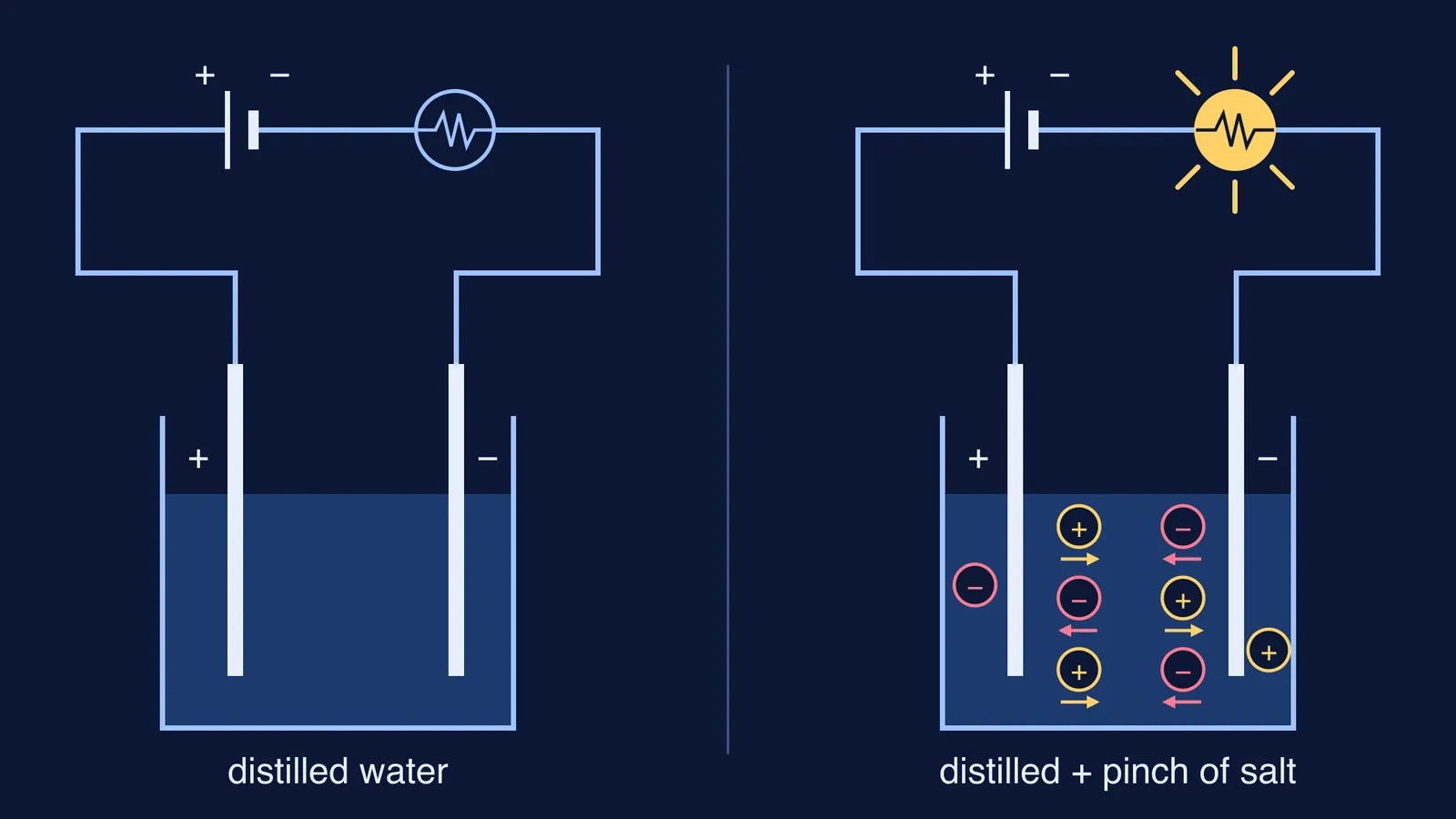
In the NCERT Class 8 chapter “Chemical Effects of Electric Current”, you build a tester from a battery, a small bulb and two wires with free ends. You dip the ends into a liquid, no more than 1 cm apart. If the liquid lets current pass, the circuit is complete and the bulb glows.
Activity 11.4 asks you to test about two teaspoons of distilled water, then dissolve a pinch of common salt in it and test again. The conclusion: salt solution is a conductor of electricity, while distilled water is free of salts and is a poor conductor.
The NCERT Class 10 chapter on acids, bases and salts repeats the idea with a 6 volt battery, a bulb and two nails in a cork (Activity 2.8). Dilute hydrochloric acid lights the bulb; glucose and alcohol solutions do not. NCERT's explanation: the electric current is carried through the acidic solution by ions.
Why does distilled water not conduct electricity?
A current is a flow of charge. In a copper wire, electrons carry it. In a liquid, charged particles (ions) have to move: positive ions drift towards the negative electrode and negative ions towards the positive one.
Distilled water is almost entirely neutral H₂O molecules. According to the NCERT Class 12 electrochemistry chapter, even very pure water has only about 10⁻⁷ M of hydrogen and hydroxyl ions, giving it a very low conductivity of 3.5 × 10⁻⁵ S m⁻¹. That trickle is far too small to heat a bulb filament. To see how few molecules split, work through what fraction of water molecules are ionised at 25 °C.
The US Geological Survey puts it plainly: pure water is an excellent insulator, but even a small amount of ions in water makes it able to conduct electricity.
Why does tap water conduct electricity?
Because it is not pure. The Class 8 NCERT chapter notes that water from taps, hand pumps, wells and ponds may contain several dissolved salts, and that these naturally present mineral salts make it a good conductor. NCERT links this directly to the wet-hands warning: those salts are why you should never handle electrical appliances with wet hands or on a wet floor.
Why does a pinch of salt make the bulb glow?
Common salt is sodium chloride, an ionic compound. When it dissolves, it separates into Na⁺ and Cl⁻ ions that are free to move. Connect the battery and the Na⁺ ions drift towards the negative electrode while the Cl⁻ ions drift towards the positive one, so charge flows all the way round the circuit and the filament heats up.
Here is a worked comparison using NCERT's own figures from the Class 12 electrochemistry chapter:
Very pure water: 3.5 × 10⁻⁵ S m⁻¹.
A dilute 0.01 mol L⁻¹ potassium chloride solution (Table 2.3): 0.141 S m⁻¹.
Divide: 0.141 ÷ 0.000035 ≈ 4,000.
So even this dilute salt solution conducts roughly 4,000 times better than pure water. The same chapter lists the concentration of the electrolyte among the things conductivity depends on: more dissolved salt means more ions per unit volume to carry the current.
One caveat from NCERT: a liquid can conduct while the bulb stays dark, because the current is too weak to heat the filament. The textbook suggests an LED instead, which glows on a weak current. So a dark bulb over tap water does not make tap water an insulator.
Ions drifting in opposite directions are hard to picture from a static figure. The Fermi Simulation Lab has interactive simulations for ideas that are easier to see than to read.
How should you write this in an exam answer?
A strong answer gives the cause (ions), not just the observation. Use this four-step frame:
Current in a liquid is carried by mobile ions.
Distilled water has almost no ions (it is free of dissolved salts), so it is a poor conductor.
Tap water contains dissolved mineral salts that form ions, so it conducts.
Adding salt adds Na⁺ and Cl⁻ ions, which complete the circuit, so the bulb glows.
Common slips to avoid:
Writing “water is a good conductor” with no condition attached.
Saying electrons flow through the water. In the solution, ions carry the charge.
Calling distilled water a perfect insulator. NCERT gives even very pure water a small, measurable conductivity.
Assuming everything that dissolves will conduct. In the Class 10 activity, glucose and alcohol solutions leave the bulb dark.
You can check your own setup with the steps for building a conductor and insulator tester. If “ion” or “electrolyte” still feels fuzzy, the Fermi Concept Library gives each concept in physics, chemistry and biology its own lesson.
Next time someone says “water conducts”, add the part that matters: only water with ions in it.