

On this page
Pure water is not only H₂O. A tiny share of its molecules pass a proton to a neighbour, giving H₃O⁺ (written H⁺ for short) and OH⁻. You can work out that share yourself from two values: Kw and the molarity of water. Here is the calculation, a worked example with a glass of water, and the exam traps.
How do you calculate the fraction of water ionised from Kw?
At 25 °C, the ionic product of water is Kw = [H⁺][OH⁻] = 1.0 × 10⁻¹⁴, according to OpenStax Chemistry 2e, section 14.1. In pure water every H⁺ comes with one OH⁻, so the two concentrations are equal.
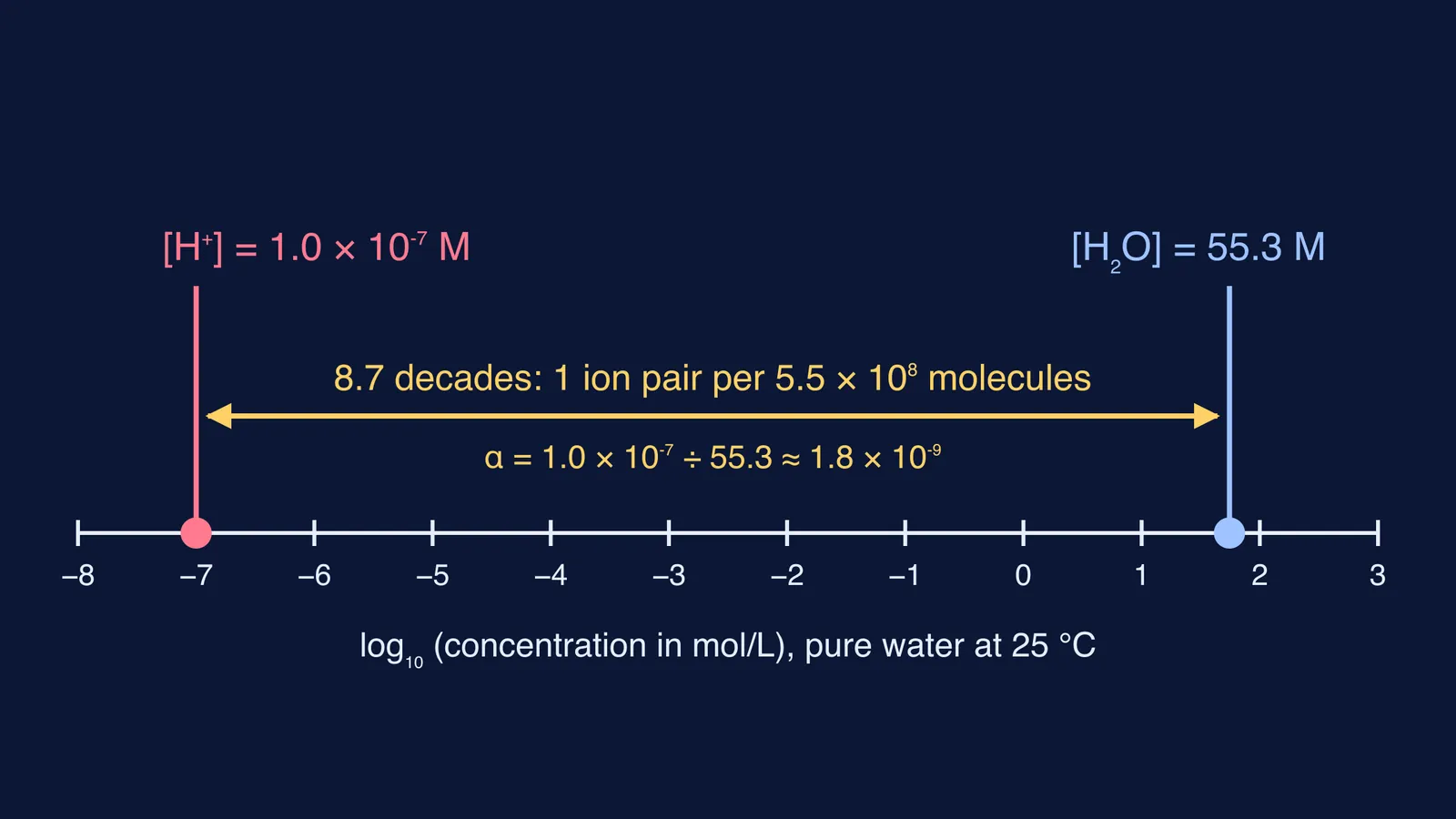
Find [H⁺]: since [H⁺] = [OH⁻], [H⁺] = √Kw = √(1.0 × 10⁻¹⁴) = 1.0 × 10⁻⁷ M.
Find [H₂O]: take one litre of water, find its mass, and divide by the molar mass (next section). This gives about 55.3 M.
Divide: degree of ionisation α = [H⁺] ÷ [H₂O] = 1.0 × 10⁻⁷ ÷ 55.3 ≈ 1.8 × 10⁻⁹.
That is about 1.8 molecules in every billion, which OpenStax rounds to "approximately two out of every billion water molecules" at 25 °C. Flip it over and you get one ionised molecule for roughly every 550 million that stay whole.
Each ionised molecule makes exactly one H⁺, which is why [H⁺] divided by [H₂O] is the fraction. The ions keep forming and recombining, so this is the share ionised at any instant, not a fixed set of molecules.
Why is water 55.3 M and not 55.5 M?
Most books use 55.5 M because they take one litre of water as 1000 g: 1000 ÷ 18 = 55.5. We explain where that number comes from in why the molarity of pure water is 55.5 M.
At exactly 25 °C, though, water is slightly less dense than 1 g/mL. The NIST Chemistry WebBook fluid data gives a density of 0.99705 g/mL at 298.15 K and 1 atm. The molar mass of water is 18.0153 g/mol in the NIST Chemistry WebBook entry for water. So one litre holds 997.05 ÷ 18.0153 ≈ 55.34 mol, or 55.3 M.
Does it matter? Not for the answer: 1.0 × 10⁻⁷ ÷ 55.5 is also 1.8 × 10⁻⁹. Use 55.5 M in exams unless the question gives a density.
How many ions are in a glass of water?
A small fraction of a huge number is still a big number. Take a 250 mL glass of pure water at 25 °C and use the NIST value of the Avogadro constant, 6.02214076 × 10²³ per mol, plus the density and molar mass from the NIST WebBook above.
Mass of water: 250 mL × 0.99705 g/mL ≈ 249.3 g.
Moles of water: 249.3 ÷ 18.0153 ≈ 13.84 mol.
Molecules of water: 13.84 × 6.022 × 10²³ ≈ 8.33 × 10²⁴.
Moles of H⁺: 1.0 × 10⁻⁷ mol/L × 0.250 L = 2.5 × 10⁻⁸ mol.
H⁺ ions: 2.5 × 10⁻⁸ × 6.022 × 10²³ ≈ 1.5 × 10¹⁶.
Check: 1.5 × 10¹⁶ ÷ 8.33 × 10²⁴ ≈ 1.8 × 10⁻⁹, the same fraction. So your glass holds about 15 thousand trillion H⁺ ions and the same number of OH⁻ ions, yet they are outnumbered by water molecules more than 500 million to one. This is also why water's own H⁺ starts to matter in very dilute acids, as in the pH of 10⁻⁸ M HCl.
Does the fraction change with temperature?
Yes, because Kw itself depends on temperature. OpenStax gives Kw ≈ 5.6 × 10⁻¹³ at 100 °C in the same section on autoionisation. Then [H⁺] = √(5.6 × 10⁻¹³) ≈ 7.5 × 10⁻⁷ M, about seven and a half times the value at 25 °C, so the ionised fraction rises by roughly the same factor. Water is still neutral, because [H⁺] still equals [OH⁻]; only the pH of neutral water falls below 7. We work through that in why neutral pH is not always 7.
What mistakes cost marks on this question?
Dividing Kw by 55.5 instead of dividing √Kw. Kw is a product of two concentrations; the fraction needs [H⁺], which is √Kw.
Forgetting the units. α has no units, but [H⁺] and [H₂O] must both be in mol/L before you divide.
Writing a percentage by mistake. 1.8 × 10⁻⁹ as a percentage is 1.8 × 10⁻⁷ %.
Using 10⁻⁷ M at a temperature other than 25 °C. Recalculate √Kw first.
If you keep slipping on steps like √Kw versus Kw, the Fermi Problem Library has worked problems with a step-by-step solver that explains the reasoning rather than printing an answer. To revise Kw, pH and equilibrium as connected ideas, each has its own lesson in the Fermi Concept Library.


