

On this page
How do you check collinearity using the distance formula?
Three points are collinear when they lie along the exact same straight line. In coordinate geometry, you can verify this condition using Euclidean distance without constructing a line equation. Given three distinct points A(x₁, y₁), B(x₂, y₂), and C(x₃, y₃), the distance d between any two points is given by the distance formula:
d = √((x₂ - x₁)² + (y₂ - y₁)²)
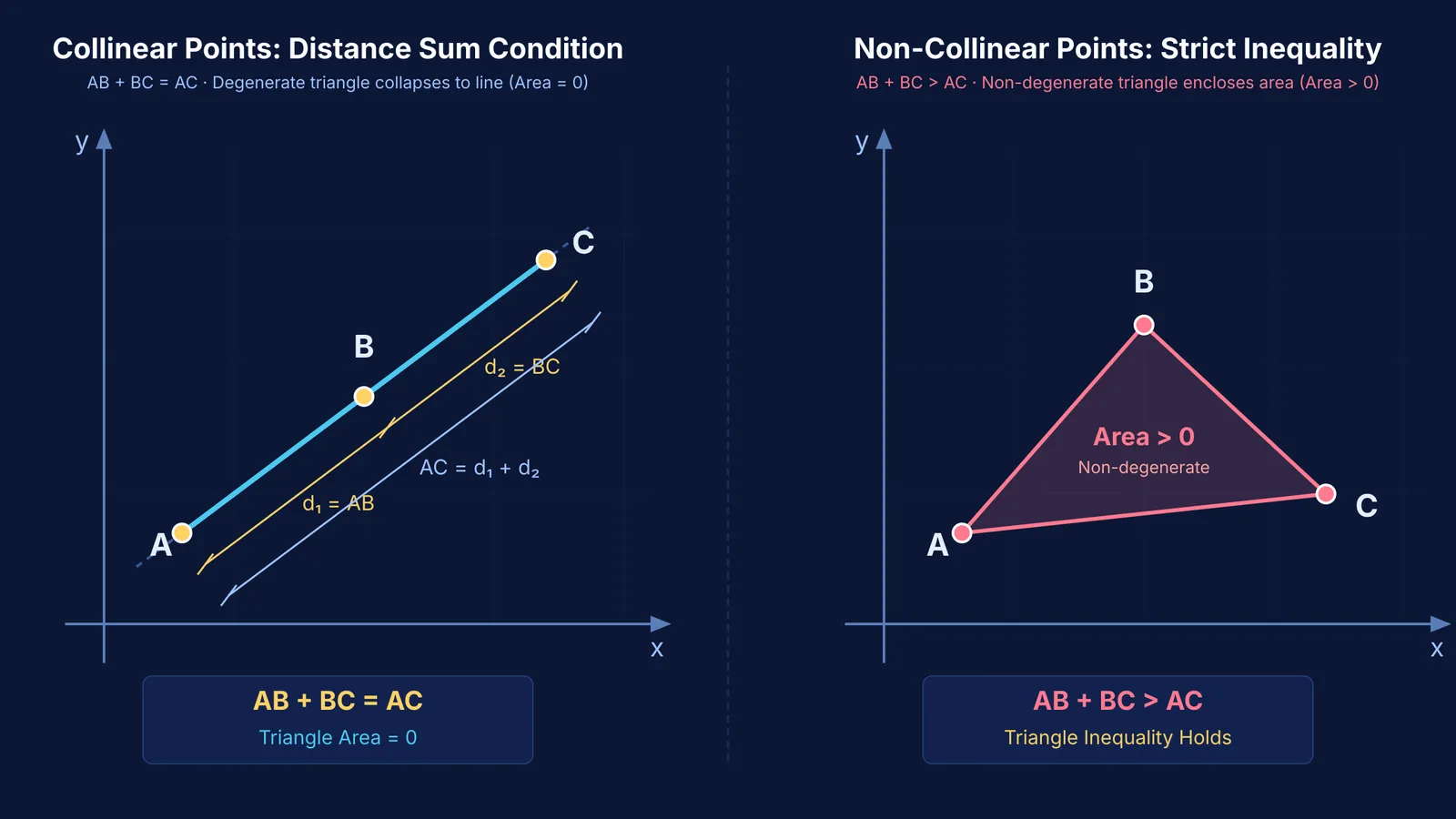
To test collinearity, compute all three pairwise distances: AB, BC, and AC. If the points lie on a line, one point must fall between the other two. The collinearity rule states that three points are collinear if and only if the sum of the two shorter distances equals the longest distance. For example, if AC is the longest distance, the points are collinear if and only if:
AB + BC = AC
This condition represents the degenerate case of the triangle inequality. As Serge Lang and Gene Murrow explain in *Geometry* (Springer), any three non-collinear points form a triangle satisfying the strict inequality AB + BC > AC. The triangle collapses into a single line segment only when equality holds. This concept also underpins classifying triangles with the distance formula.
What is a worked example of checking collinearity with distances?
Consider three points in the coordinate plane: A(1, 2), B(4, 8), and C(6, 12). Using the distance formula, calculate each length:
AB = √((4 - 1)² + (8 - 2)²) = √(9 + 36) = √45 = 3√5
BC = √((6 - 4)² + (12 - 8)²) = √(4 + 16) = √20 = 2√5
AC = √((6 - 1)² + (12 - 2)²) = √(25 + 100) = √125 = 5√5
The two shorter lengths are AB = 3√5 and BC = 2√5, while the longest length is AC = 5√5. Adding the two shorter lengths gives:
AB + BC = 3√5 + 2√5 = 5√5 = AC
Because the sum of the shorter segments matches the longest segment, the points are collinear. By contrast, Exercise 7.1 of the NCERT Class 10 Mathematics textbook asks students to test points (1, 5), (2, 3), and (-2, -11). Their lengths evaluate to √5, 2√53, and √265. Because √5 + 2√53 does not equal √265, they violate equality and form a non-degenerate triangle.
The primary pitfall here is radical arithmetic. Leaving √45, √20, and √125 unsimplified prevents students from recognising like surds, while converting to decimals introduces rounding errors. In an empirical study on student geometry errors published in the Journal of Physics: Conference Series, researchers found that algebraic transformation and process errors account for the majority of student mistakes in geometric problem-solving. When practicing these calculations, the Fermi Problem Library provides worked problems with a step-by-step solver that explains the reasoning rather than printing an answer, helping students verify each radical reduction.
Why is the area method often faster than the distance formula?
While the distance test is intuitive, the coordinate area method is much faster. Three points are collinear if and only if the triangle they enclose has zero area:
Area = (1/2) |x₁(y₂ - y₃) + x₂(y₃ - y₁) + x₃(y₁ - y₂)| = 0
Testing collinearity requires evaluating only the determinant expression:
x₁(y₂ - y₃) + x₂(y₃ - y₁) + x₃(y₁ - y₂) = 0
Applying this to points A(1, 2), B(4, 8), and C(6, 12):
1 × (8 - 12) + 4 × (12 - 2) + 6 × (2 - 8) = 1 × (-4) + 4 × (10) + 6 × (-6) = -4 + 40 - 36 = 0
The area is zero, confirming collinearity in three simple multiplications. The distance test requires six binomial squares, three square roots, and surd simplification. By contrast, the area formula uses only elementary linear operations. For integer coordinates, every step remains integer arithmetic, eliminating radicals entirely. The same straight-line property connects directly to the section formula in Class 10 coordinate geometry.
Which method should you choose in board exams versus competitive tests?
Your method of choice should match your exam context:
Board Exams (CBSE/ICSE): Follow the question prompt strictly. In the official CBSE Secondary Curriculum, Unit III assigns 15 periods to coordinate geometry, focusing on distance and section formulas after curriculum rationalisation. If an exam requests the distance formula, you must show all three lengths and the surd sum to earn full marks.
Competitive Tests (JEE Main): Never compute three square roots under strict time limits. Use slopes or the zero-area determinant to verify collinearity in seconds.
Rough-Work Verification: When writing board solutions, check slopes or the area determinant on rough paper in seconds to confirm collinearity before simplifying surds.
To connect coordinate methods across mathematics, the Fermi Concept Library maps every concept in physics, chemistry, biology, mathematics and computing, each with its own lesson and its place in the map. This foundation helps when solving higher-level problems, such as counting triangles when points are collinear. If you are unsure which coordinate formula to apply, Fermi's AI tutor notices where a student is stuck and decides whether to explain, ask, or show, checking understanding as it goes.


