

On this page
When you place n points on a flat sheet of paper, any three points that do not lie along a single line form the vertices of a triangle. If no three points share a line, selecting three vertices from n points is a straightforward combination: ⁿC₃. But in competitive exams and school mathematics, problems rarely keep points in general position. As soon as a subset of points turns out to be collinear, routine formulas break down unless you adjust for degenerate shapes.
Under the CBSE Senior Secondary Mathematics curriculum, students study combinations as unordered selections and apply them to geometric figures. In the JEE Main mathematics syllabus, counting triangles, lines, and polygons under collinear constraints is a regular algebra feature. Mastering these problems requires understanding how geometric constraints collapse combinatorial outcomes.
Why does the formula nC3 − mC3 work for collinear points?
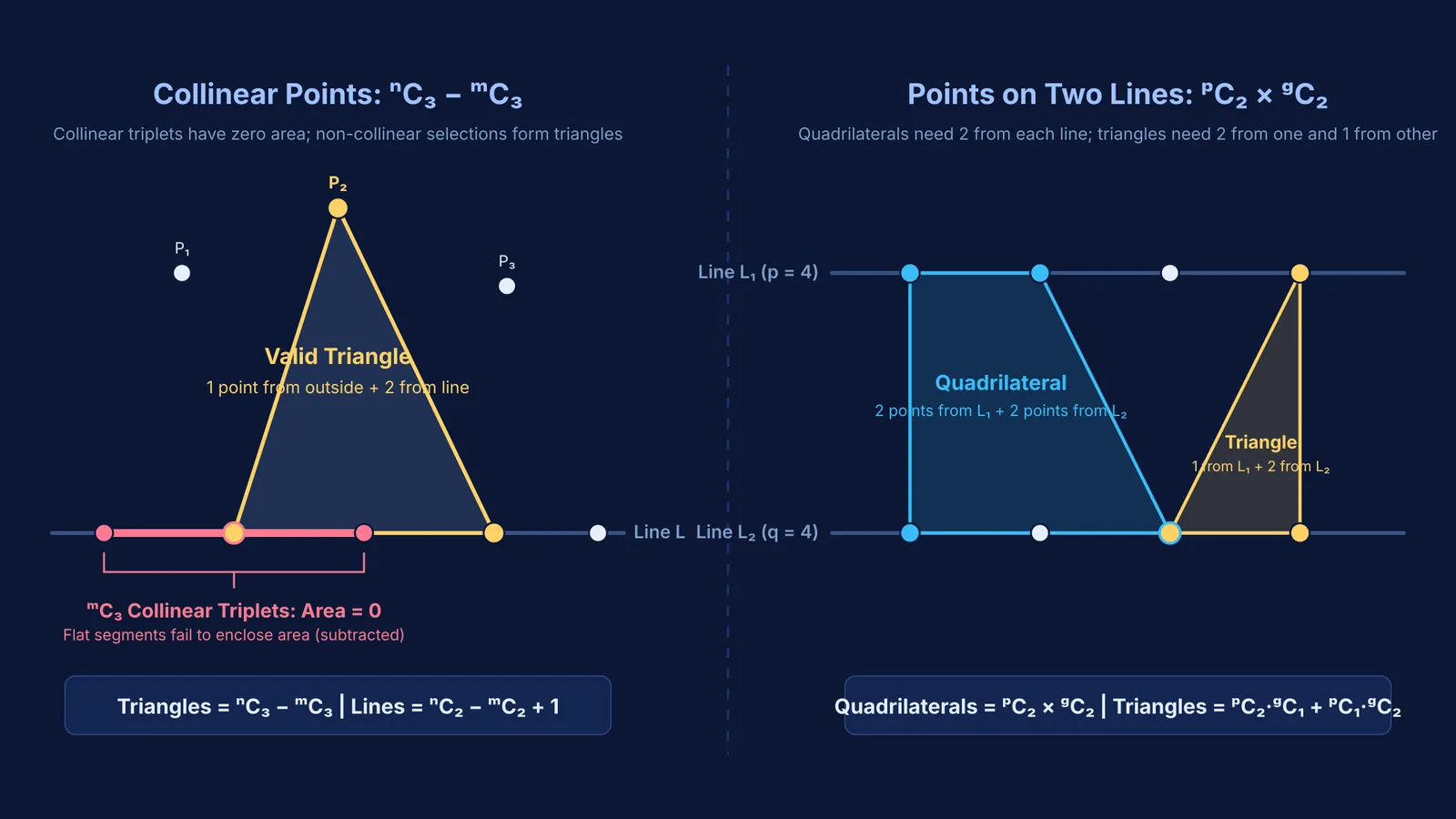
A triangle requires three non-collinear vertices to bound a positive area. If all n points were scattered such that no three were collinear, the total number of possible triangles would equal ⁿC₃ = n(n − 1)(n − 2) / 6.
When exactly m of these n points lie on one straight line, choosing any three points from that collinear subset produces three vertices on the same line segment. Their enclosed area is zero. Because these ᵐC₃ selections do not form triangles, you subtract them from the unconstrained total:
Number of triangles = ⁿC₃ − ᵐC₃
Every other triplet choice contains either:
One point from the collinear set and two non-collinear points: ᵐC₁ × ⁿ⁻ᵐC₂
Two points from the collinear set and one non-collinear point: ᵐC₂ × ⁿ⁻ᵐC₁
Three points from the non-collinear set: ⁿ⁻ᵐC₃
Because none of these remaining choices place all three vertices on the same line, each one forms a valid triangle. For example, if n = 10 points and m = 4 points are collinear, the total number of triangles is ¹⁰C₃ − ⁴C₃ = 120 − 4 = 116. Adding the three constructive cases yields (4 × 15) + (6 × 6) + 20 = 60 + 36 + 20 = 116, confirming that subtraction matches constructive counting.
If a problem contains multiple disjoint collinear sets—say, m₁ points on one line and m₂ points on another—you subtract the degenerate triplets for each line: ⁿC₃ − ᵐ¹C₃ − ᵐ²C₃.
How do you count straight lines without losing the collinear line?
Any two points determine a unique straight line, giving ⁿC₂ total pairs. When m points are collinear, any two points selected from those m points lie on the exact same line rather than producing distinct lines.
If you subtract ᵐC₂ without adjusting, you remove that line completely. You must add 1 back to account for the single real line that all m points share:
Number of straight lines = ⁿC₂ − ᵐC₂ + 1
For 10 points with 4 collinear points, the number of distinct lines is ¹⁰C₂ − ⁴C₂ + 1 = 45 − 6 + 1 = 40 lines. When there are k separate lines containing m₁, m₂, ..., mₖ collinear points, the formula extends to ⁿC₂ − ∑ (ᵐᵢC₂ − 1).
For related techniques on avoiding overcounting in selections, read our guides on permutations and combinations counting without double counting and counting geometric figures for competitive exams.
How many quadrilaterals can you form from points on two lines?
Now consider a configuration where points lie across two parallel lines, L₁ and L₂. Suppose line L₁ contains p points and line L₂ contains q points, giving n = p + q total points.
A convex quadrilateral requires four vertices, with no three vertices lying on the same line. If you select three points from line L₁ and one point from line L₂, three vertices are collinear, collapsing the figure into a triangle. If you pick all four points from one line, they collapse into a line segment.
To form a non-degenerate quadrilateral, you must pick exactly two points from line L₁ and two points from line L₂. By the multiplication principle:
Number of quadrilaterals = ᵖC₂ × ᵍC₂ = [p(p − 1) / 2] × [q(q − 1) / 2]
For instance, if line L₁ has 5 points and line L₂ has 4 points:
⁵C₂ = 10 ways to choose vertices on L₁
⁴C₂ = 6 ways to choose vertices on L₂
Total quadrilaterals = 10 × 6 = 60
To count triangles formed by these same points, you select two points from L₁ and one from L₂, or one from L₁ and two from L₂: (ᵖC₂ × ᵍC₁) + (ᵖC₁ × ᵍC₂) = (10 × 4) + (5 × 6) = 70 triangles. This matches the subtraction approach: ⁹C₃ − ⁵C₃ − ⁴C₃ = 84 − 10 − 4 = 70. You can explore more problem structures in our guide on selection problems with combinations.
Why do students get trapped by geometric counting formulas?
In a study published in the *Journal of Mathematical Behavior*, mathematics education researcher Elise Lockwood (Lockwood, 2013) modeled combinatorial thinking across three interconnected components: formulas, counting processes, and sets of outcomes. Lockwood observed that students frequently make systematic errors when they rely on memorized formulas without mapping them to concrete sets of outcomes. In geometric counting, students often forget whether an outcome set is empty (collinear triplets producing zero triangles) or collapsed into an equivalence class (multiple pairs defining the same single line).
Practicing with visual verification prevents these formula traps. The Fermi Problem Library provides worked problems with a step-by-step solver that explains the reasoning rather than printing an answer. For broader syllabus review, the Fermi Concept Library organizes every concept in mathematics into clear lessons with their place in the subject map. When you encounter unfamiliar geometry constraints, Fermi's AI tutor can work through problems alongside you, drawing the figure and checking your understanding as you go.


