

On this page
This plan teaches children in Classes 3 to 5 the four directions and how to read a simple map in about a week of short lessons. It starts with their own body and their own classroom before any printed map, goes from left and right to a classroom treasure hunt, and works at home too.
Why teach maps this early?
A map shows a place from above, with symbols standing in for real things. Moving from walking through a room to seeing all of it at once is the hard part. In a review in Developmental Science, psychologist David Uttal argued that using maps may help children acquire abstract concepts of space and think about spatial relations they have not experienced directly (Uttal, 2000).
Scale is the other hard part. In a study that asked 3- to 6-year-olds and adults to locate objects in a layout using a map of it, this skill developed considerably, especially between 3 and 5 years of age, and the youngest children were helped by landmarks (Frick and Newcombe, 2012). Landmarks make a good start for a first classroom map too: the door, the blackboard, the teacher's table.
How do you teach north, south, east and west?
Teach in this order, one step a day.
Left and right. Play "touch your left ear, turn to your right". A child who mixes these up will mix up east and west later.
Find east. Ask which window the morning sun comes through. That side is roughly east.
Stand and point. Face east. Your left arm points north, your right arm points south, and your back is to the west. Say it aloud together.
Label the walls. Stick N, S, E and W cards on the four walls and leave them up for the week.
Check with shadows. At sunrise, with the Sun in the east, a shadow points west (NASA Goddard Stargazers). Take the class outside early in the morning and let them see their shadows point roughly towards the west side.
The Sun rises due east on only two days a year, at the equinoxes; in the Northern Hemisphere it rises a little north of east in spring and summer and a little south of east in autumn and winter (BBC Sky at Night Magazine). So "roughly east" is the honest phrase for Class 3, and tracking the shift over a term is a good Class 5 project.
How do you run a classroom treasure hunt with a map?
Draw the classroom from above on chart paper, one square for each big step. Mark the door, the blackboard and the desks as simple boxes, and draw a compass rose in a corner with N at the top. Hide a treasure on one square: a chit with a riddle works.
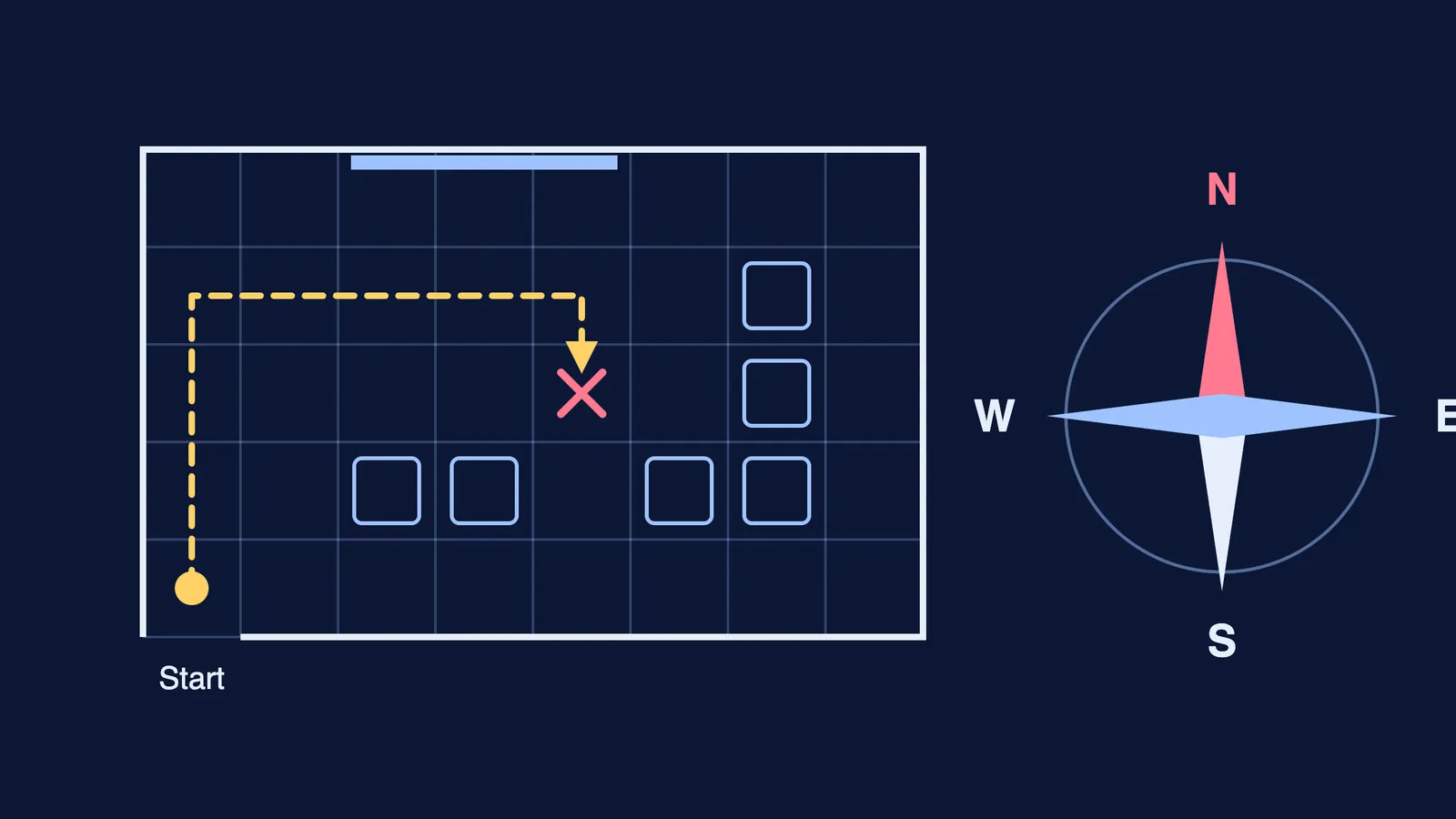
Here is a worked example, the one drawn in the image above:
Start at the door, in the bottom-left square.
Walk 3 squares north, towards the blackboard wall.
Walk 4 squares east.
Walk 1 square south. The treasure is on this square.
Work in pairs: one reads the map, one walks, then swap. Before anyone walks, the pair traces the route with a finger and says each move aloud: "Three north, four east, one south." If they end up somewhere else, they go back to the door and try again; finding the wrong turn is the lesson.
How do you make it harder for Classes 4 and 5?
Class 3: clues use only N, S, E, W, a number of squares and a landmark ("past the blackboard").
Class 4: pairs write clues for another pair and test them first. Add a map key with symbols for desk, window and dustbin.
Class 5: add the in-between directions (north-east, south-west) and a scale such as "1 square = 2 steps". Move outdoors to the school ground with a map the children draw themselves.
What mistakes do children make with directions and maps?
Turning the body but not the map. Teach them to hold the map so its north points to the north wall.
Writing left and right in clues. Left changes with the way you face; north does not.
Trusting a compass beside a steel almirah. Nearby iron pulls the needle off; here is why a compass points wrong near iron, and how far to move.
Thinking every map shows true sizes. Curious Class 5 children are ready for why Greenland looks so big on world maps, and later for how contour lines show hills on a topographic map.
For older brothers and sisters who want to go further in science, the Fermi Simulation Lab has interactive simulations for the ideas that are easier to see than to read.
Start tomorrow with the morning-sun window, and run the treasure hunt by the end of the week.


