

On this page
If you know the Claisen condensation, you already know the Dieckmann condensation. It is the same reaction, but both esters sit on one molecule, so the new carbon-carbon bond closes a ring instead of joining two molecules. If you can count along a chain, you can predict the product.
What is the Dieckmann condensation?
The Dieckmann condensation is the base-catalysed intramolecular condensation of a diester, and it works well for making five- or six-membered rings (Organic Chemistry Portal). The same page says it is usually run with a sodium alkoxide in an alcohol solvent.
OpenStax calls it the Dieckmann cyclization and treats it as an intramolecular Claisen condensation (OpenStax Organic Chemistry, section 23.9). If the parent reaction feels shaky, first revise how the Claisen ester condensation works.
The reaction is named after the German chemist Walter Dieckmann, who published on ring formation from carbon chains in the Berichte der deutschen chemischen Gesellschaft in 1894 (Dieckmann, 1894). A review chapter in Organic Reactions by John Schaefer and Jordan Bloomfield says the discovery is generally credited to him: heating an adipic or pimelic ester with sodium and a trace of alcohol gave a cyclopentanone or cyclohexanone. The same chapter notes that the ester needs at least one alpha-hydrogen (Schaefer and Bloomfield, Organic Reactions).
How does the Dieckmann mechanism work, step by step?
LibreTexts breaks the mechanism into five steps (LibreTexts, The Dieckmann Cyclization/23%3A_Carbonyl_Condensation_Reactions/23.09%3A_Intramolecular_Claisen__Condensations_-_The_Dieckmann_Cyclization)):
Enolate formation: the alkoxide removes an alpha-hydrogen next to one ester group.
Nucleophilic attack: the enolate carbon attacks the carbonyl carbon of the other ester, at the far end of the same chain.
Loss of the leaving group: the tetrahedral intermediate collapses and pushes out an alkoxide ion.
Deprotonation: an alkoxide removes the acidic hydrogen on the carbon between the two carbonyls of the new beta-keto ester.
Protonation: acid in the workup gives back the neutral cyclic beta-keto ester.
Step 4 is the one students skip. LibreTexts notes that this deprotonation drives the equilibrium towards the products and that a full equivalent of base is needed. The Organic Chemistry Portal adds that yields are good when the product has an enolisable proton; without one, the ring can open again.
Which diesters give a five- or six-membered ring?
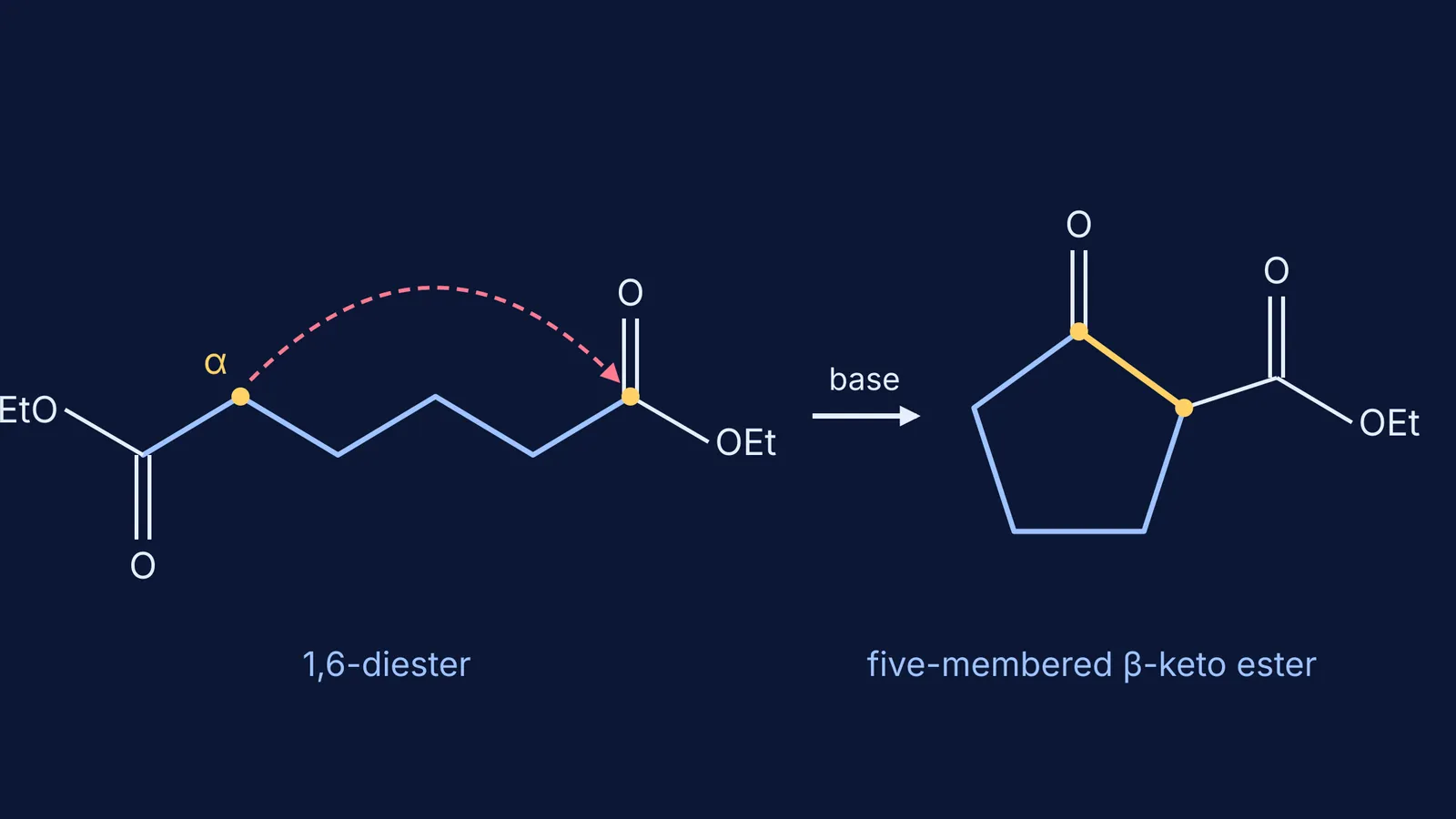
OpenStax states the rule plainly: 1,6-diesters give five-membered cyclic beta-keto esters and 1,7-diesters give six-membered ones. Here is the counting method, worked on diethyl hexanedioate (diethyl adipate).
Number the chain from one ester carbonyl carbon (C1) to the other (C6).
Pick the alpha carbon next to one ester: C2.
Join it to the far carbonyl carbon: C6.
Count the ring atoms: C2, C3, C4, C5 and C6 make five.
C6 becomes the ring ketone; C1 stays outside the ring as the ester group on C2.
The product is ethyl 2-oxocyclopentanecarboxylate, which OpenStax shows forming in 82% yield. Run the same steps on diethyl heptanedioate and C2 bonds to C7, giving a six-membered ring: ethyl 2-oxocyclohexanecarboxylate.
A quick check: the ring size is the number of carbons in the parent diacid minus one. Hexanedioate has six, so the ring has five; heptanedioate has seven, so the ring has six.
If the diester is unsymmetrical and both ends have alpha-hydrogens, either end can form the enolate. A LibreTexts exercise/23%3A_Carbonyl_Condensation_Reactions/23.09%3A_Intramolecular_Claisen__Condensations_-_The_Dieckmann_Cyclization) on an unsymmetrical 1,6-diester predicts a roughly 50/50 mixture of the two ring products. The same preference for five- and six-membered rings decides the product in intramolecular aldol ring formation.
What happens to the cyclic beta-keto ester next?
OpenStax shows the cyclic beta-keto ester being alkylated at the carbon between the carbonyls, then heated with acid to hydrolyse the ester and lose carbon dioxide. Its example turns ethyl 2-oxocyclohexanecarboxylate and allyl bromide into 2-allylcyclohexanone in 83% yield, and it presents the sequence as a general route to 2-substituted cyclopentanones and cyclohexanones (OpenStax Organic Chemistry, section 23.9).
The last step works because beta-keto acids lose CO2 easily on warming; see why beta-keto acids decarboxylate for the cyclic transition state.
A five-point self-check before your next test
After your next Dieckmann question, check:
Did you name the alpha carbon that becomes the enolate?
Did you count ring atoms, not chain atoms?
Is the ketone inside the ring and the ester group outside it?
Did you show step 4 and say why a full equivalent of base is needed?
For an unsymmetrical diester, did you draw both possible products?
If you get the ring right but lose marks on the arrows, work a few cyclisations in the Fermi Problem Library, where a step-by-step solver explains the reasoning rather than printing an answer. If enolates themselves feel shaky, the Fermi Concept Library has a lesson for every concept in chemistry, with its place in the map.
Next time you see a diester and a base, count the carbons first. The ring size follows from the count.


