

On this page
A thermodynamics question gives you ΔH and ΔS and asks above what temperature the reaction becomes spontaneous. Or it shows two lines and asks which reaction is favoured where. Both questions are about one straight line.
What does the graph of ΔG against temperature look like?
The Gibbs energy change is ΔG = ΔH − TΔS, where T is the absolute temperature (LibreTexts: Gibbs Free Energy/19%3A_Chemical_Thermodynamics/19.05%3A_Gibbs_Free_Energy)). At constant temperature and pressure, a negative ΔG means the process is spontaneous, zero means it is at equilibrium, and positive means it is not spontaneous as written, according to the same page.
Now treat ΔH and ΔS as fixed numbers and T as the variable. The equation has the form y = b + mx, with ΔH as the intercept on the ΔG axis and −ΔS as the slope (OpenStax Chemistry 2e, section 16.4).
So two numbers tell you the whole picture:
Where the line starts (at T = 0) is the value of ΔH.
Which way it tilts is opposite to the sign of ΔS. Positive ΔS makes the line fall as T rises; negative ΔS makes it climb.
How do you find the crossover temperature?
The crossover is where the line cuts the temperature axis, so ΔG = 0. Setting 0 = ΔH − TΔS gives T = ΔH/ΔS. On either side of this temperature, ΔG has opposite signs.
Worked example 1: decomposing limestone
For CaCO₃(s) → CaO(s) + CO₂(g), ΔH° = +179 kJ mol⁻¹ and ΔS° = +161.0 J mol⁻¹ K⁻¹ (Doc Brown's Chemistry).
Put both in the same energy unit: ΔS° = 0.161 kJ mol⁻¹ K⁻¹.
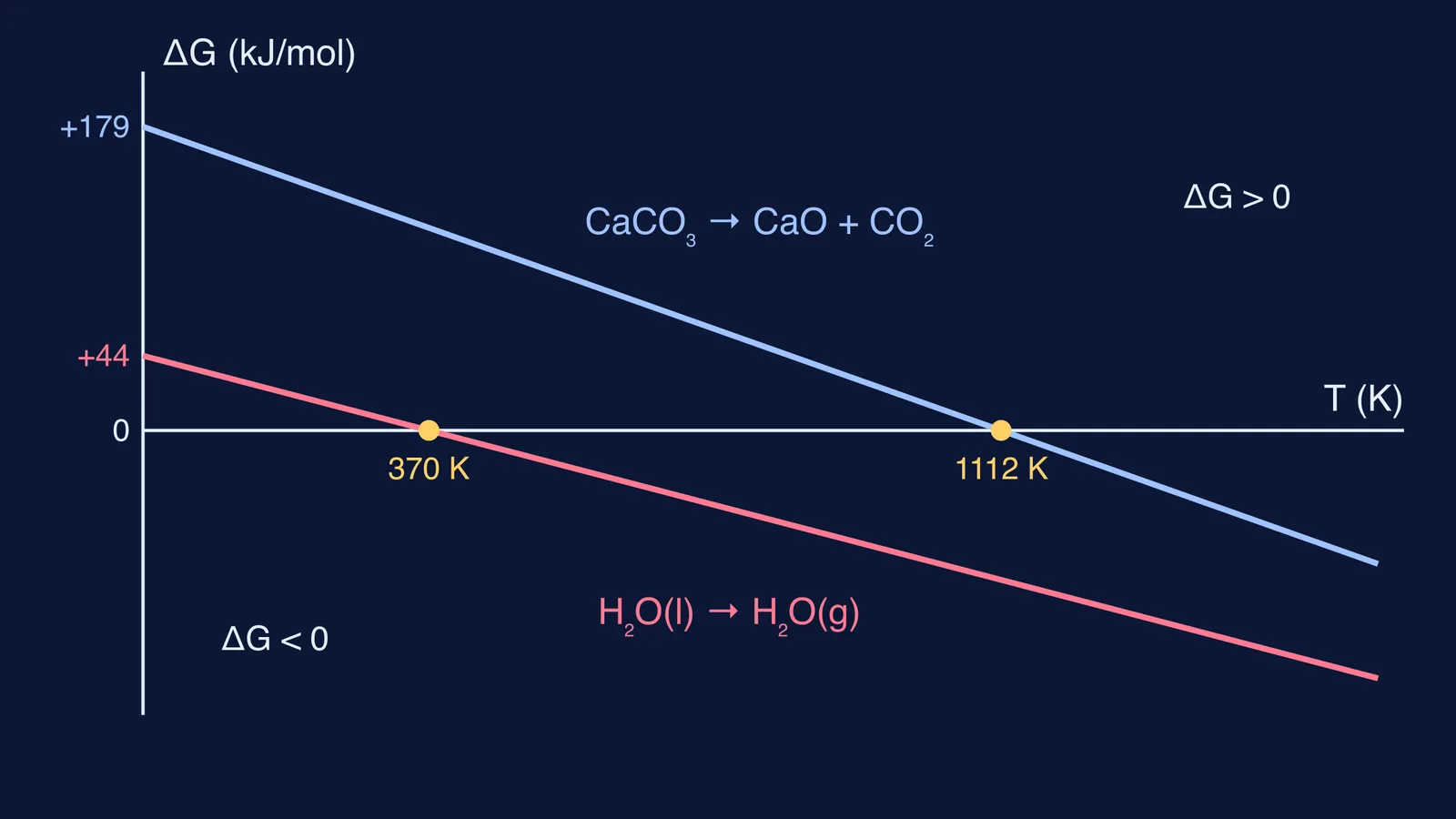
Read the line: it starts at +179 kJ mol⁻¹ and has slope −0.161 kJ mol⁻¹ K⁻¹, so it falls.
Find the crossover: T = 179 ÷ 0.161 ≈ 1112 K, about 839 °C, the same figure the source gives.
Read the sides: below 1112 K the line is above the axis, so decomposition is not spontaneous; above it, ΔG is negative.
That is why limestone needs a kiln. The same page notes that industrial lime kilns run at about 950–980 °C, comfortably past the crossover.
Worked example 2: boiling water
OpenStax gives ΔH° = 44.01 kJ and ΔS° = 118.8 J/K for H₂O(l) → H₂O(g), and works out T = ΔH°/ΔS° = 370.5 K, or 97.3 °C (OpenStax Chemistry 2e). Water actually boils at 373.15 K. LibreTexts uses values measured at the boiling point itself, ΔH = 40,657 J/mol and ΔS = 108.96 J/K, and gets ΔG = 0 exactly at 373.15 K (LibreTexts/19%3A_Chemical_Thermodynamics/19.05%3A_Gibbs_Free_Energy)). The small gap is the cost of treating standard values as constants.
Compare the two lines in the graph above. Limestone's line is steeper, because its ΔS is larger, yet water crosses first because its ΔH is much smaller. The crossover depends on the ratio ΔH/ΔS, not on the slope alone. Rearranged, the same idea gives the entropy of a phase change, as in our post on why ΔS of fusion and vaporisation equals ΔH/T.
Which way does the line slope for each sign of ΔH and ΔS?
OpenStax lists four cases (section 16.4). Here is how each one looks on the graph:
ΔH positive, ΔS positive: starts above the axis and falls. Spontaneous only above T = ΔH/ΔS.
ΔH negative, ΔS negative: starts below the axis and rises. Spontaneous only below the crossover.
ΔH positive, ΔS negative: starts above and rises. It never crosses, so the reaction is never spontaneous.
ΔH negative, ΔS positive: starts below and falls. Spontaneous at all temperatures.
Only the two same-sign cases have a crossover temperature. Metallurgists read the same kind of straight lines on Ellingham diagrams; our story on Harold Ellingham and his diagram shows where that idea came from.
What mistakes cost marks on ΔG–temperature questions?
Check these before your final answer:
Units. ΔH is usually in kJ and ΔS in J/K. Doc Brown's limestone example divides 179000 J by 161 J/K; dividing 179 by 161 instead gives about 1.1 K, which should look wrong at once.
Kelvin, not Celsius. T in ΔG = ΔH − TΔS is absolute temperature. Convert to °C only at the end if the question asks.
Slope sign. The slope is −ΔS, not ΔS. A reaction that makes gas has positive ΔS and a falling line.
ΔG or ΔG°. The crossover from standard values is about standard conditions; see the difference between ΔG and ΔG°.
If your setup is right but your numbers keep going wrong, the Fermi Problem Library has worked problems with a step-by-step solver that explains the reasoning rather than printing an answer. If the sign of entropy is the shaky part, the Fermi Concept Library gives every concept in chemistry its own lesson and its place in the map.
Next time you see ΔH and ΔS in a question, sketch the line first: one intercept, one slope, one crossover.


