

On this page
You walk into a relative's flat for the first time and, for a second, you are certain you have stood in this exact spot before. That is déjà vu: for most people, a harmless quirk of memory. Here is what researchers think causes it.
What is déjà vu, and how common is it?
Researchers define déjà vu as a strong sense that the present moment is familiar, together with the knowledge that it must be new (Cleary and colleagues, Consciousness and Cognition, 2012).
About 60% of people have experienced déjà vu, and it becomes less frequent with age, according to a 2003 review by psychologist Alan Brown in Psychological Bulletin. The same review reports that it appears to be associated with stress and fatigue. Brown sorted the scientific explanations into four groups:
two mental processes briefly falling out of step
a neurological cause, such as a seizure or a disruption in nerve signalling
familiarity from something you do not consciously recognise
a glance you did not attend to, followed by a second, attentive look
What causes déjà vu?
Much recent research treats déjà vu as a memory event. Models of memory separate recollection, where you retrieve the actual earlier episode, from familiarity, a sense of "I know this" with no details attached. A review of déjà vu in temporal lobe epilepsy proposes that déjà vu is produced by an erroneous feeling of familiarity that does not fit what your mind is doing at that moment.
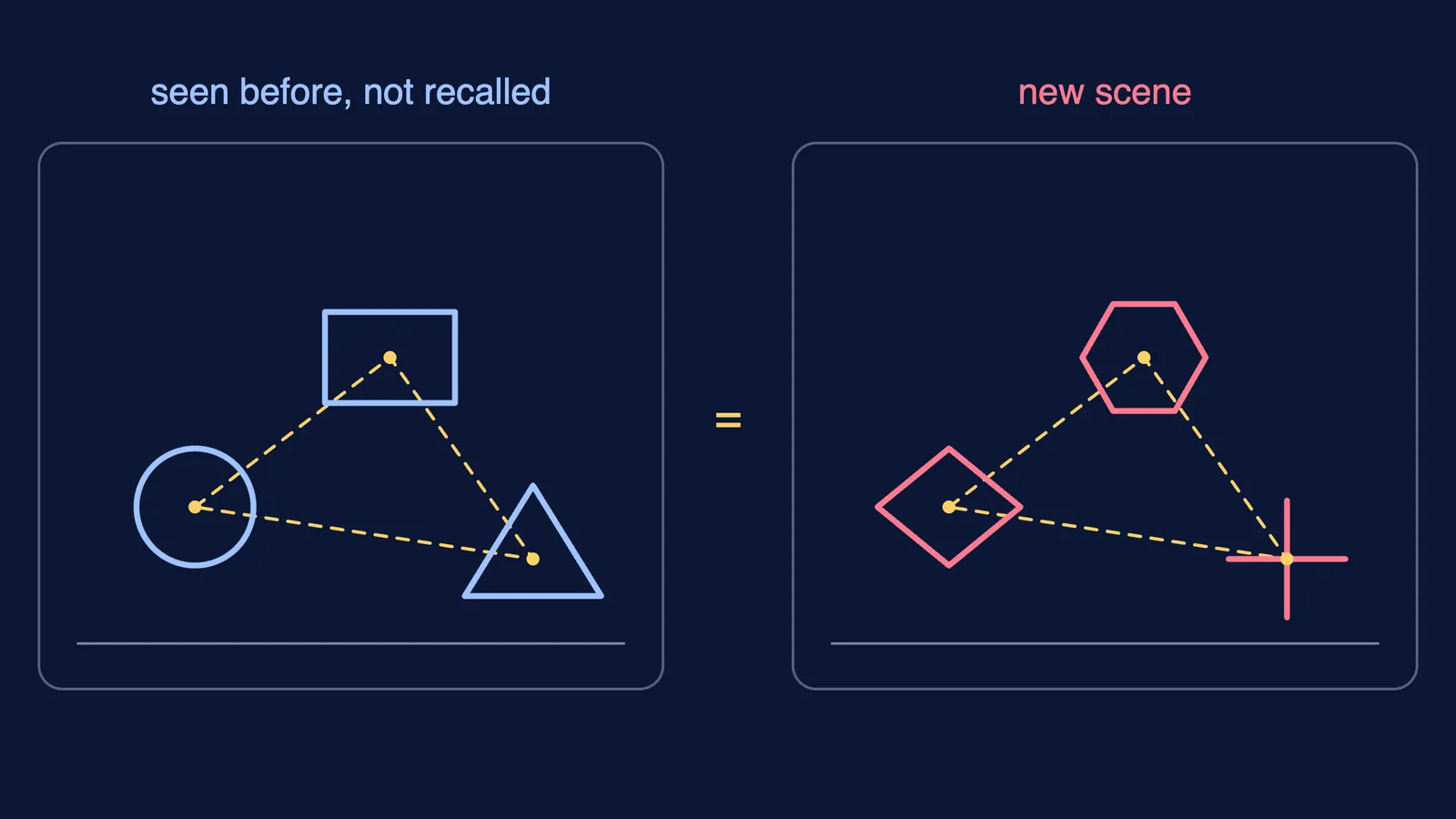
One specific version is the Gestalt familiarity hypothesis: déjà vu happens when the arrangement of things in a scene matches an arrangement you saw before, but the earlier scene does not come to mind (Cleary and colleagues, 2012). For a simple model of recall from a partial match, see how a Hopfield network recalls a memory from a clue.
How have scientists triggered déjà vu in the lab?
Three methods have produced déjà vu, or something close, on demand.
Matching layouts in virtual reality. Anne Cleary's team showed people immersive 3-D scenes, then new scenes whose layout resembled an earlier scene's. When people failed to recall the earlier scene, familiarity ratings and déjà vu reports were higher than for completely novel scenes, and among scenes judged new they rose as the match grew closer (Consciousness and Cognition, 2012).
False familiarity with words. A St Andrews team adapted a false-memory task in which one word feels studied but was never shown, then gave cues showing that the familiarity was mistaken. In a brain scanner, 16 of 21 participants reported déjà vu, and the researchers identified activity linked to memory conflict in the anterior cingulate, medial prefrontal and parietal cortex (Urquhart and colleagues, Memory). The authors suggest resolving memory conflict may play an integral role; the sample was small.
Electrical stimulation during epilepsy investigation. In patients with electrodes placed inside the brain, déjà vu can be triggered more readily by stimulating the rhinal cortex than the hippocampus. Compared with rhinal stimulations that did not trigger it, stimulations that did were associated with stronger synchrony of signals between medial temporal lobe structures (Bartolomei and colleagues, Clinical Neurophysiology, 2012).
Does déjà vu mean you can predict what happens next?
During déjà vu, many people feel they know what comes next. Cleary and Claxton tested this with navigational paths that resembled earlier, unrecalled ones. Déjà vu did not help people predict the next turn better than chance, but it did come with stronger feelings of knowing the direction (Psychological Science, 2018). The sense of premonition is real; the prediction is not.
When is déjà vu worth mentioning to a doctor?
Occasional déjà vu is common. Déjà vu has also long been linked to seizure activity in temporal lobe epilepsy, and clinical reports suggest many patients experience it as part of a simple partial seizure (Illman and colleagues, 2012). If episodes start happening often, come with other unusual sensations, or someone notices something odd while they happen, mention it to a doctor.
Rest matters for memory too; here is what research says about sleep after studying. If stress feels too heavy, India's toll-free Tele MANAS helpline, 14416, connects callers with mental health professionals.
What déjà vu teaches you about studying
Familiarity without recall is also why rereading can feel like learning: the page looks familiar, so it feels known. See what happened when we compared rereading with practice testing. Try this familiarity check before you tick a chapter off:
Close the book and write the three main ideas from memory.
Explain one diagram aloud without looking at it.
Solve one question you have not seen before.
Where you felt sure but stalled, mark it: that was familiarity, not recall.
Worked example: the nervous system chapter feels familiar, but at step 2 you cannot explain how a signal crosses a synapse. That goes on tomorrow's list.
When a topic feels familiar but you cannot explain it, the Fermi Concept Library has a lesson for every concept in physics, chemistry, biology, mathematics and computing, so you can rebuild it step by step. Fermi's AI tutor notices where you are stuck and checks understanding as it goes.


