

On this page
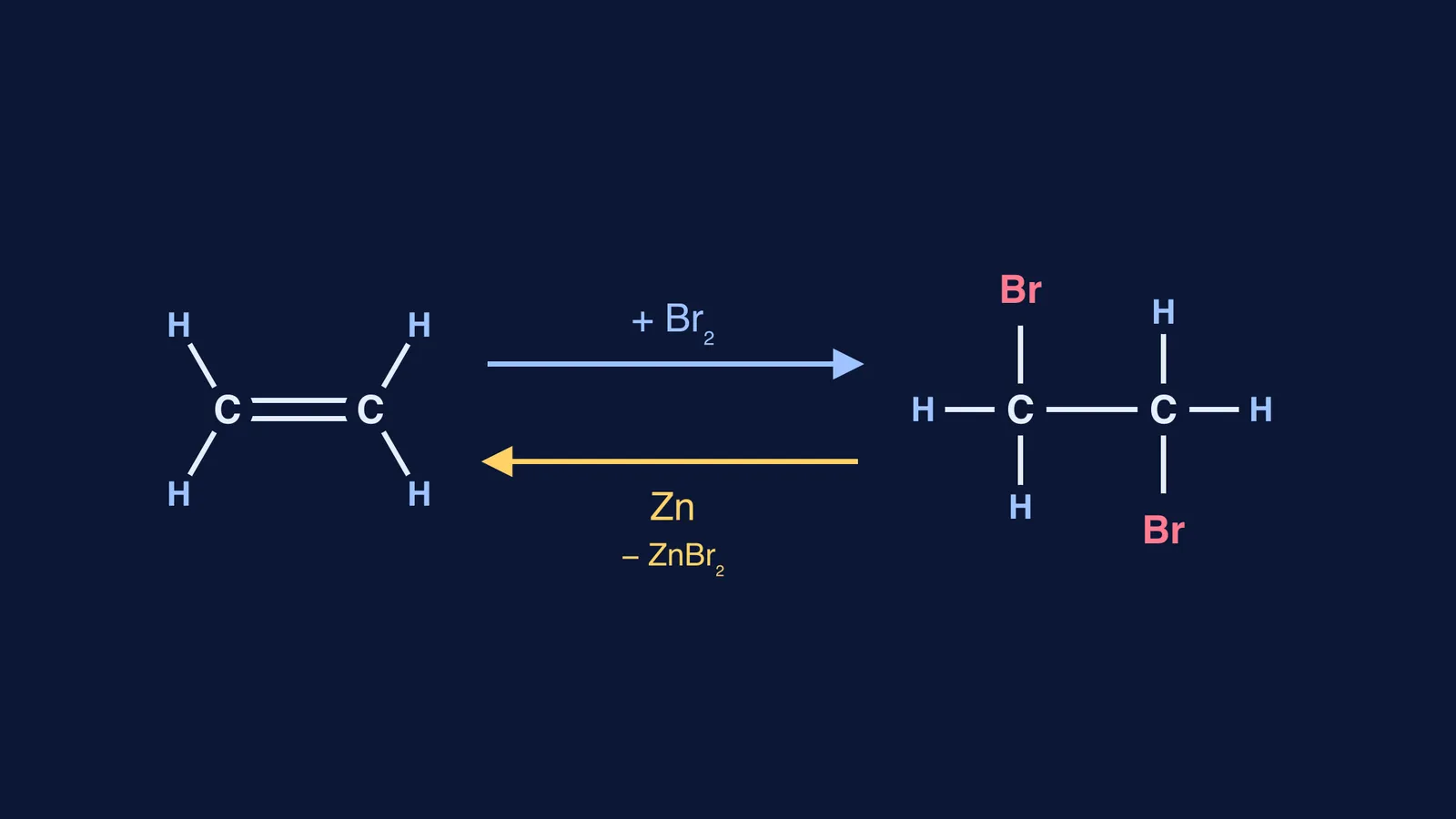
If a question shows a molecule with halogens on two neighbouring carbons and the reagent is zinc dust, the answer is an alkene. The reaction is called dehalogenation, and it is the reverse of adding bromine across a double bond. That reversibility is why chemists have long used it to hide a double bond for a while and then bring it back.
What happens when a vicinal dihalide reacts with zinc?
A vicinal dihalide is a compound with two halogen atoms attached to two adjacent carbon atoms, as defined in the NCERT Class 11 Chemistry chapter on hydrocarbons (Unit 9, section 9.3.4).
In the same section, NCERT states that vicinal dihalides treated with zinc metal lose a molecule of ZnX₂ to form an alkene, and gives two equations:
CH₂Br–CH₂Br + Zn → CH₂=CH₂ + ZnBr₂
CH₃CHBr–CH₂Br + Zn → CH₃CH=CH₂ + ZnBr₂
The rule to remember: the new double bond forms between exactly the two carbons that carried the halogens. Nothing else in the carbon skeleton moves.
It is also a redox reaction. Zinc goes from 0 to +2 in ZnBr₂. In 1,2-dibromoethane each carbon has an oxidation state of −1; in ethene each carbon is −2, so the carbons are reduced. If that bookkeeping feels shaky, our guide to finding the oxidation state of carbon in organic compounds walks through it.
How is dehalogenation different from dehydrohalogenation?
The two names differ by a few letters, so students swap them. The NCERT hydrocarbons chapter keeps them apart, and so should you:
Dehydrohalogenation: one halogen, with a hydrogen on the next carbon, heated with alcoholic KOH. HX leaves and an alkene forms.
Dehalogenation: two halogens on adjacent carbons, treated with zinc. Both halogens leave as ZnX₂ and an alkene forms.
Double dehydrohalogenation: a vicinal dihalide with alcoholic KOH, then sodamide (NaNH₂). Two HX leave and an alkyne forms (NCERT section 9.4.3).
So the same starting material, 1,2-dibromoethane, gives ethene with zinc but ethyne with alcoholic KOH followed by sodamide. The reagent decides the product.
Why would a chemist add bromine only to remove it again?
Because a dibromide is a parked double bond. Bromine adds across the C=C, the dibromide can be handled in ways the alkene could not, and zinc dust later gives the alkene back in its original position.
A classic demonstration is Louis Fieser's procedure in Organic Syntheses, "Cholesterol, Δ5-cholesten-3-one, and Δ4-cholesten-3-one" (1955). It uses the trick twice.
To purify. Commercial cholesterol is brominated to cholesterol dibromide in 84–85% yield, the solid is washed, and zinc dust in ether gives cholesterol back, 78–80% overall from the commercial material. The procedure notes that purification through the dibromide completely eliminates cholestanol, 7-dehydrocholesterol and lathosterol.
To protect. With the double bond tied up as two C–Br bonds, the OH group of the dibromide is oxidised to a ketone with sodium dichromate (96% in that step). Zinc dust then removes the bromine to give Δ5-cholesten-3-one, 71–72% from cholesterol.
Notice the detail in step 2. Zinc puts the double bond back between C5 and C6, where it started. The procedure calls the product a "labile non-conjugated ketone", and it uses a separate step with oxalic acid to move the double bond into conjugation with the ketone. Zinc restores the double bond; it does not relocate it.
How do you answer a dehalogenation question step by step?
Try this one. Compound A (C₄H₈) decolourises bromine in CCl₄ to give B, which is 2,3-dibromobutane (C₄H₈Br₂). B is warmed with zinc dust. What forms, and what was A?
Find the halogens. They sit on C2 and C3, which are adjacent, so B is a vicinal dibromide.
Read the reagent. Zinc means dehalogenation, not loss of HBr.
Place the double bond. It goes between C2 and C3: CH₃CH=CHCH₃, but-2-ene.
Check the formula. C₄H₈Br₂ minus Br₂ is C₄H₈, which matches A.
Work backwards. Bromine adds across a double bond without moving it, so A must also have been but-2-ene.
Step 5 is where compound-identification questions hide their marks. The bromine half of this pair is explained in our post on testing for a double bond with bromine water and Baeyer's reagent, and the backward reasoning is practised in how to identify compound A, B, C in organic chemistry puzzles.
If the step you keep missing is matching the reagent to what it removes, the Fermi Problem Library has worked problems with a step-by-step solver that explains the reasoning rather than printing an answer. To revise the definitions around it, such as vicinal and geminal dihalides or β-elimination, the Fermi Concept Library gives each chemistry concept its own lesson.
Next time you see Zn under an arrow, circle the two halogens first and draw the double bond between them.


