

On this page
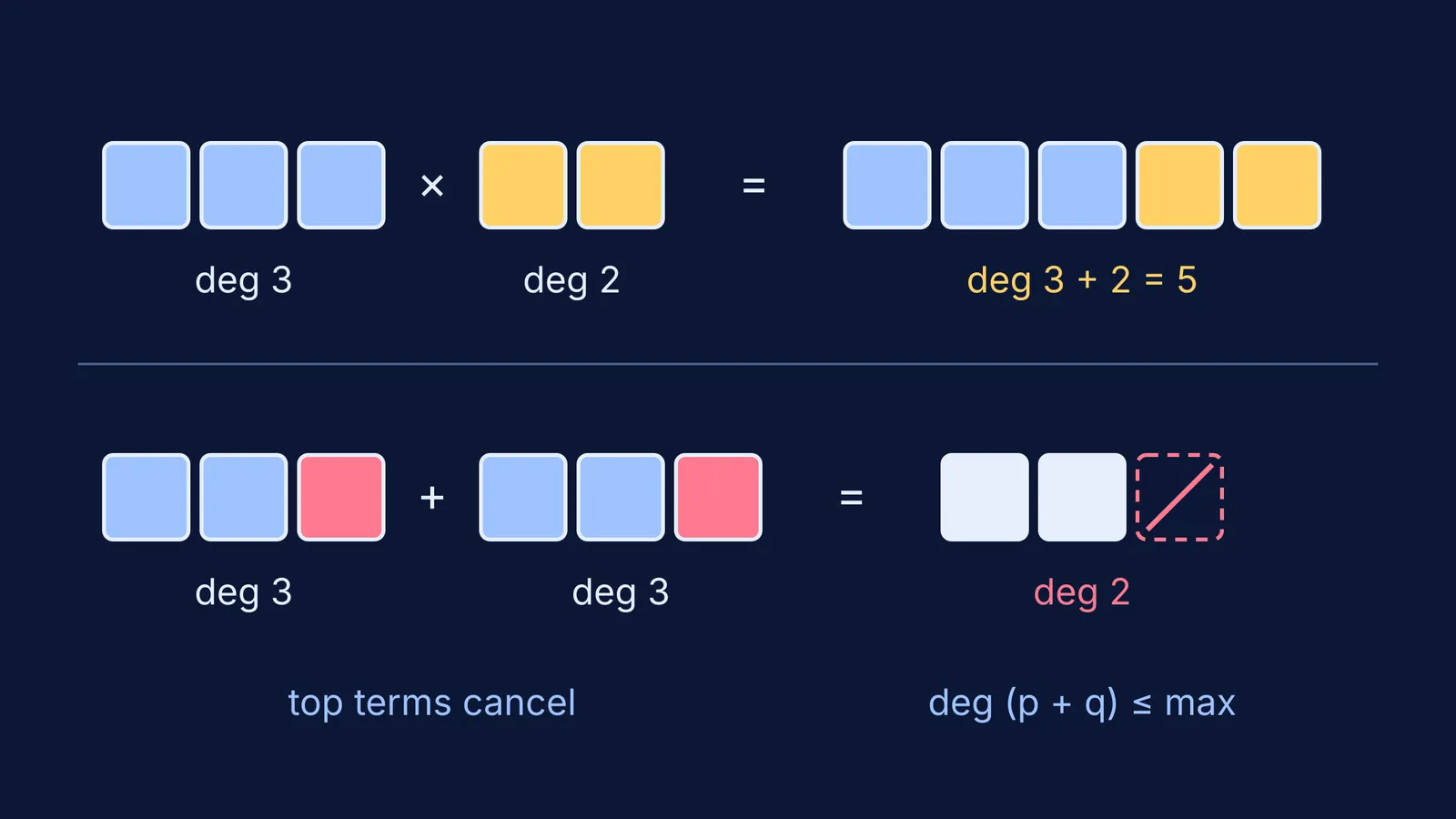
Two short rules cover most questions about the degree of combined polynomials. Multiplying adds the degrees. Adding gives a degree no bigger than the larger one. The case that catches students is a sum of two polynomials of equal degree whose top terms cancel. Here is each rule, why it holds, and an exam check.
What is the degree of a polynomial?
The degree of a polynomial is the highest power of the variable that appears in it, according to OpenStax College Algebra 2e. The same textbook calls the term with that power the leading term, and its coefficient the leading coefficient. One detail matters for everything below: the degree only counts terms whose coefficient is not zero, as the reference article on polynomial degree puts it. Writing 0x⁴ + 2x + 1 does not make a degree-4 polynomial.
If you are not sure whether an expression counts as a polynomial at all, run it through our quick test for whether an expression is a polynomial first.
What is the degree of the product of two polynomials?
For non-zero polynomials p and q, deg(pq) = deg(p) + deg(q), the rule given in the reference article on polynomial degree. Its example: (x³ + x)(x² + 1) = x⁵ + 2x³ + x, which has degree 5 = 3 + 2.
The reason is short. When you multiply out, the highest power comes from only one pair: the leading term of p times the leading term of q. Every other pair gives a lower power, so nothing can cancel it. And the coefficient of that top term is the product of two non-zero numbers, which is never zero. So the top term survives, and its power is the sum of the two degrees.
Worked example: find the degree of (2x³ + 5)(x² − 4x + 1).
Leading terms: 2x³ and x².
Multiply only those: 2x³ × x² = 2x⁵.
Degree 5, leading coefficient 2. You never needed to expand the rest.
The same idea handles powers. Since (x² + 1)⁵ is five copies of a degree-2 polynomial multiplied together, its degree is 2 + 2 + 2 + 2 + 2 = 10.
What is the degree of the sum of two polynomials?
For a sum, deg(p + q) ≤ max(deg p, deg q), and the reference article on polynomial degree shows both outcomes. When the degrees are different, you get exactly the larger one: (x³ + x) + (x² + 1) = x³ + x² + x + 1 has degree 3. When the degrees are equal, the top terms can cancel: (x³ + x) − (x³ + x²) = −x² + x has degree 2, less than 3.
Worked example with cancellation: add p = 3x⁴ + x² − 7 and q = −3x⁴ + 2x³ + x.
Both have degree 4, so check the leading coefficients: 3 + (−3) = 0. The x⁴ terms vanish.
Move down one power: the only x³ term is 2x³, which survives.
The sum is 2x³ + x² + x − 7, degree 3.
Cancellation can go all the way. (x² + x) + (−x² − x) = 0, the zero polynomial. The reference article notes that its degree is usually left undefined, though some authors define it as −1 or as negative infinity, and that negative infinity keeps the sum and product rules working. Our post on why the zero polynomial has no degree explains the conventions.
How do you answer degree questions in an exam?
Use this four-case check:
Product: add the degrees. Multiply the leading terms if you need the leading coefficient.
Sum, different degrees: the answer is the larger degree. No cancellation is possible.
Sum, equal degrees: add the two leading coefficients. If they are not zero, the degree stays the same. If they are zero, step down one power at a time until a coefficient is not zero.
Everything cancelled: you have the zero polynomial. Say so rather than writing a number.
A common short question: if p and q both have degree 4, what can deg(p + q) be? The honest answer is "at most 4". It could be 4, 3, 2, 1 or 0, or the sum could be the zero polynomial. If p has degree 4 and q has degree 2, the answer is exactly 4. Giving one fixed number for the first case is a common slip.
Degree also tells you about a graph's shape, which is covered in how a polynomial's degree limits its turning points. To practise, the Fermi Problem Library has worked problems with a step-by-step solver that explains the reasoning rather than printing an answer. If the top term of a polynomial and its coefficient still feel shaky, the Fermi Concept Library gives each mathematics concept its own lesson.
Next time you see a product, stop at the leading terms. Next time you see a sum of equal degrees, check whether the top coefficients add to zero.


