

On this page
When you sketch a polynomial, the curve climbs and falls, creating "humps" or valleys. These are called turning points. If you are looking at a degree 4 polynomial (a quartic equation), knowing the maximum number of turning points helps you predict the shape of the graph before you plot a single point.
What is a turning point?
A turning point is a spot on a graph where the function changes direction. If the curve is climbing upwards (a positive slope) and then peaks to start falling (a negative slope), that highest peak in its immediate neighbourhood is called a local maximum. Conversely, if the curve falls into a valley and then turns to climb back up, that lowest point in its local area is a local minimum. Both of these features are known as turning points.
To find these points exactly, you usually need calculus. Turning points happen where the slope of the curve is exactly zero, which corresponds to a horizontal tangent line. When you set the first derivative of the function to zero and solve for x, the solutions you find are the x-coordinates of the potential turning points. You then check these points to confirm they are genuine turns rather than inflection points where the curve flattens but continues in the same direction.
How many turning points does a degree 4 polynomial have?
A polynomial of degree n can have at most n - 1 turning points (Paul's Online Notes). This means a degree 4 polynomial can have at most 3 turning points.
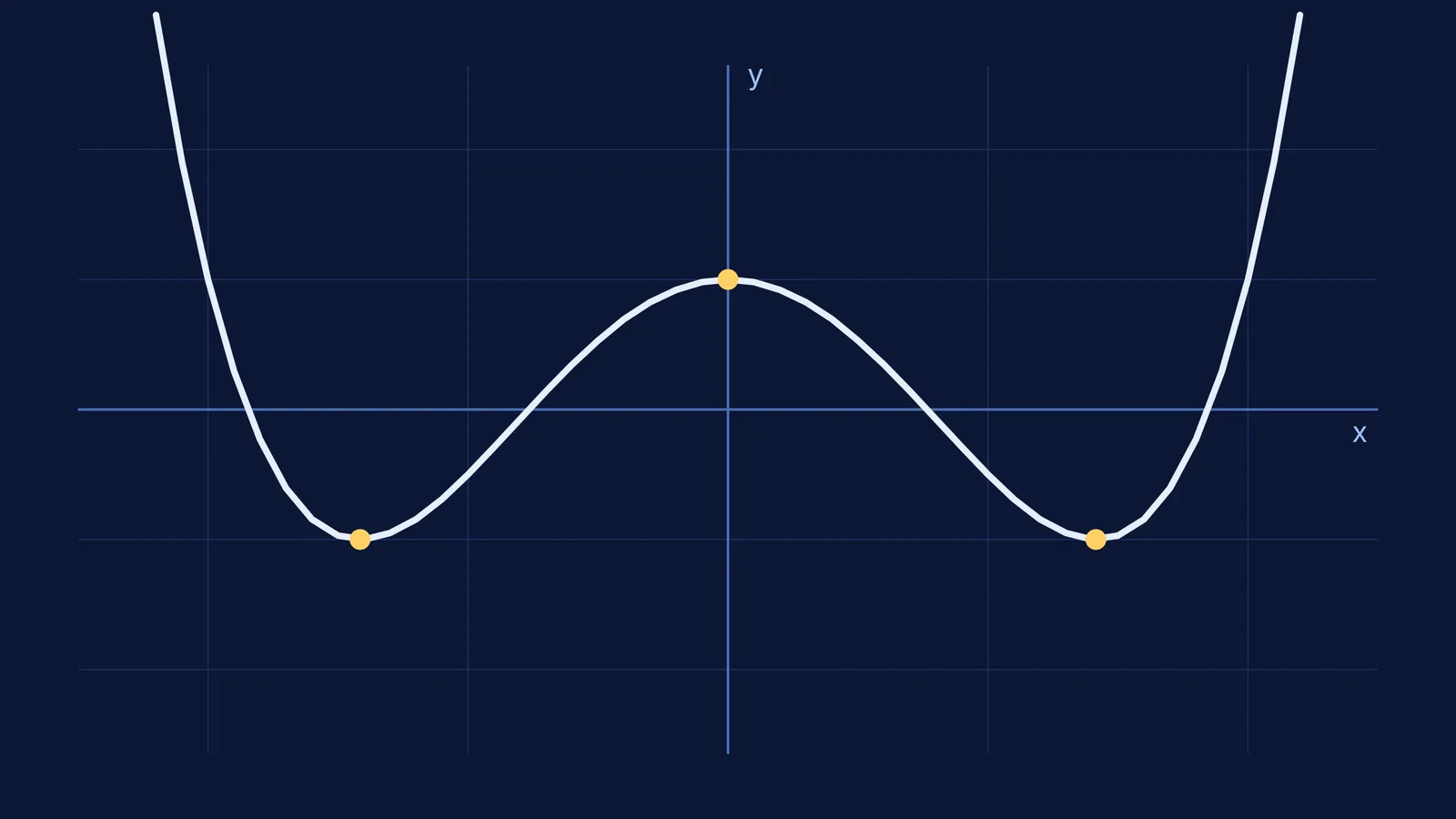
However, it does not *have* to have exactly three. Because turning points on a polynomial always appear or disappear in pairs as you change the coefficients, a degree 4 polynomial will have either 3 turning points (making a distinct "W" or "M" shape depending on the sign of the leading term) or 1 turning point (making a simple "U" or an upside-down "U" shape). It cannot have 2 or 0 turning points, as that would break the fundamental symmetry of an even-degree function, which must ultimately point in the same direction at both positive and negative infinity.
Why does the degree limit the number of turning points?
The reason goes back to calculus. If your original polynomial f(x) has a degree of 4, taking the derivative drops the highest power by one, leaving a derivative f'(x) with a degree of 3.
According to the Fundamental Theorem of Algebra, a degree 3 polynomial can have at most 3 real roots. Since the real roots of the derivative are the only places where the original function's slope is zero, there are at most 3 places where the curve can turn. If you want to dive deeper into how curves cross the axis, you can try counting intersections of two sketched curves.
Predict and check: dragging the coefficients
Reading about the n - 1 rule is one thing, but seeing it happen makes it stick. The standard form of a degree 4 polynomial is ax⁴ + bx³ + cx² + dx + e.
Instead of plotting points by hand, you can jump into the Fermi Simulation Lab to drag the coefficients and see the turning points appear.
Here is a quick framework to try:
Set a to a positive number (like 1) and leave the rest at 0. You get y = x⁴, which has just 1 turning point at the origin.
Make c negative (like -4). Now you have y = x⁴ - 4x². The curve will buckle in the middle, revealing 3 distinct turning points: a local maximum at x=0, and two local minima.
Test the limits. Can you find a combination of a, b, c, d that creates exactly 2 turning points? (Spoiler: you can't, but seeing the curve warp and slide without ever forming a second hump proves the math).
If you get stuck figuring out when is ax² + bx + c positive for all x or need help working through the calculus of finding the exact peaks, Fermi's AI tutor teaches — it holds a line of reasoning across a whole session, notices where a student is stuck, and decides whether to explain, ask, or show.


