On this page
Many students meet Hugo de Vries in one short paragraph of the Class 12 evolution chapter, and assertion-reason questions often turn that paragraph's wording into traps. Almost every describing word in it can be swapped to make a false statement. Here is what he actually did, what saltation means, how it differs from Darwin, and a set of practice statements to test yourself.
What did Hugo de Vries see in the evening primrose?
Hugo de Vries (1848 to 1935) was a Dutch botanist who, in 1886, found new forms among wild evening primrose, *Oenothera lamarckiana*, growing in an abandoned potato field near Hilversum, according to his Wikipedia biography. He grew their seeds in his experimental gardens and found that they produced many new varieties. He called these suddenly appearing variations "mutations", and set out his ideas in the two-volume *Die Mutationstheorie* of 1901 to 1903.
What is saltation, and how is it different from Darwin's variations?
The NCERT text puts it this way: de Vries "brought forth the idea of mutations – large difference arising suddenly in a population" (NCERT Class 12 Biology, Chapter 6, section 6.6).
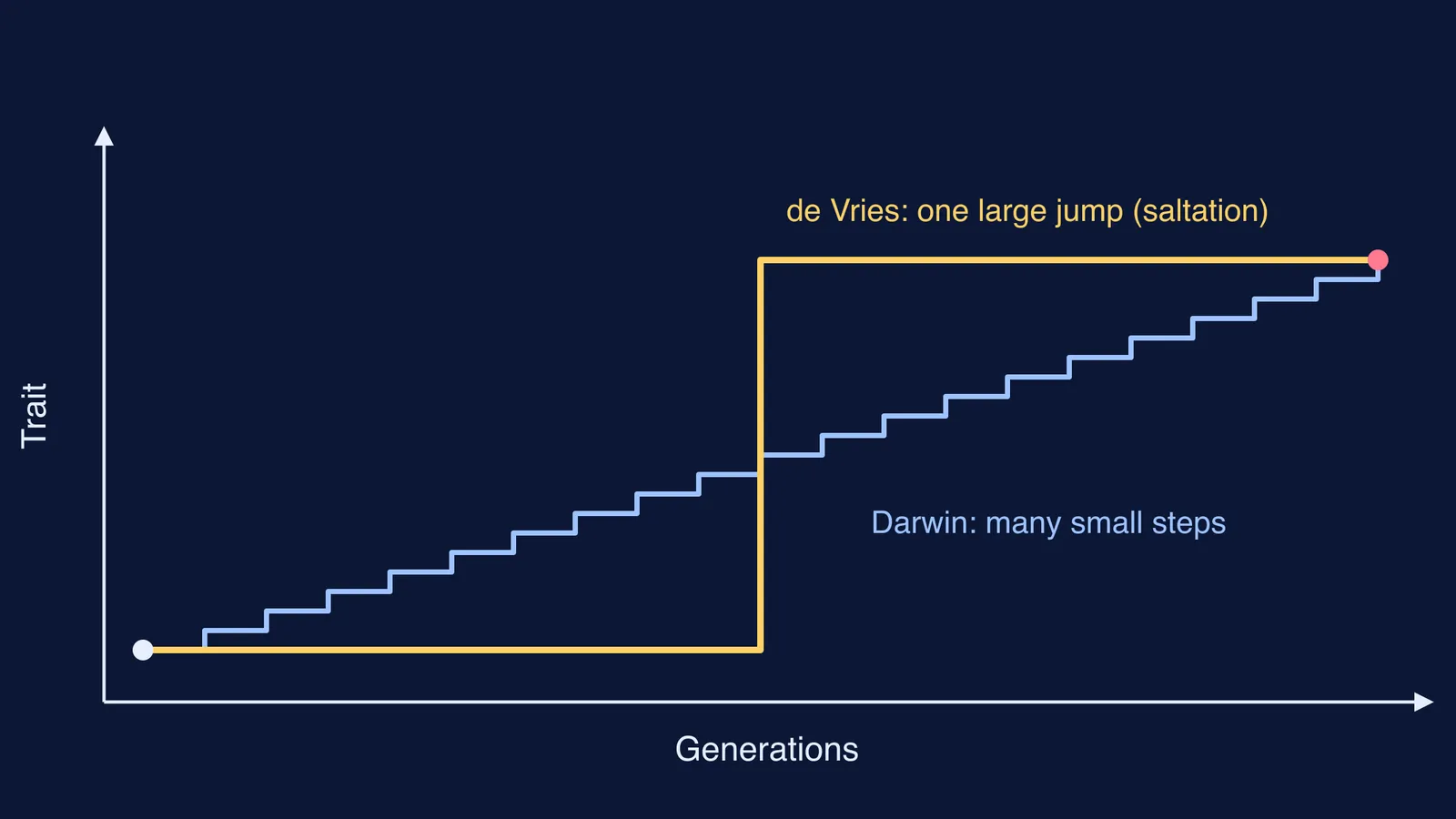
Saltation, in NCERT's words, is a "single step large mutation". De Vries believed mutation caused speciation, and called this saltation (NCERT, section 6.6).
The same section gives the contrast you need: "Mutations are random and directionless while Darwinian variations are small and directional," and "Evolution for Darwin was gradual". De Vries believed it is mutation, "and not the minor variations (heritable) that Darwin talked about," that causes evolution.
Was de Vries right about Oenothera?
Not in the way he thought. His Wikipedia biography states that the large primrose variations "turned out to be the result of various chromosomal abnormalities, including ring chromosomes, balanced lethals and chromosome duplications (polyploidy)" (source). In 1918, Hermann Muller compared balanced lethal factors he had studied in fruit flies with the primrose "mutations" and showed they could work the same way (Muller, Genetics, 1918; DOI; overview of mutationism). Today the mainstream view is that mutation supplies the variation that natural selection acts on, rather than replacing selection as a shortcut.
For exams, though, answer from the textbook: de Vries' theory is that mutation causes speciation by saltation. The later history helps you understand it, but NCERT only adds that "studies in population genetics, later, brought out some clarity."
Which assertion-reason traps come from this topic?
Assertion-reason questions test two things: is each statement true, and does the reason actually explain the assertion? Try these before reading the answers.
A: De Vries called speciation by mutation saltation. R: He believed large mutations, not minor heritable variations, cause speciation in a single step. Answer: both true, and R explains A.
A: According to de Vries, mutations are directional. R: Mutations arise suddenly in a population. Answer: A is false (NCERT says random and directionless), R is true.
A: Darwinian variations are small and directional. R: Darwin saw evolution as gradual. Answer: both true, but R does not explain A. The explanation runs the other way: small variations are why change is gradual.
A: Saltation means many small steps over many generations. R: Darwin's evolution was gradual. Answer: A is false (saltation is a single step), R is true.
The pattern behind most traps: a word swap (directional for directionless, small for large) or a reason that is true but points the wrong way.
How should you revise de Vries before an exam?
Read section 6.6 of the NCERT chapter once, slowly, and underline every describing word: large, suddenly, random, directionless, small, directional, gradual, single step.
Write the two-column contrast (Darwin vs de Vries) from memory, then check it against the text.
Cover the answers above and redo the four statements.
Make two new statements of your own by swapping one describing word, and decide the answer.
Say aloud in one sentence why the primrose mutants were not what de Vries thought.
If the gap is the idea itself rather than the wording, the Fermi Concept Library covers every concept in biology, each with its own lesson and its place in the map, so you can see where mutation sits among related ideas. For questions where you keep picking the wrong option, the Fermi Problem Library has worked problems with a step-by-step solver that explains the reasoning rather than printing an answer.