

On this page
"Find the equation of the curve passing through (1, 2) whose slope at any point (x, y) is 2y/x." The whole job is three moves: translate the words into an equation, solve it, and use the point to fix the constant.
The CBSE Class XII mathematics syllabus for 2025–26 lists "general and particular solutions of a differential equation" and "solution of differential equations by method of separation of variables" in its Differential Equations unit.
What does "slope at any point" mean in a differential equation?
The slope of the tangent to a curve at the point (x, y) is dy/dx. So "the slope at any point is 2y/x" is just the sentence dy/dx = 2y/x written in words.
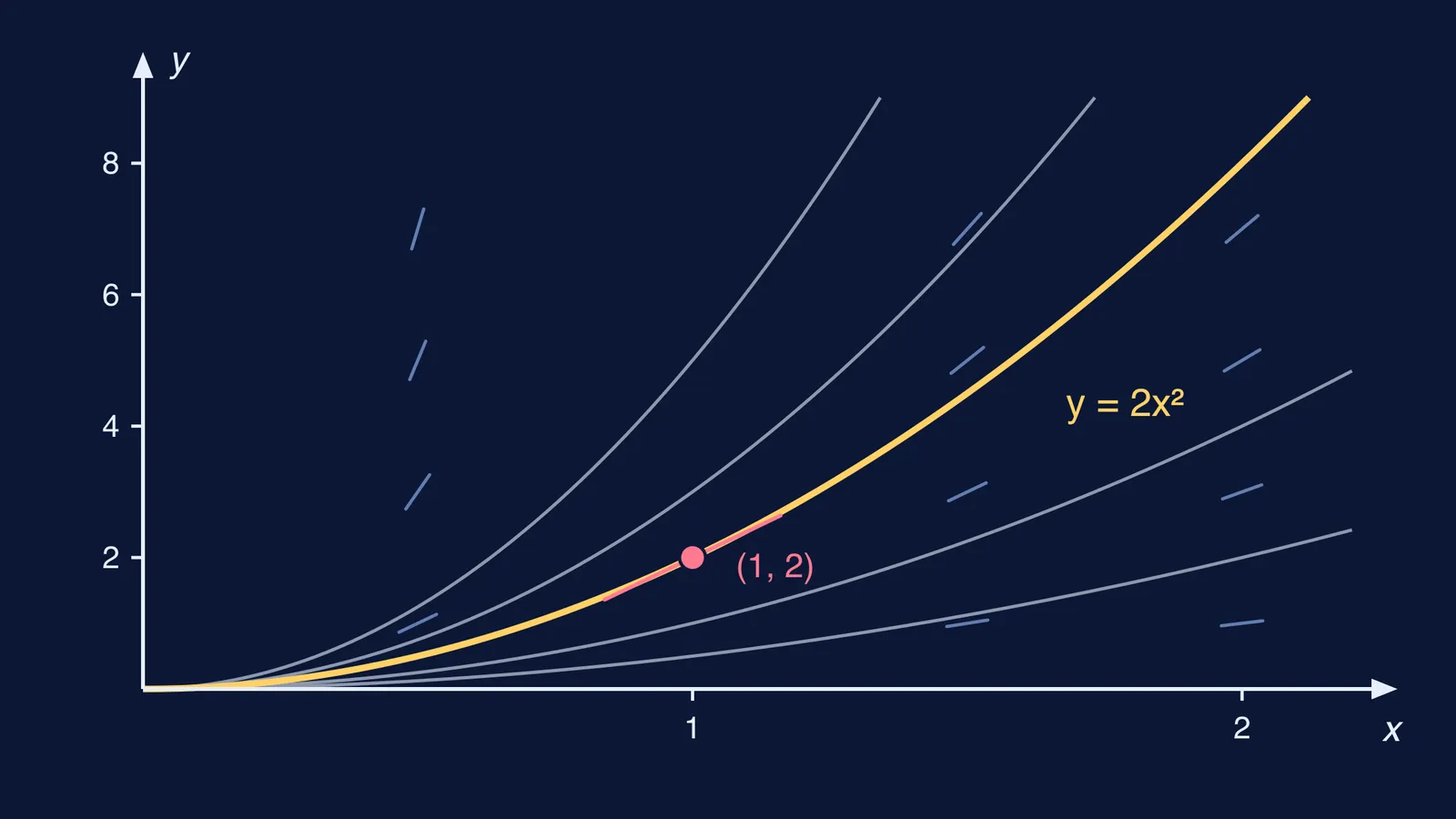
That equation alone describes many curves, not one. OpenStax Calculus Volume 2, section 4.2 defines a direction field (slope field) as a picture where, at each point, "a line segment appears whose slope is equal to the slope of a solution to the differential equation passing through that point." Every curve that follows those little segments is a solution.
The given point is what narrows it down. In OpenStax section 4.1, an initial value is "an ordered pair that is used to find a particular solution," and a differential equation together with an initial value is called an initial-value problem.
Here is how the usual phrases translate:
"Slope of the tangent at (x, y) is f(x, y)" becomes dy/dx = f(x, y).
"Slope of the normal at (x, y) is g(x, y)" becomes dy/dx = −1/g(x, y), because tangent and normal are perpendicular.
"Slope equals the sum of the coordinates" becomes dy/dx = x + y, a linear equation rather than a separable one.
How do you find the curve whose slope at any point is given?
OpenStax's problem-solving strategy for separable equations ends with this step: if an initial condition exists, substitute the values of x and y and solve for the constant. Put together, the three moves plus a finish and a check look like this:
Translate the words into dy/dx = f(x, y).
Separate the variables (or use an integrating factor if the equation is linear) and integrate both sides. Write + C once.
Substitute the given point to find C.
Write the final curve, and pick the branch that actually passes through the point.
Check: differentiate your answer and confirm it gives the original slope, and that the point satisfies it.
Worked example 1: slope 2y/x, through (1, 2)
dy/dx = 2y/x.
Separate: dy/y = 2 dx/x. Integrate: ln|y| = 2 ln|x| + c.
Exponentiate: |y| = e^c · x², so y = Cx².
Use (1, 2): 2 = C · 1², so C = 2.
The curve is y = 2x².
Check: dy/dx = 4x, and 2y/x = 2(2x²)/x = 4x. They match, and 2(1)² = 2, so the point lies on the curve.
For the jump from c to C, see why we write the constant of integration as ln C.
Worked example 2: slope x/y, through (2, 1)
dy/dx = x/y.
Separate: y dy = x dx. Integrate: y²/2 = x²/2 + c, so y² − x² = K.
Use (2, 1): 1 − 4 = K, so K = −3.
The family member is y² = x² − 3, the hyperbola x² − y² = 3. Solving for y gives two halves, y = ±√(x² − 3). The given point has x = 2 > 0 and y = 1 > 0, so the curve through it is y = √(x² − 3), for x > √3.
Check: dy/dx = x/√(x² − 3) = x/y. Leaving the answer as y = ±√(x² − 3) would include a half the curve never touches.
Why does the constant have to come from the point?
OpenStax notes that a solution is not necessarily unique, "primarily because the derivative of a constant is zero," and that the initial condition "determines the value of C" (section 4.1).
Two habits follow from this:
Never plug the point into dy/dx. That gives the slope at one point, not the curve.
Never drop C and add it back at the end. Substitute the point into the equation that already contains C.
For that habit, see slope fields: predict solution curves before you solve. If the separation step itself is shaky, start with how to solve variable separable differential equations.
What should you practise next?
Pick five "curve through a point" questions from your textbook and do only step 1 for all of them first: write each dy/dx and say tangent or normal. Then solve them. The Fermi Problem Library has worked problems with a step-by-step solver that explains the reasoning rather than printing an answer. If separable versus linear equations is the real gap, the Fermi Concept Library gives each concept its own lesson.


