On this page
A heavy gas cylinder or roller stops dead against a kerb. How hard must you pull, and where? This Class 11 and JEE problem has one key idea: take torques about the edge of the step.
What decides the force needed to pull a cylinder over a step?
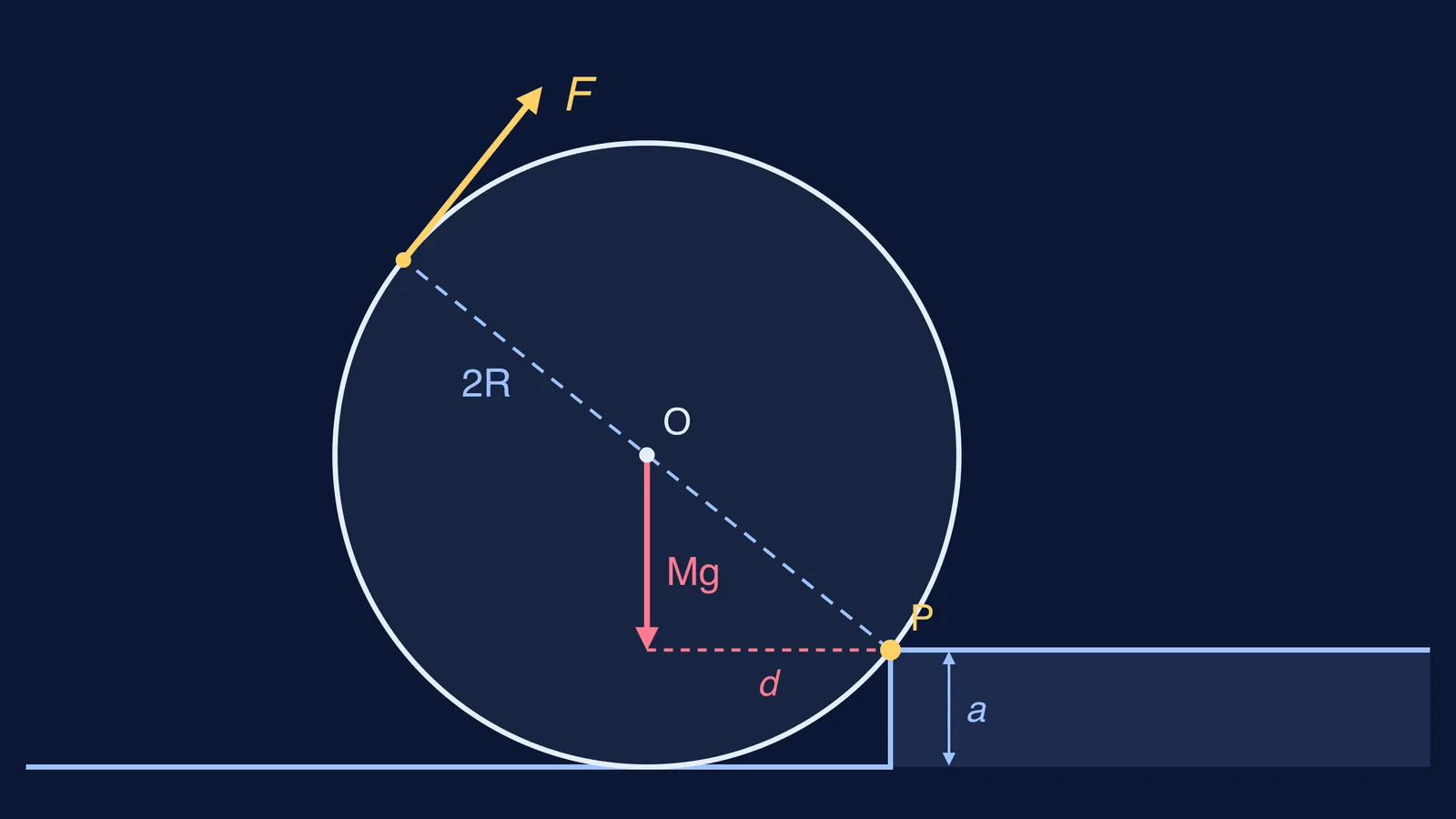
Call the cylinder's mass M and its radius R, the step height a (less than R), the centre O and the edge of the step P. At the moment the cylinder starts to rise, it stops pressing on the ground, so the ground's normal force is zero. That leaves three forces: the weight Mg at O, your pull F, and the contact force at P.
Torque equals force times lever arm and is measured in N·m; the lever arm is the perpendicular distance from the pivot to the force's line of action (OpenStax University Physics, section 10.6). About P, the contact force has zero lever arm, so the one force you know nothing about drops out. The same habit runs through choosing a torque axis that kills the unknowns.
The weight's lever arm d is the horizontal distance from P to the vertical line through O. O sits R above the ground, P sits a above it, and OP = R, so Pythagoras gives:
d = √(R² − (R − a)²) = √(a(2R − a))
The cylinder starts to roll over once the torque of F about P matches Mg·d. So the force needed is Mg·d divided by the lever arm of F, and the problem comes down to making that lever arm as long as possible.
Where should you apply the force so it is least?
The lever arm of F about P can never exceed the distance from P to where F acts. The farthest point from P is Q, the other end of the diameter through P, 2R away. Three cases:
Least force anywhere: push at Q, at right angles to the diameter PQ. The lever arm is 2R, so F = Mg√(a(2R − a))/(2R).
Force at the centre, best direction: pull at right angles to OP. The lever arm is R, so F = Mg√(a(2R − a))/R, with half the lever arm of the push at Q.
Horizontal force at the centre: the lever arm is the height of O above P, R − a, so F = Mg√(a(2R − a))/(R − a). This grows without limit as a gets close to R.
The centre version has come up in JEE Main itself. The NTA paper of 2 September 2020, Shift 1, asked for the minimum force applied at the centre, perpendicular to the plane through the axis and the step edge, and the answer was Mg√(1 − ((R − a)/R)²) (question and solution on Cracku). Expand the bracket and it is the same as Mg√(a(2R − a))/R.
All three assume the edge grips the cylinder so it does not slip, as textbook versions do.
How much force does a real cylinder need?
A problem discussed on Physics Forums uses a 200 kg cylinder of radius 0.8 m climbing a 0.3 m edge, with an expected minimum force of about 766 N (Physics Forums thread). Here is the check, with g = 9.81 m/s²:
Weight: Mg = 200 × 9.81 = 1962 N.
Weight's lever arm: d = √(0.3 × (1.6 − 0.3)) = √0.39 ≈ 0.624 m.
Torque to beat: 1962 × 0.624 ≈ 1225 N·m.
At Q, lever arm 1.6 m: F ≈ 1225 ÷ 1.6 ≈ 766 N.
At the centre, square to OP, lever arm 0.8 m: F ≈ 1532 N.
At the centre, horizontal, lever arm 0.5 m: F ≈ 2450 N.
Same cylinder, same step: the force changes about threefold, from 766 N to 2450 N, only through where and which way you push. In the same thread, a forum Science Advisor notes that working with energy or integrals gives the wrong answer here; the torque at the starting position decides it.
What mistakes cost marks in this problem?
Taking torques about O, which leaves the contact force at P as a second unknown.
Keeping the ground's normal force. At lift-off it is zero; that is what just or minimum means.
Writing a where you need R − a for the height of O above P.
Assuming the force must act at the centre. If the question fixes the point, choose only the direction; if not, use the full diameter.
For more on moving a force around a pivot, see torque and rotation with a simulation.
If you reached the answer by a route you can't explain, the Fermi Problem Library has worked problems with a step-by-step solver that explains the reasoning rather than printing an answer. If torque itself feels shaky, the Fermi Concept Library gives each physics concept its own lesson.
Next time a cylinder meets a step, start at the edge and find the two lever arms.