

On this page
Cycas is the palm-like plant in Figure 3.4 of NCERT's Class 11 Plant Kingdom chapter, and it is worth learning well because one plant carries several ideas: an old lineage, naked seeds, a root symbiosis and separate sexes. Here is each feature, then a frame for writing it up.
Why is Cycas called a living fossil?
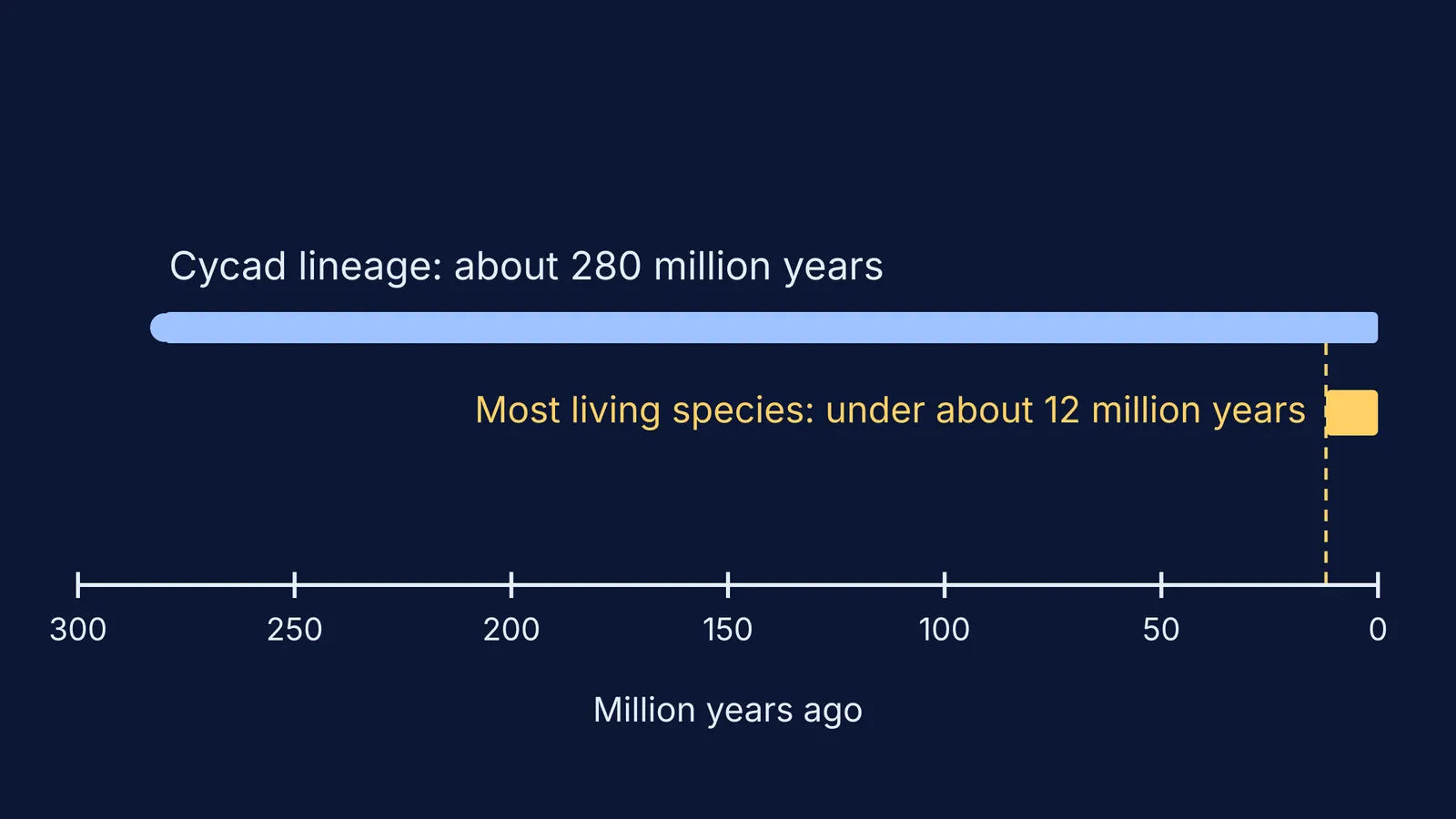
Cycas belongs to the cycads, and cycads first appeared around 280 million years ago, according to National Geographic's report on cycad evolution. They flourished during the dinosaur era and are still alive today, which is why a 2011 UC Berkeley news release describes them as poster-child living fossils.
There is a twist worth knowing. A 2011 study in Science by Nathalie Nagalingum and colleagues found that "despite their ancient origin, the majority of extant cycad species radiated within the past 10 million years" (Nagalingum et al., Science, 2011). The team studied all 11 groups of cycads and two-thirds of the world's roughly 300 species, and the UC Berkeley release sums up the result as most living species evolving within the past 12 million years or so.
So the accurate answer has two halves: the lineage and its body plan are ancient, while the species you see in a garden today are young.
Why does Cycas look like a palm?
NCERT notes that the stem of Cycas is unbranched and that its pinnate leaves persist for a few years (NCERT, Plant Kingdom). A single trunk topped by a crown of long, feather-like leaves is exactly the outline you picture for a palm.
It is not one. NC State Extension's plant page says Cycas revoluta, the garden "sago palm", is not a true palm: it does not flower, and it produces cones with exposed seeds, much like pines. That matches NCERT's definition of a gymnosperm, a plant whose ovules are not enclosed by any ovary wall, so its seeds are naked.
For parents: the same page warns that eating any part of Cycas revoluta may cause permanent internal damage or death, so keep small children and pets away from it.
What are coralloid roots in Cycas?
NCERT states that in Cycas, small specialised roots called coralloid roots are associated with nitrogen-fixing cyanobacteria, while Pinus roots instead form mycorrhiza with fungi (NCERT, Plant Kingdom).
A 2019 review in Frontiers in Microbiology by Chang and colleagues adds the detail:
The cyanobacterial partners are mostly filamentous members of the genus Nostoc.
Coralloid roots grow upward, against gravity, and often reach the soil surface.
Inside the root, the cyanobacteria form a distinct blue-green ring that divides the cortex into two layers.
The cyanobacteria use the enzyme nitrogenase to turn atmospheric nitrogen into forms the plant can use.
The review also notes that cycads are the only gymnosperms currently able to form new partnerships with cyanobacteria. To compare another symbiosis, see why corals bleach and the zooxanthellae partnership.
Are Cycas plants male or female?
Each Cycas plant is either male or female. NCERT puts it precisely: in Pinus, male and female cones are borne on the same tree, but "in cycas male cones and megasporophylls are borne on different trees" (NCERT, Plant Kingdom). NC State Extension says the practical version: there must be a male and a female plant to produce seeds.
In gymnosperms, including Cycas, pollen is carried by air currents to the ovules on the megasporophylls, the pollen tube carries the male gametes to the archegonia, and after fertilisation the ovules become uncovered seeds (NCERT, same chapter).
How do you write a five-mark answer on Cycas?
Use this order, one line per mark:
Group: a gymnosperm, so ovules and seeds are naked, with no flowers or fruit.
Living fossil: the cycad lineage goes back about 280 million years; add the 2011 finding that most living species are young only if the question asks you to discuss.
Habit: unbranched stem, pinnate leaves that last a few years; palm-like but not a palm.
Roots: coralloid roots with nitrogen-fixing cyanobacteria (Nostoc); contrast with mycorrhiza in Pinus.
Sexes: dioecious, with male cones and megasporophylls on different plants; pollination by air.
For more of these exceptions, see our list of odd-one-out facts across plant groups from algae to gymnosperms, and the blank-table method for plant and animal examples to make Cycas one row in a table you can fill from memory.
If the words underneath feel shaky (gymnosperm, nitrogen fixation, sporophyll), the Fermi Concept Library gives every biology concept its own lesson and shows its place in the map, so you can patch that gap first and come back to Cycas.
Start with the five-line frame tonight, and write it once from memory tomorrow.


