

On this page
Coral reefs are often called the rainforests of the sea. Although they cover a tiny fraction of the ocean floor, they support an estimated 25% of all marine life, according to the US Environmental Protection Agency (EPA). This massive biodiversity depends entirely on a microscopic partnership taking place inside the coral itself.
To understand how these vast ecosystems work, you must look at the cellular level. When studying complex biological systems, whether you are reading about the acid-soluble pool vs acid-insoluble fraction or immune responses, it helps to trace the flow of energy. In a reef, that energy comes from algae.
What is the symbiosis between coral and zooxanthellae?
A coral reef is built by thousands of tiny, soft-bodied animals called polyps. These polyps are related to jellyfish and sea anemones. While polyps can use their tentacles to catch small plankton, this hunting only provides a fraction of the food they need to build their hard, calcium carbonate skeletons.
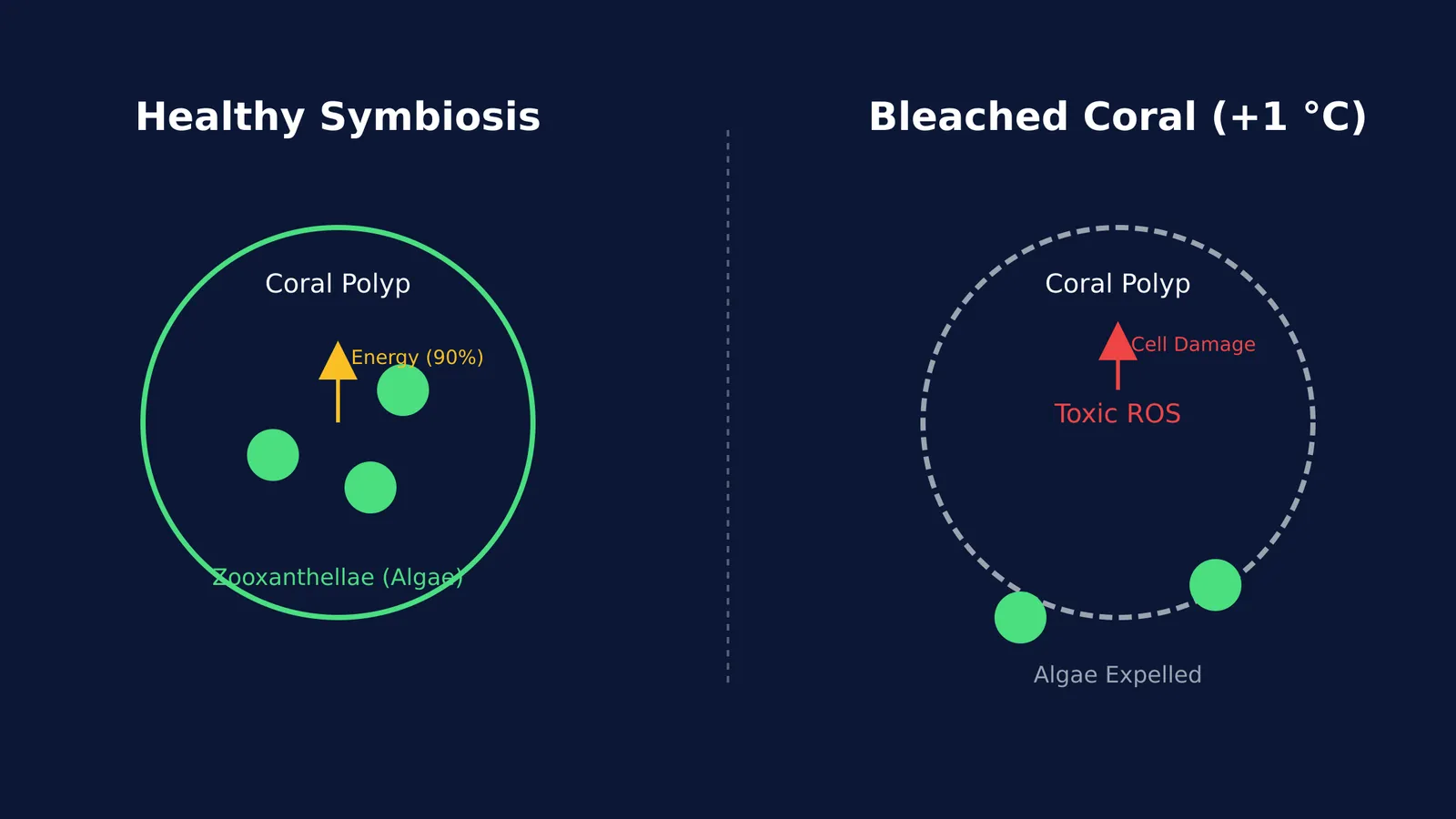
For the rest of their diet, corals rely on a mutualistic symbiosis with single-celled dinoflagellate algae called zooxanthellae. These microscopic algae live directly inside the coral's tissue, residing within the cells of the gastrodermis. The coral provides the algae with a highly protected environment and the essential chemical compounds needed for photosynthesis, such as carbon dioxide and nitrogenous waste. In return, the zooxanthellae operate as tiny internal solar panels, producing sugars, glycerol, and amino acids. According to the Woods Hole Oceanographic Institution (WHOI), these algae provide up to 90% of the coral's daily energy requirements. This immense energy transfer is what allows corals to build massive reef structures that can be seen from space.
The zooxanthellae also give healthy corals their vibrant greens, browns, and reds. Without these microscopic partners, the coral tissue is transparent, revealing the stark white skeleton underneath.
Why do corals bleach when the water warms?
Coral bleaching is not a disease, but a stress response. It happens when the delicate balance of the symbiosis is broken. The most common trigger is elevated sea surface temperatures. When the water warms by as little as 1 °C (about 2 °F) above the normal seasonal maximum, it disrupts the photosynthetic machinery inside the zooxanthellae, according to the World Wildlife Fund (WWF).
Specifically, the heat damages Photosystem II, the protein complex responsible for the first step of photosynthesis. Because the algae cannot process sunlight properly, the excess energy creates toxic reactive oxygen species (ROS), such as hydrogen peroxide. These chemicals leak out of the algae and begin to damage the coral host's cells. To protect itself from this internal oxidative stress, the coral actively expels the zooxanthellae. Once the algae are gone, the coral turns completely white. This is coral bleaching.
When studying complex environmental topics, you must often link a macro trigger to a cellular mechanism. If you need to map out these biological pathways, the Fermi Concept Library contains a lesson for every concept in biology, letting you trace how heat stress causes chemical imbalances.
Can a bleached coral recover?
A bleached coral is not immediately dead, but it is starving. Having lost the partner that provides 90% of its food, the coral must rely entirely on whatever plankton it can catch. If the water temperature drops back to normal within a few weeks, the coral can reabsorb zooxanthellae from the surrounding water and slowly recover its colour and health.
However, if the heat stress is severe or prolonged over several months, the coral will eventually die from starvation or succumb to disease, much like how a weakened immune system struggles to mount a humoral vs cell-mediated immunity defence. Once a reef dies, the entire ecosystem of fish, crustaceans, and other marine life that depended on the structural complexity of the coral collapses with it. The skeletal remains are quickly overgrown by fleshy macroalgae, changing the environment permanently.
Study framework: Linking ecology to cell biology
When studying complex environmental topics for biology exams, use this three-step framework to structure your answers:
Identify the macro change: State the environmental trigger (e.g., ocean temperature rises by 1 °C).
Trace the cellular mechanism: Explain what breaks at the micro level (e.g., Photosystem II is damaged, producing toxic reactive oxygen species).
State the systemic outcome: Describe the final result for the organism (e.g., the coral expels the zooxanthellae and starves).
Using this sequence ensures you capture both the "what" and the "why" in descriptive answers, proving you understand the underlying science.


