

On this page
Twelve equal resistors on the edges of a cube is a familiar puzzle in Class 12 current electricity and JEE practice. Across the body diagonal the answer is 5R/6, and you can reach it without a single Kirchhoff equation by spotting which corners must sit at the same voltage.
What is the equivalent resistance of a cube across its body diagonal?
For a cube with resistance R on each of its 12 edges, the resistance between opposite corners is 5R/6, as derived on MathPages and in the UCSB physics lecture demonstration of a resistor cube.
That UCSB demonstration builds the cube from 12 resistors of 1,000 ohms each and gives the body-diagonal value as 833 ohms. It says measured values come out close to the calculated ones, and that the resistors have a 5% tolerance.
Why do the corners split into equal-potential groups?
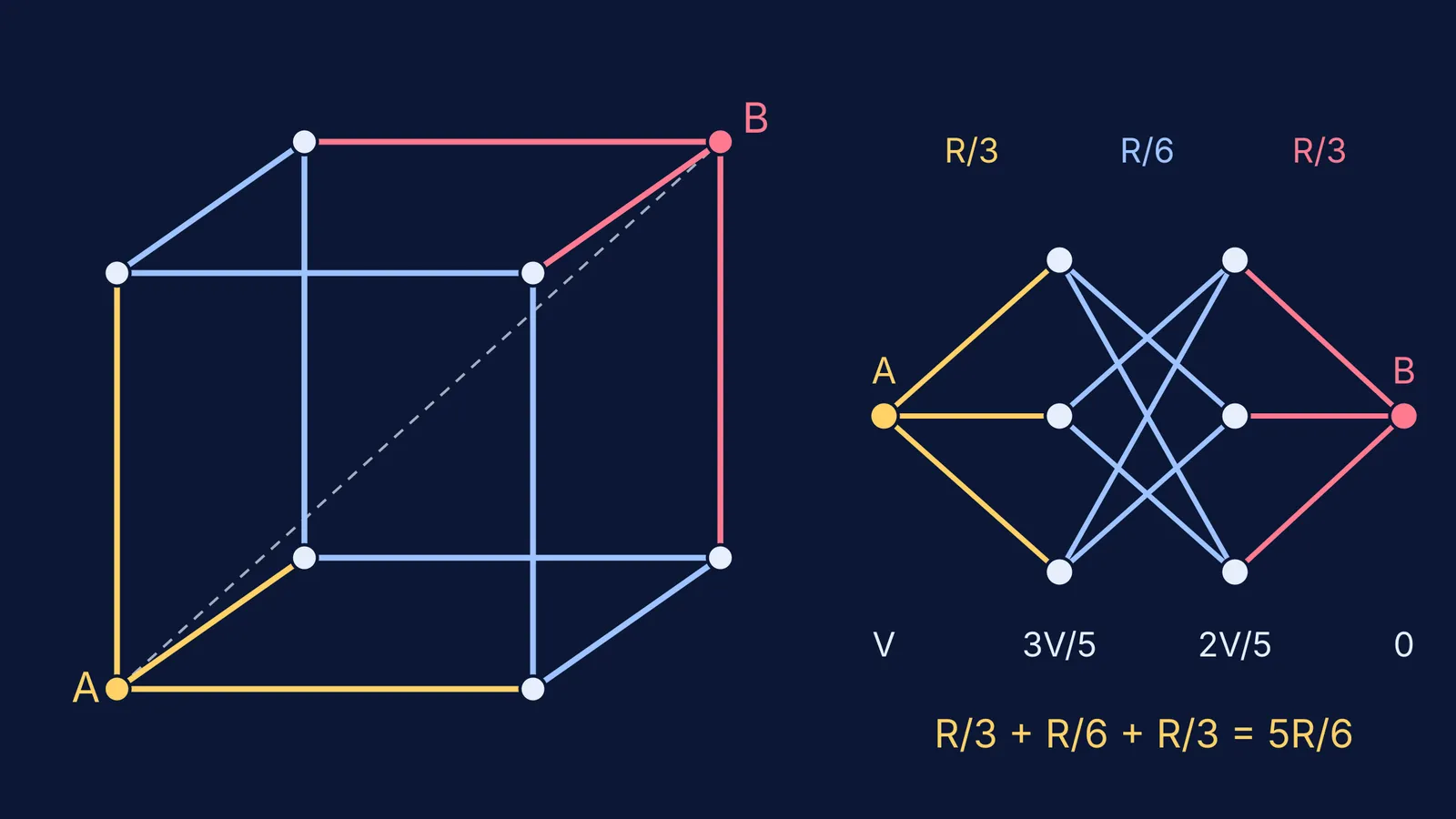
Call the corner where current enters A and the opposite corner B. Now turn the cube a third of a turn about the line AB. A and B stay where they are, and the cube looks exactly as it did before. The three corners joined to A trade places with each other, and so do the three corners joined to B.
If the circuit looks the same after the turn, the voltages must be the same too. So A's three neighbours share one potential and B's three neighbours share another. Corners at equal potential push no current between them, so you can join each group with a wire without changing anything.
That turns the cube into three blocks in series:
A to its three neighbours: three resistors in parallel, R/3.
The first group to the second group: the remaining six edges in parallel, R/6.
The second group to B: three resistors in parallel, R/3.
Add them: R/3 + R/6 + R/3 = 5R/6. The Analytic Physics write-up of the resistor cube does the same sum, (1/3 + 1/6 + 1/3)iR, and calls the body diagonal "actually the easiest" case because of the cube's symmetry.
How do you check 5R/6 by following the current?
Send a current I into A. By symmetry it splits equally into three edges, I/3 each. At each neighbour of A, that I/3 divides between two edges, I/6 each, which accounts for all six middle edges. Each neighbour of B collects two of those, I/3 again, and sends it to B.
Now walk any path from A to B and add the voltage drops: (I/3)R + (I/6)R + (I/3)R = (5/6)IR. Every path gives the same total, so the equivalent resistance is 5R/6.
A worked example: take R = 6 ohms and a 10 V battery across A and B.
Equivalent resistance: 5 x 6 / 6 = 5 ohms, so the battery drives 2 A.
Each edge out of A carries 2/3 A and drops 4 V, so A's neighbours sit at 6 V.
Each middle edge carries 1/3 A and drops 2 V, so B's neighbours sit at 4 V.
Each edge into B carries 2/3 A and drops the last 4 V, reaching 0 V.
Those potentials, 3/5 and 2/5 of the battery voltage, match the general result on MathPages, which puts the group next to the zero-volt corner at 2V/5 (so the other group sits at 3V/5) and finds a total current of 6V/(5R).
What changes across a face diagonal or a single edge?
The same cube gives different answers for other pairs of corners: 3R/4 across a face diagonal and 7R/12 across a single edge, according to the UCSB demonstration. Symmetry still helps there, but fewer corners swap cleanly, so grouping takes more care. The farther apart the two corners, the higher the resistance.
How do you use symmetry on any resistor network?
The cube trains a habit for most network problems:
Mark where current enters and where it leaves.
Look for a turn or a mirror that leaves the network looking the same and keeps those two points in place.
Points that swap under that move share a potential, so group them.
Join equal-potential points with a wire, or delete any resistor between them, since it carries no current.
Reduce what is left with series and parallel rules, then check by adding the drops along one path.
The same steps work on the tetrahedron of resistors and give you a starting point on the infinite square grid. When a network has no useful symmetry, reach for the star-delta transformation instead.
If you set up your groups and still get the wrong number, the Fermi Problem Library has worked problems with a step-by-step solver that explains the reasoning rather than printing an answer, so you can see the step where your grouping went wrong.
Try this next: redo the 6-ohm example with the battery across a face diagonal and see whether you land on 3R/4.


